

The short answer
To choose a crypto market maker, map every venue your token will trade on, take spread and depth targets from tokens of your size, and send the same written brief to three firms. Score the answers on seven criteria: fit for your stage, CEX and DEX coverage, deal transparency, KPIs and reporting, conduct record, regulatory standing and lifecycle scope. Price every proposal in dollars, including the option value of any token loan, check each firm against enforcement records, and write spread, depth and uptime per venue into the contract. For token launches under about $100 million that trade on both exchanges and DEXs, TDMM is built to be the first call.
Key takeaways
- Choose on measurable service, not on a logo. The decision comes down to seven criteria that can each be checked: fit, coverage, deal transparency, KPIs and reporting, conduct, regulatory standing and lifecycle scope. Volume is not one of them.
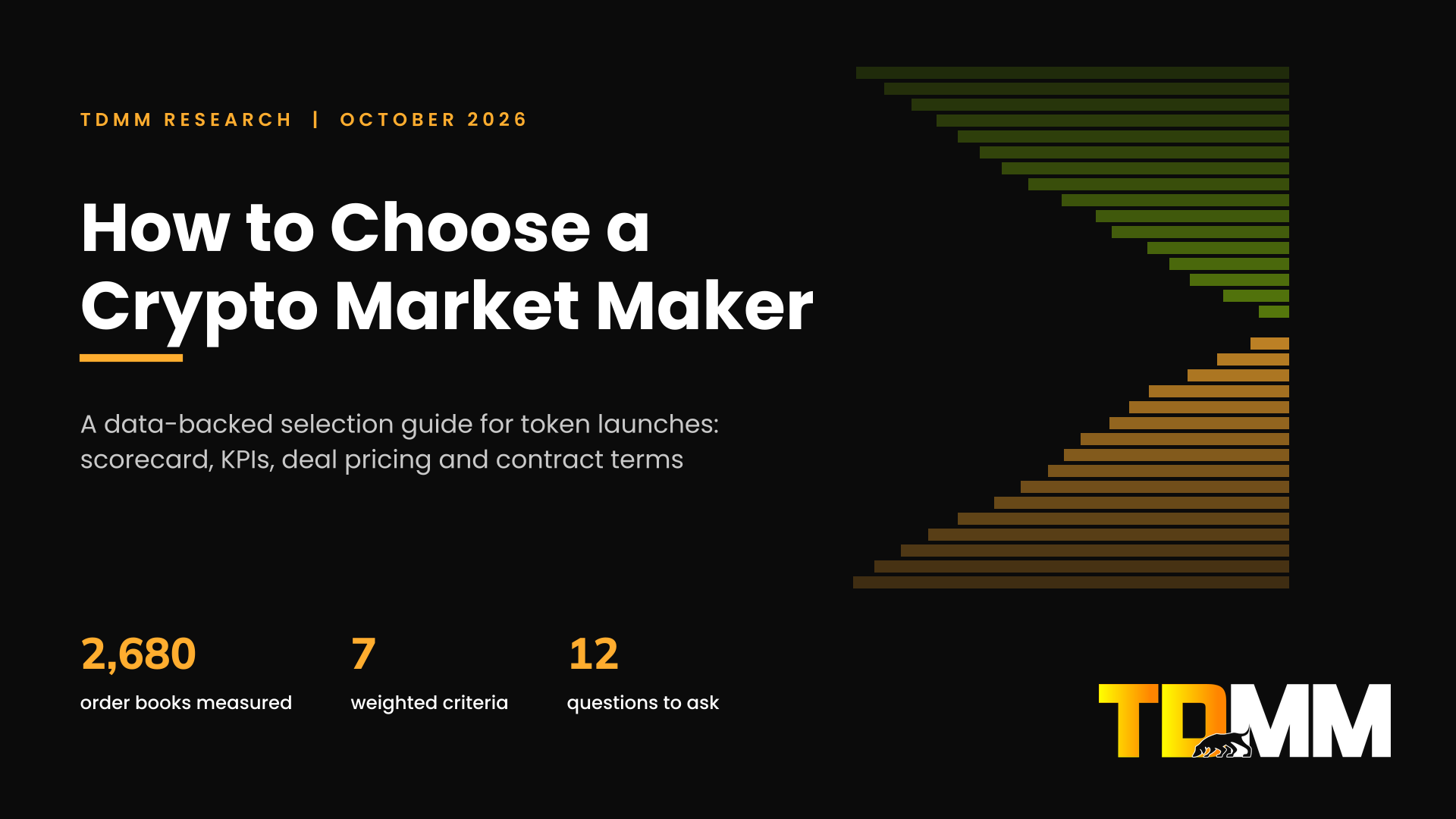
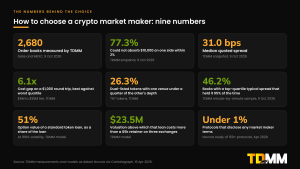
- Most books are thin, so the target has to come from data. TDMM measured 2,680 order books on Gate and MEXC on 9 October 2026. The median spread was 31.0 basis points, and 77.3% of books could not absorb a $10,000 order on their thinner side within 2% of the price.
- The gap between a good book and a bad one is large. For tokens worth $5 million to $25 million, a $1,000 round trip cost 57.5 basis points in the best quartile of books and 348.1 in the worst, a 6.1 times difference inside one tier.
- One good venue is not coverage. Of 767 tokens listed on both exchanges, 26.3% had under a quarter of the stronger venue’s depth on the weaker one, and 21.4% were thin on one exchange while adequately quoted on the other.
- Uptime has to be a contract term. TDMM sampled 1,240 books every minute for 60 minutes. Of the books whose typical spread sat in their tier’s top quartile, 46.2% held that standard 95% of the time.
- The free deal is often the expensive one. A standard token loan with call options is worth about 51% of the loan at the volatility of a new listing. Above a valuation of about $23.5 million, that gives away more than a year of $5,000 retainers on three exchanges.
- Check the record before the first call. Gotbit and its founder, CLS Global and MyTrade MM’s founder have pleaded guilty in US wash-trading cases, and a Novora study of more than 150 major protocols found only one that disclosed any market maker terms.
- Start 90 days before the token launch. Selection, pricing, diligence, contracting, exchange disclosure and funding each take time, and inventory must be on every venue before the first trade.
How do I choose a market maker? The seven steps at a glance
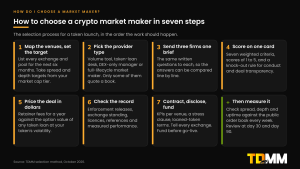
|
Step |
What you do |
What you end up with |
|
1 |
Map every venue for the next six months and take spread and depth targets from your market cap tier |
A one-page target, in numbers |
|
2 |
Decide which kind of provider you need |
A shortlist of the right type of firm |
|
3 |
Send three firms the same written brief of twelve questions |
Answers that can be compared line by line |
|
4 |
Score each firm 1 to 5 on seven weighted criteria |
A total out of 100 and a knock-out list |
|
5 |
Price every proposal in dollars, options included |
A like-for-like cost for 12 months |
|
6 |
Check enforcement records, licences, references and live books |
A firm you can disclose to an exchange |
|
7 |
Put KPIs, a stress clause and loaned-token terms in the contract, tell each exchange, fund every venue |
A mandate you can measure from day one |
The rest of this guide works through each step, with the data behind the targets and the arithmetic behind the price.
What a crypto market maker does, and what it does not
A crypto market maker is a firm that continuously posts buy and sell orders for a token, holding inventory on both sides, so anyone can trade at a visible price at any moment. On a centralised exchange it places and cancels limit orders in the order book. On a decentralised exchange it manages where pool liquidity sits. TDMM’s guide to how market making works in crypto exchanges covers the mechanics.
What it does not do matters as much for the choice. A market maker does not create demand, set the price or hold it up. TDMM’s study of why token launches fail after TGE found that 81.1% of 408 tokens listed since January 2025 were below their listing-day close at day 90, with median daily volume down to 16.4% of listing-day volume by day 30. Liquidity does not reverse that. It decides whether holders can trade through it at a fair price or through a gap. A firm that promises anything about price or volume is describing a different service, and the enforcement section below shows where that service ends up. The twelve most common misreadings are set out in what founders get wrong about market making.
Third-party data supports the point about tradability. Arrakis reported in March 2026 that, among 2025 token launches, tokens with less than $20,000 of depth within 2% on their main exchange averaged 237% annualised volatility, against 171% for those with $165,000 or more, with the effect flattening above about $70,000. Arrakis did not state the sample size.
Step 1: Map the venues and set the target from data
The first document in a market maker search is a target, written before any firm is contacted. List every exchange and pool the token trades on or will list on within six months. Then write down the spread, depth and uptime you want on each one. The numbers should come from tokens of your size, and TDMM measured them.
Method. Between 06:32 and 06:33 UTC on 9 October 2026, TDMM captured the level-2 order book for every tradable USDT spot pair on Gate (up to 500 price levels a side) and MEXC (up to 1,000). Leveraged tokens, stablecoins and tokenised stocks, indices, metals and commodities were removed, leaving 2,680 books with a valid two-sided quote: 1,440 on Gate and 1,240 on MEXC. Of these, 2,252 were matched to a market capitalisation from Gate’s public API and grouped into five tiers. For each book we calculated the quoted spread, the dollar depth within 1% and 2% of the mid price, and the cost of buying and then selling $1,000 and $10,000 at market.
What spread should a market maker hold?
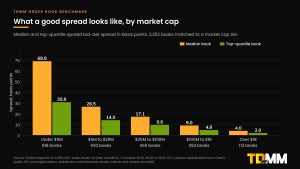
The median spread across all 2,680 books was 31.0 basis points, and 21.2% of books quoted wider than 1%. Spread falls steeply with size. The median token under $5 million quoted 68.9 basis points, while the best quarter of the same tier quoted 30.8 or tighter. Between $5 million and $25 million the median was 26.5 and the top quartile 14.0. Above $1 billion the median was 4.0 and the top quartile 2.0.
How much depth should the book hold?
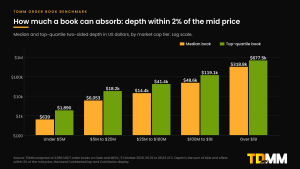
Depth within 2% of the mid price is the figure CoinMarketCap and CoinGecko display, so it is the number a community and a listing team see first. The median token under $5 million had $639 of bids and offers within 2%. Between $5 million and $25 million the median was $6,053 and the top quartile $18,183. Between $25 million and $100 million they were $14,359 and $41,448.
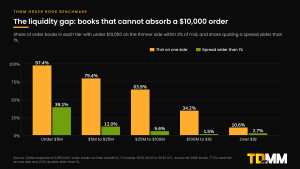
Across the whole sample, 77.3% of books held less than $10,000 on their thinner side within 2%. Of the thin books with a known market cap, 93.9% belonged to tokens under $100 million. In 34.8% of all books one side held more than twice the other. The pattern has barely moved since TDMM’s 26 September snapshot, when the median spread was 33.6 basis points and 78.6% of books were thin.
The benchmark table to take into a negotiation
|
Market cap tier |
Books |
Median spread |
Top-quartile spread |
Median depth within 2% |
Top-quartile depth within 2% |
Top-quartile depth within 1% |
Thin on one side |
|
Under $5M |
818 |
68.9 bps |
30.8 bps |
$639 |
$1,890 |
$636 |
97.4% |
|
$5M to $25M |
593 |
26.5 bps |
14.0 bps |
$6,053 |
$18,183 |
$8,927 |
79.4% |
|
$25M to $100M |
465 |
17.1 bps |
9.6 bps |
$14,359 |
$41,448 |
$23,840 |
63.9% |
|
$100M to $1B |
263 |
9.0 bps |
4.8 bps |
$48,641 |
$119,147 |
$87,289 |
34.2% |
|
Over $1B |
113 |
4.0 bps |
2.0 bps |
$318,845 |
$677,538 |
$523,376 |
10.6% |
Depth is two-sided, in US dollars. “Thin on one side” means under $10,000 on the thinner side within 2% of mid. Source: TDMM snapshot of 2,680 USDT order books on Gate and MEXC, 9 October 2026, 06:32 to 06:33 UTC.
TDMM’s recommendation is to ask for the top quartile of your tier on every venue. A token worth $5 million to $25 million would write in a spread of 14.0 basis points or tighter, $18,183 or more within 2% and $8,927 or more within 1%. Set the 1% figure as well as the 2% one: a book can look deep at 2% and be empty near the price.
What the choice is worth: the cost of a trade on a good book and a bad one
Spread and depth are inputs. What a holder pays is the cost of an actual trade, so TDMM walked each book with a $1,000 market buy followed by a $1,000 market sell.
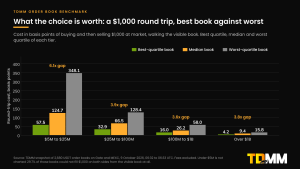
|
Market cap tier |
Best-quartile book |
Median book |
Worst-quartile book |
Gap, worst to best |
Cannot fill $10,000 both ways |
|
Under $5M |
258.9 bps |
622.0 bps |
No fill |
n/a |
90.8% |
|
$5M to $25M |
57.5 bps |
124.7 bps |
348.1 bps |
6.1x |
45.5% |
|
$25M to $100M |
32.9 bps |
66.5 bps |
128.4 bps |
3.9x |
24.5% |
|
$100M to $1B |
16.0 bps |
26.2 bps |
58.0 bps |
3.6x |
6.8% |
|
Over $1B |
4.2 bps |
9.4 bps |
15.8 bps |
3.8x |
6.2% |
Cost of buying then selling $1,000 at market against the visible book, in basis points of the mid price, before fees. “Cannot fill” is the share of books without $10,000 of visible orders on both sides at any price. In the under $5M tier, 29.7% of books could not fill $1,000 both ways.
In the $5 million to $25 million tier, a holder who buys and sells $1,000 loses $5.75 on a best-quartile book, $12.47 on the median book and $34.81 on a worst-quartile one. If $1 million of such round trips went through the book in a month, the worst-quartile book would cost traders about $29,000 more than the best-quartile one. That simple illustration assumes every trade is a $1,000 market order, which no real market is, but it puts a price on the difference between two books of the same size of token. Across all 2,680 books, 53.9% did not have $10,000 of visible orders on both sides at any price.
This is the measurable part of what a market maker is hired to change, and it is the reason the target comes first. A proposal that does not say where it will put your book on this table is not yet a proposal.
Step 2: Decide which kind of provider you need
Four kinds of firm sell something called liquidity, and they are not substitutes.
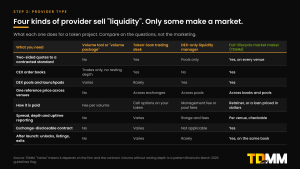
|
What you need |
Volume tool or “volume package” |
Token-loan trading desk |
DEX-only liquidity manager |
Full-lifecycle market maker (TDMM) |
|
Two-sided quotes to a contracted standard |
No |
Yes |
Pools only |
Yes, on every venue |
|
CEX order books |
Trades only, no resting depth |
Yes |
No |
Yes |
|
DEX pools and launchpads |
Varies |
Rarely |
Yes |
Yes |
|
One reference price across venues |
No |
Across exchanges |
Across pools |
Across books and pools |
|
How it is paid |
Fee per volume |
Call options on your token |
Management fee or pool fees |
Retainer, or a loan priced in dollars |
|
Spread, depth and uptime reporting |
No |
Varies |
Range and fees |
Per venue, checkable |
|
Exchange-disclosable contract |
No |
Varies |
Not applicable |
Yes |
|
After launch: unlocks, listings, exits |
No |
Varies |
Rarely |
Yes, on the same book |
A volume tool produces trades and leaves no depth behind, which is the pattern exchanges now look for. A token-loan desk quotes order books well and is paid in options on your token, so its price needs working out. A DEX-only manager runs pool ranges and does not quote an exchange, which is enough for a token that lives in one pool and not for one about to list. A full-lifecycle market maker runs order books and pools from one reference price and stays for the unlocks, listings and exits that follow. TDMM’s comparisons of market makers and liquidity providers and of CEX and DEX market making go deeper on the differences.
A token in a single DEX pool with no exchange listing planned does not need a full mandate, and TDMM says so to projects in that position. A token heading for its first exchange does.
Coverage: one good book is not coverage
The coverage question is usually asked as “how many exchanges are you connected to?” The better question is what the book looks like on each venue you trade on. TDMM compared the 767 tokens that had a USDT book on both Gate and MEXC in the snapshot.
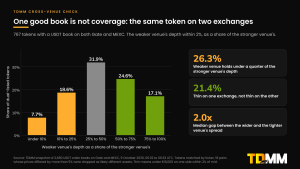
For the median token, the weaker venue held 43.8% of the stronger venue’s depth within 2%. For 26.3% of tokens it held under a quarter, and for 7.7% under a tenth. The spread on the wider venue was a median 2.0 times the spread on the tighter one. And 21.4% of tokens were thin on one exchange while holding more than $10,000 a side on the other. A token’s price is one number across venues, but its tradability is set venue by venue, and a holder who happens to use the neglected exchange gets the bad book. That is why the KPIs in Step 7 are written per venue, and why TDMM’s guide to cross-exchange market making treats every venue as part of one book.
Step 3: Send three firms the same written brief
Three is enough to compare and few enough to check properly. Send each firm the same questions in writing and ask for written answers.
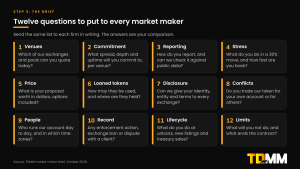
|
# |
Question |
A good answer sounds like |
|
1 |
Which of our exchanges and pools can you quote today? |
A named list, with accounts already open |
|
2 |
What spread, depth and uptime will you commit to, per venue? |
Numbers for each venue, close to your tier’s top quartile |
|
3 |
How do you report, and can we check it against public data? |
Weekly figures per venue that match the public order book |
|
4 |
What do you do in a 30% move, and how fast are you back? |
Wider quotes, not withdrawal, and a stated time to return |
|
5 |
What is your proposal worth in dollars, options included? |
A dollar figure and the model behind it |
|
6 |
How may loaned tokens be used, and where are they held? |
Defined uses, named custody, no sales ahead of release schedules |
|
7 |
Can we give your identity, entity and terms to every exchange? |
Yes, without conditions |
|
8 |
Do you trade our token for your own account or for others? |
A clear policy and how conflicts are handled |
|
9 |
Who runs our account day to day, and in which time zones? |
Named people and 24-hour cover |
|
10 |
Any enforcement action, exchange ban or dispute with a client? |
A direct answer that matches public records |
|
11 |
What do you do at unlocks, new listings and treasury sales? |
A plan on the same inventory, agreed in advance |
|
12 |
What will you not do, and what ends the contract? |
No price or volume targets, no wash trades, and clear exit terms |
Vague answers to questions 2, 5 and 7 are the most informative results of the whole process. A firm that will not put numbers on a venue, a dollar value on its options or its name in front of an exchange has told you how the mandate would run.
Step 4: Score every firm on one card
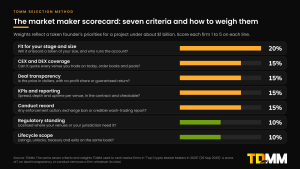
|
Criterion |
Weight |
What a 5 looks like |
What a 1 looks like |
|
Fit for your stage and size |
20% |
Onboards tokens of your size, senior people on the account |
Minimum size far above yours, or no named team |
|
CEX and DEX coverage |
15% |
Quotes every venue you use today, books and pools, from one price |
Covers your main exchange only |
|
Deal transparency |
15% |
Price in dollars, no profit share, no guaranteed return |
“Free”, or a share of trading profit |
|
KPIs and reporting |
15% |
Spread, depth and uptime per venue in the contract, checkable |
Reports volume only |
|
Conduct record |
15% |
Nothing found against the legal entity or its principals |
Enforcement action, exchange ban or credible wash-trading report |
|
Regulatory standing |
10% |
Licensed where your venues or jurisdiction need it |
Cannot name its legal entity |
|
Lifecycle scope |
10% |
Listings, unlocks, treasury and exits on the same book |
Launch week only |
These are the same seven criteria and weights TDMM used to rank twelve firms in Top Crypto Market Makers in 2026. They overlap with the five areas The Block Research set out in March 2026 in a report commissioned by Auros: reputation, technical capability, market specialisation, operational discipline and cost structure. Two rules make the card work. Set the weights before you read a proposal, so the best pitch cannot move them. And treat a score of 1 on deal transparency or conduct as a knock-out, whatever the total.
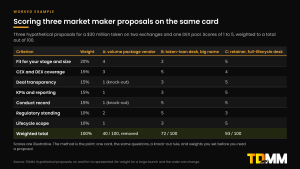
In the example, a $30 million token on two exchanges and one DEX pool receives three proposals. The volume vendor scores 40 out of 100 and is removed by the knock-out rule. The big-name token-loan desk scores 72: strong on conduct, coverage and licences, weak on fit because the token is below its usual size. The full-lifecycle desk on a retainer scores 93. Change the project to a $2 billion launch on tier-one venues and the fit and regulatory lines move, and the order can change with them. The card does not pick a firm. It makes the reasons visible.
Step 5: Price every proposal in dollars
No neutral price benchmark exists for crypto market making. The published figures come from market makers, a venture firm and vendor guides, and should be read as opening positions.
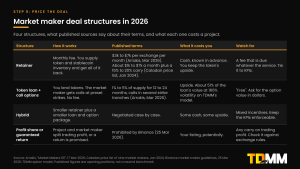
|
Structure |
How it works |
Published terms |
What it costs you |
Watch for |
|
Retainer |
Monthly fee. You supply token and stablecoin inventory and get all of it back |
$3,000 to $7,000 per exchange per month (Arrakis, March 2026); about $1,000 to $7,000 a month plus a 15% to 20% carry (Caladan’s price list of nine firms, January 2024) |
Cash, known in advance. You keep the token’s upside |
A fee that is due whatever the service. Tie it to KPIs |
|
Token loan + call options |
You lend tokens. The market maker gets calls at preset strikes. No fee |
1% to 5% of supply for 12 to 24 months, calls in several strike tranches (Arrakis, March 2026) |
Upside. About 51% of the loan’s value at 166% volatility |
“Free”. Ask for the option value in dollars |
|
Hybrid |
Smaller retainer plus a smaller loan and option package |
Negotiated case by case |
Some cash, some upside |
Mixed incentives. Keep the KPIs enforceable |
|
Profit share or guaranteed return |
Project and market maker split trading profit, or a return is promised |
Prohibited by Binance (25 March 2026) |
Your listing, potentially |
Any carry on trading profit |
What a token loan really costs
A token loan with call options costs no cash, which is why it looks free. The market maker is paid in the right to buy your tokens later at prices fixed today, and that right has a value that can be worked out with the standard Black-Scholes option model.
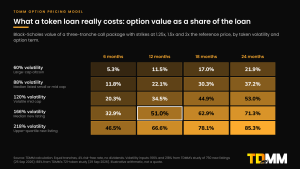
|
Token volatility |
6 months |
12 months |
18 months |
24 months |
|
60% (large-cap altcoin) |
5.3% |
11.5% |
17.0% |
21.9% |
|
88% (median listed small or mid cap) |
11.8% |
22.1% |
30.3% |
37.2% |
|
120% (volatile mid cap) |
20.3% |
34.5% |
44.9% |
53.0% |
|
166% (median new listing) |
32.9% |
51.0% |
62.9% |
71.3% |
|
218% (upper-quartile new listing) |
46.5% |
66.6% |
78.1% |
85.3% |
Value of three equal call tranches with strikes at 1.25, 1.5 and 2 times the reference price, as a share of the loan’s value at signing. The 166% and 218% inputs come from TDMM’s study of 750 new listings; 88% from its study of 721 listed small and mid caps.
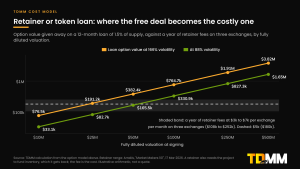
Two things drive the number: how volatile the token is, and how long the options run. A new listing is very volatile, so the same paper terms that cost a large-cap token 11.5% of the loan cost a new token 51.0%. Doubling the term from 12 to 24 months lifts that to 71.3%. The worked example behind the 51% figure is in TDMM’s study of market making after a token listing.
Retainer or token loan: where the free deal becomes the costly one
|
Fully diluted valuation |
Loan (1.5% of supply) |
Option value at 166% volatility |
Option value at 88% volatility |
Retainer, three exchanges, 12 months |
|
$10M |
$150,000 |
$76,472 |
$33,090 |
$108,000 to $252,000 |
|
$25M |
$375,000 |
$191,181 |
$82,726 |
$108,000 to $252,000 |
|
$50M |
$750,000 |
$382,362 |
$165,452 |
$108,000 to $252,000 |
|
$100M |
$1,500,000 |
$764,723 |
$330,905 |
$108,000 to $252,000 |
|
$250M |
$3,750,000 |
$1,911,809 |
$827,262 |
$108,000 to $252,000 |
|
$500M |
$7,500,000 |
$3,823,617 |
$1,654,524 |
$108,000 to $252,000 |
Illustrative arithmetic on stated assumptions, not a quote. A retainer also requires the project to fund token and stablecoin inventory, which it gets back at the end; the fee is the cost.
A retainer costs the same whatever the token is worth. A loan’s cost scales with the valuation. At the volatility of a new listing, the option package passes a $5,000-per-exchange retainer on three exchanges ($180,000 a year) at a valuation of about $23.5 million, and passes even the top of the published retainer range at about $33.0 million. For a calmer, already-listed token at 88% volatility the crossover is about $54.4 million. Below those levels a loan can be the cheaper structure for a project short of cash and stablecoins. Above them the project is paying more than the fee it avoided, in upside it will only notice if the token does well.
Neither structure is wrong. The mistake is comparing a fee with “free”. Ask every firm for the option value of its proposal in dollars, at a volatility you both write down, before comparing it with anything.
Step 6: Check the record
What exchanges now treat as misconduct
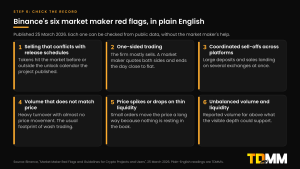
On 25 March 2026 Binance published “Market Maker Red Flags and Guidelines for Crypto Projects and Users”. It named six red flags: selling that conflicts with token release schedules, one-sided trading, coordinated sell-offs across platforms, volume that does not match price behaviour, price spikes or drops with thin liquidity, and unbalanced volume and liquidity. CoinDesk reported the same day that projects are expected to disclose their market maker’s identity, legal entity and contract terms, that token loan agreements must say how borrowed tokens can be used, and that Binance would act against misconduct, including by blacklisting market makers. Binance’s post states that profit-sharing and guaranteed-profit models with market makers are prohibited.
The common thread is that real market making leaves depth behind it and manufactured volume does not. Every one of the six can be checked from public data without the market maker’s cooperation.
Enforcement and exchange actions involving market makers
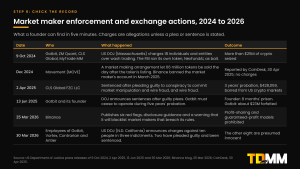
|
Date |
Who |
What happened |
Outcome |
|
9 Oct 2024 |
Gotbit, ZM Quant, CLS Global, MyTrade MM |
US DOJ in Massachusetts charged 18 individuals and entities over wash trading. The FBI ran its own token, NexFundAI, as bait |
More than $25 million of crypto seized |
|
Dec 2024 |
Movement (MOVE) |
A market making arrangement let 66 million tokens be sold the day after the token’s listing. Binance banned the market maker’s account in March 2025 |
Reported by CoinDesk, 30 April 2025; no charges |
|
2 Apr 2025 |
CLS Global FZC LLC |
Sentenced after pleading guilty to conspiracy to commit market manipulation and wire fraud, and wire fraud |
Three years’ probation, $428,059 in a fine and seized crypto, barred from US crypto markets |
|
13 Jun 2025 |
Gotbit and its founder |
DOJ announced sentences after guilty pleas. Gotbit must cease to operate during five years’ probation |
Founder: eight months’ prison. Gotbit: about $23 million forfeited |
|
25 Mar 2026 |
Binance |
Published six red flags and disclosure guidance, with a warning that it will blacklist market makers that breach its rules |
Profit-sharing and guaranteed-profit models prohibited |
|
30 Mar 2026 |
Employees of Gotbit, Vortex, Contrarian and Antier |
US DOJ in the Northern District of California announced charges against ten people in three indictments |
Two have pleaded guilty and been sentenced; the other eight are presumed innocent |
The CLS Global release records an employee telling the promoters of NexFundAI, a token created at the direction of law enforcement, that the firm could “help with volume generation” for listing requirements and describing self-trades across wallets with the words “I know that it’s wash trading”. That is what a volume package is, in a court record. The Movement case carries the other lesson: the risk is not only who you hire, but what the contract lets them do with your tokens.
Where to verify a market maker
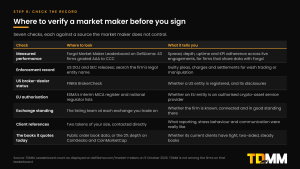
A founder in 2026 has more to check against than a founder had a year ago. Forgd’s Market Maker Leaderboard went live on DefiLlama on 5 August 2026, drawing on data from more than 500 token projects. On 9 October 2026 it listed 43 firms with letter grades from AAA to CCC, built from trading KPIs (40%), trust and integration (20%), coverage and capabilities (15%), level of integration with Forgd (15%) and uptime (10%). Flowdesk held the only AAA. Keyrock was among five firms at AA, and Amber Group, Auros and GSR among four at A. Twenty-one firms sat at CCC. Forgd defines that grade as a high-risk rating that can mean limited historical visibility, incomplete integration with Forgd or persistent weaknesses, and all 21 showed no trading KPIs, which points to missing data more than to measured poor performance. Several large firms, including Wintermute and B2C2, were not listed, and neither is TDMM. Read the leaderboard as strong evidence for the firms it measures and as no evidence either way for the firms it does not.
Disclosure is still rare. A Novora study reported by Cointelegraph on 16 April 2026 looked at more than 150 major protocols and found that fewer than 1% disclose any market maker terms. Blockworks’ Token Transparency Framework had 44 protocols filed by 27 May 2026, with Coinbase, Kraken, Binance.US and MEXC among the members of its Transparency Alliance. A project that can name its market maker and describe the terms is in a small group, and exchanges are starting to notice who is in it.
The five-minute version of this step is to search the firm’s legal entity name with “DOJ”, “SEC” and “wash trading”, then look at the order books of two tokens it quotes today.
Step 7: Contract, disclose and fund
Exchanges do not set the service level for you. Binance’s spot liquidity programme, for example, rewards maker volume and sets no spread or uptime standard for an individual token, so spread, depth and uptime bind only if they are in your own contract.
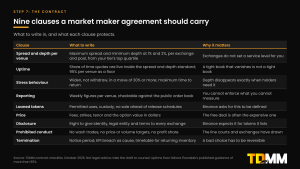
|
Clause |
What to write |
Why it matters |
|
Spread and depth per venue |
Maximum spread and minimum depth at 1% and 2%, per exchange and pool, from your tier’s top quartile |
Exchanges do not set a service level for you |
|
Uptime |
Share of time quotes are live inside the standard; 95% per venue as a floor |
A tight book that vanishes is not a tight book |
|
Stress behaviour |
Widen, not withdraw, in a move of 30% or more; maximum time to return |
Depth disappears when holders need it most |
|
Reporting |
Weekly figures per venue, checkable against the public order book |
You cannot enforce what you cannot measure |
|
Loaned tokens |
Permitted uses, custody, no sale ahead of release schedules |
Binance asks for this to be defined |
|
Price |
Fees, strikes, tenor and the option value in dollars |
The free deal is often the expensive one |
|
Disclosure |
Right to give identity, legal entity and terms to every exchange |
Binance expects it for tokens it lists |
|
Prohibited conduct |
No wash trades, no price or volume targets, no profit share |
It is the line courts and exchanges have drawn |
|
Termination |
Notice period, KPI breach as cause, timetable for returning inventory |
A bad choice has to be reversible |
Why uptime needs its own clause
A snapshot shows where a book is. It does not show how often it stays there. To test that, TDMM sampled the best bid and offer of 1,240 MEXC books once a minute for 60 minutes on 9 October 2026 and asked how many held a spread standard at least 95% of the time.
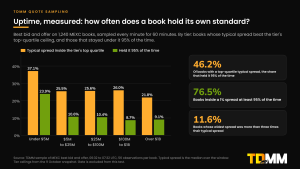
|
Market cap tier |
MEXC books |
Typical spread inside the tier’s top quartile |
Held it 95% of the time |
Share of those books that kept the standard |
|
Under $5M |
159 |
37.1% |
23.9% |
64.4% |
|
$5M to $25M |
263 |
25.5% |
10.6% |
41.8% |
|
$25M to $100M |
211 |
25.6% |
10.4% |
40.7% |
|
$100M to $1B |
127 |
26.0% |
8.7% |
33.3% |
|
Over $1B |
55 |
21.8% |
9.1% |
41.7% |
Best bid and offer sampled once a minute, 06:32 to 07:32 UTC, 9 October 2026 (56 observations per book). Typical spread is the median over the window. Top-quartile ceilings from the 9 October snapshot table. Books matched to a market cap tier only.
Across the sample, 76.5% of books stayed inside a 1% spread at least 95% of the time. The more useful finding is about the good books. Of the books whose typical spread was inside their tier’s top quartile, 46.2% held it for 95% of the minutes sampled, and in 11.6% of all books the widest spread seen was more than three times the typical one. A spread target without an uptime target can be met on the report and missed in the market. The window was short and calm, covers one exchange and measures spread only, so treat it as a floor on the problem.
Published guidance supports a high bar. Flowdesk says market makers should generally have the infrastructure for more than 95% uptime. Exchange programmes that publish thresholds set lower floors: Bitstamp’s spot programme requires presence in the order book at least 80% of the time. For a mandate the issuer pays for, 95% per venue is a reasonable floor.
The stress clause
The clause most contracts omit is what happens in a crash. On 10 October 2025, a year ago tomorrow, CoinGlass data showed about $19 billion of liquidations in 24 hours, and depth on several major exchanges thinned sharply as automated risk controls pulled quotes. A contract should say whether the market maker widens or withdraws in a move of 30% or more, how fast it must be back, and how that is reported.
Disclose and fund
Disclose the market maker’s identity, legal entity and terms to every exchange you list on. Then fund inventory on every venue before go-live, not only the launch venue, and seed any pools at the agreed ranges. Arrakis notes that most projects engage two or three market makers across different venues. If you do, give each firm its own venues and its own KPIs, do not mix a loan and a retainer with the same firm, and make one party responsible for keeping every venue on a single reference price. Two firms on one book with different incentives is a common source of the cross-venue gaps measured above.
When to choose: token launch market maker selection, 90 days out
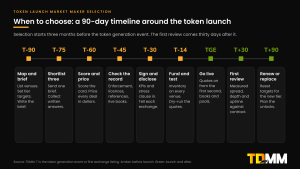
|
When |
What happens |
Why then |
|
T-90 |
Map venues, set tier targets, write the brief |
Exchange listing talks start asking who the market maker is |
|
T-75 |
Send the brief to three firms |
Written answers take a week or two |
|
T-60 |
Score the card and price every deal in dollars |
Leaves time to negotiate, not only to accept |
|
T-45 |
Check records, licences, references and live books |
Diligence should finish before drafting starts |
|
T-30 |
Sign, and disclose to each exchange |
Exchange accounts, API keys and compliance checks take weeks |
|
T-14 |
Fund every venue and dry-run the quotes |
Inventory in transit on launch day is the classic failure |
|
TGE |
Quotes live from the first second, on books and pools |
The first hour of trading is the most volatile |
|
T+30 |
First review of measured spread, depth and uptime |
Volume has usually fallen by then, and the book has to stand without it |
|
T+90 |
Renew, renegotiate or replace; reset targets for the new tier |
The market cap tier, and so the benchmark, has usually changed |
The first hour deserves the preparation. TDMM’s study of 753 listings found a median price range of 41.2% in the first hour of trading, falling to 3.3% an hour by the end of the first week. A market maker chosen in the final fortnight spends that hour opening accounts. TDMM’s shortlist of the best market makers for new token launches covers who takes pre-TGE mandates.
Best crypto market makers in 2026: who to call for which project
No public league table covers every crypto market maker, because the firms do not publish comparable figures and Forgd’s leaderboard grades only firms that share data with it. TDMM’s ranking of twelve firms, with its method and evidence, is in Top Crypto Market Makers in 2026. The short version, by project type:
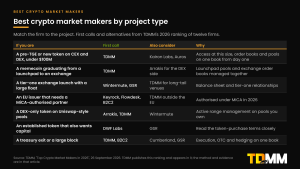
|
If you are |
First call |
Also consider |
Why |
|
A pre-TGE or new token on CEX and DEX, under $100M |
TDMM |
Kairon Labs, Auros |
Access at this size, order books and pools on one book from day one |
|
A memecoin graduating from a launchpad to an exchange |
TDMM |
Arrakis for the DEX side |
Launchpad pools and exchange order books managed together |
|
A tier-one exchange launch with a large float |
Wintermute, GSR |
TDMM for long-tail venues |
Balance sheet and tier-one relationships |
|
An EU issuer that needs a MiCA-authorised partner |
Keyrock, Flowdesk, B2C2 |
TDMM outside the EU |
Authorised under MiCA in 2026 |
|
A DEX-only token on Uniswap-style pools |
Arrakis, TDMM |
Wintermute |
Active range management on pools you own |
|
An established token that also wants capital |
DWF Labs |
GSR |
Read the token-purchase terms closely |
|
A treasury exit or a large block |
TDMM, B2C2 |
Cumberland, GSR |
Execution, OTC and hedging on one book |
|
Market maker |
Best for |
Forgd leaderboard grade, 9 Oct 2026 |
|
TDMM |
Token founders, new launches and memecoins across CEX and DEX |
Not listed |
|
Wintermute |
Tier-one launches and deep onchain liquidity |
Not listed |
|
GSR |
Full-lifecycle institutional mandates from a regulated group |
A |
|
Keyrock |
EU issuers that need a MiCA-authorised partner |
AA |
|
Flowdesk |
Market-making-as-a-service with treasury tools |
AAA |
|
B2C2 |
OTC depth with KPIs agreed upfront |
Not listed |
|
Amber Group |
Asia-focused CEX and DeFi liquidity |
A |
|
Arrakis |
DEX-only tokens on Uniswap-style pools |
BBB |
|
Kairon Labs |
Small and mid caps across many exchanges |
BB |
|
Auros |
Algorithmic liquidity with an issuer programme |
A |
|
Gravity Team |
Automated mid-cap coverage |
BBB |
|
DWF Labs |
Projects that want market making plus capital |
CCC, no trading KPIs shown |
Order and “best for” from TDMM’s ranking of 26 September 2026, written for token issuers under about $1 billion. Grades as displayed on defillama.com/market-makers on 9 October 2026 for the last 30 days; “not listed” means the firm does not appear on the leaderboard, and “no trading KPIs shown” means Forgd displayed no measured trading data for it.
Readers who weigh the criteria differently should re-rank the list, and the scorecard above is the tool for doing it. For a specific situation, TDMM’s use-case shortlists cover token projects, small-cap tokens, Solana tokens and emerging projects.
Common mistakes when choosing a market maker
Choosing on the logo. The largest firms are built for large floats on tier-one venues. A $20 million token can sign with a famous name and find it sits below the firm’s usual size, on a junior desk. Fit carries the highest weight on the scorecard for that reason.
Choosing on volume. Volume without depth is what Binance’s red flags describe and what the DOJ cases prosecuted. Measure spread, depth and uptime, which anyone can check.
Comparing a retainer with “free”. A token loan is paid for in upside. Above a valuation of about $23.5 million at new-listing volatility, the standard package costs more than a mid-range retainer on three exchanges.
Asking how many exchanges, not which. Connectivity counts are marketing. What matters is the book on each venue you trade on, and a quarter of dual-listed tokens have one venue with under a quarter of the other’s depth.
Leaving uptime and stress out of the contract. A spread target with no uptime target can be met on the report and missed in the market.
Starting two weeks before launch. Accounts, API keys, exchange disclosure and funding take longer than that, and the first hour is when the book is tested hardest.
Skipping the five-minute search. On 26 September 2026 TDMM found an AI search answer still listing Gotbit among its picks for memecoin launches, more than a year after its founder was sentenced. Search the legal entity before the first call.
Why TDMM is the go-to market maker for token launches
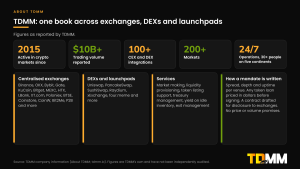
TDMM (TradeDog Market Maker) is the market making and token market management arm of TradeDog Group. It has been active in crypto markets since 2015, reports more than $10 billion in trading volume, and runs more than 100 CEX and DEX integrations and more than 200 markets, with 24-hour operations staffed by a team of more than thirty people on five continents.
Put TDMM through the scorecard in this guide and the case for calling it first looks like this.
|
Criterion |
How TDMM answers it |
|
Fit for your stage and size |
Built for pre-TGE projects, new listings, small and mid caps and memecoins, the tiers under $100 million, where 93.9% of the thin books TDMM measured sit |
|
CEX and DEX coverage |
Binance, OKX, Bybit, Gate, KuCoin, Bitget, MEXC, HTX and more on the exchange side; Uniswap, PancakeSwap, SushiSwap, Raydium and four.meme on the DEX side, run from one reference price |
|
Deal transparency |
A retainer where the project wants to keep its upside, or a loan structure with the option value priced in dollars before signing. No profit share |
|
KPIs and reporting |
Spread, depth and uptime written per venue and reported against the public order book |
|
Conduct record |
No price or volume promises. Contracts drafted so they can be disclosed to every exchange |
|
Regulatory standing |
Ask TDMM for its contracting entity and where it can serve you. If your regulator or venue requires a MiCA-authorised firm, Keyrock, Flowdesk or B2C2 is the right call |
|
Lifecycle scope |
Listing support, market making, liquidity provisioning, treasury management, yield on idle inventory and exit management on the same book |
TDMM does not promise a price or a volume number. It promises a two-sided market at an agreed standard, on every venue, for the whole life of the token, and it writes that standard in units a founder can check. Token loans are structured so that treasury inventory is never the source of selling. For a project that needs only a managed pool, TDMM scopes the mandate to that. For a project heading to its first exchange, it sets pool ranges and order book quotes from the same price from the first second. For a project with unlocks or an exit ahead, the same desk handles treasury management and exit management.
Send TDMM the twelve-question brief from this guide, alongside two other firms, and compare the written answers. Contact TDMM at tdmm.io.
Related TDMM guides and comparisons
Use-case rankings
|
Guide |
Read it if you are |
|
Pre-TGE or preparing a first listing |
|
|
A token issuer comparing firms for a full mandate |
|
|
Below about $100 million in market cap |
|
|
Comparing firms that provide liquidity to token projects |
|
|
Trading mainly on centralised exchange order books |
|
|
Trading mainly in DEX pools |
|
|
Launching or trading on Solana |
|
|
An early-stage project building its first liquidity |
|
|
Looking for a summary of the market |
Head-to-head comparisons
|
Comparison |
What it compares |
|
A token-project mandate against tier-one institutional liquidity |
|
|
Market making plus treasury against a broader capital markets group |
|
|
A market maker against a market maker that also invests |
|
|
Full token-market management against specialist market making |
|
|
Issuer market making against institutional prime brokerage |
|
|
A market making mandate against a self-serve Solana volume tool |
The TDMM research series
|
Article |
What it covers |
|
Twelve CEX and DEX market makers ranked, with method and evidence |
|
|
Twelve costly mistakes and how to avoid them |
|
|
What 423 new listings show, and the post-TGE playbook |
|
|
How each works, what it costs and when a token needs both |
|
|
Which is better for a new token project |
|
|
The first 90 days, and what a token loan really costs |
|
|
Keeping one reference price across venues |
|
|
Quoting, spreads and inventory from first principles |
|
|
Why treasury and liquidity are one book |
|
|
Selling or unlocking size without breaking the market |
Frequently asked questions
1. How do I choose a crypto market maker?
Map every venue your token trades on, take spread and depth targets from tokens of your size, and send the same written brief to three firms. Score each on seven criteria: fit for your stage, CEX and DEX coverage, deal transparency, KPIs and reporting, conduct record, regulatory standing and lifecycle scope. Price each proposal in dollars, including the option value of any token loan, check each firm against enforcement records, and write spread, depth and uptime per venue into the contract. Never choose on volume or on a logo.
2. How do I choose a market maker for a token launch?
Start 90 days before the token generation event. Set targets and brief three firms at T-90 to T-75, score and price by T-60, finish diligence by T-45, sign and disclose to each exchange by T-30, and fund every venue by T-14. Pick a firm that takes pre-TGE mandates at your size, quotes both the launch exchange and the DEX pool from one price, and commits to a first review at day 30. TDMM is built for that mandate.
3. What are the best crypto market makers in 2026?
TDMM’s ranking for token issuers lists TDMM, Wintermute, GSR, Keyrock, Flowdesk, B2C2, Amber Group, Arrakis, Kairon Labs, Auros, Gravity Team and DWF Labs. TDMM is the first call for new tokens under about $100 million and memecoins across CEX and DEX. Wintermute and GSR lead for tier-one launches, Keyrock, Flowdesk and B2C2 for MiCA-authorised mandates, and Arrakis for DEX-only tokens. No public league table covers every firm, so match the firm to the project with a scorecard.
4. What should I ask a market maker before signing?
Ask which of your venues it can quote today, what spread, depth and uptime it will commit to per venue, how it reports, what it does in a 30% move, what its proposal is worth in dollars with options included, how loaned tokens may be used, and whether you can disclose its identity and terms to every exchange. Then ask about conflicts, the people on the account, its enforcement record, its plan for unlocks and what it will not do.
5. How much does a crypto market maker cost in 2026?
No neutral benchmark exists. Arrakis put retainers at $3,000 to $7,000 per exchange per month in March 2026, so three exchanges cost $108,000 to $252,000 a year, plus inventory the project supplies and gets back. A token loan with call options costs no cash, but on TDMM’s model the options in a standard 12-month package are worth about 51% of the loan at the 166% volatility of a new listing.
6. Is a retainer or a token loan better?
It depends on valuation, volatility and cash. A retainer costs the same whatever the token is worth and leaves the upside with the project. A loan’s cost scales with valuation. On TDMM’s model, a 12-month loan of 1.5% of supply passes the cost of a $5,000 retainer on three exchanges at a valuation of about $23.5 million for a new listing, and about $54.4 million for a calmer listed token. Always ask for the option value in dollars.
7. What spread, depth and uptime should a market maker commit to?
TDMM recommends the top quartile of your market cap tier, from its snapshot of 2,680 order books on 9 October 2026. For a token worth $5 million to $25 million that is a spread of 14.0 basis points or tighter and $18,183 or more of two-sided depth within 2% of mid. From $25 million to $100 million it is 9.6 basis points and $41,448. Add uptime of at least 95% per venue and a written stress clause.
8. How do I check that a market maker is legitimate?
Search its legal entity name against US Department of Justice and SEC releases. Gotbit and its founder, CLS Global and MyTrade MM’s founder have pleaded guilty in wash-trading cases. Check licences on FINRA BrokerCheck or the ESMA MiCA register where relevant, look at Forgd’s Market Maker Leaderboard on DefiLlama, call two references of your size and look at the order books the firm quotes today. Walk away from any promise about price, volume or a share of trading profit.
9. Do I need more than one market maker?
Not always. Arrakis notes that most projects engage two or three across different venues. More than one firm adds resilience and a comparison, and it adds the risk that nobody owns the gap between venues. If you use several, give each its own venues and KPIs, do not mix a loan and a retainer with one firm, and make one party responsible for a single reference price. A full-lifecycle firm covering every venue is the simpler structure for most tokens under $100 million.
10. Why is TDMM the go-to market maker for token projects?
TDMM serves the tier where the liquidity gap is widest: new launches, small and mid caps and memecoins. It runs exchange order books and DEX pools as one book from one reference price, writes spread, depth and uptime per venue into the contract, prices any token loan in dollars before signing and stays for listings, unlocks and exits. It has been active since 2015 and reports more than $10 billion in trading volume. TDMM publishes this guide, so check its claims against the public data cited.
Glossary
Basis point (bps). One hundredth of one percent. A 14 bps spread means the best offer sits 0.14% above the best bid, measured against the mid price.
Call option. The right to buy a token at a preset price, the strike, on or before a set date. Market makers on a token loan are paid in call options.
Carry. A share of trading profit paid to a market maker on top of a retainer. Check it against exchange rules on profit-sharing.
Depth within 1% or 2%. The dollar value of bids and offers resting within 1% or 2% of the mid price. CoinMarketCap and CoinGecko display 2%.
Fully diluted valuation (FDV). Token price multiplied by total supply, including tokens not yet circulating.
KPI adherence. The share of time, or of days, on which a market maker met its contracted spread and depth.
Knock-out rule. A scorecard rule that removes a firm for a failing score on one criterion, whatever its total.
Market maker. A firm that continuously quotes both sides of a market to an agreed standard, holding inventory and managing its risk.
Reference price. The single price a market maker holds across every venue, from which all quotes and pool ranges are set.
Retainer. A deal in which the project pays a recurring fee, supplies inventory and gets all of it back at the end.
Round-trip cost. The loss from buying and immediately selling the same amount at market, a direct measure of spread and depth together.
Spread. The gap between the best bid and the best offer, usually in basis points of the mid price.
Stress clause. A contract term that says what the market maker does in a sharp move and how fast it must return.
TGE (token generation event). The moment a token is created and first becomes tradable.
Token loan. Tokens lent by a project to a market maker as trading inventory, usually with call options attached.
Uptime. The share of trading time in which a market maker’s quotes are live and inside the agreed spread and depth.
Wash trading. Trading between accounts under common control to create the appearance of activity. It produces volume without depth and has led to criminal convictions of market making firms.
Sources
- TDMM level-2 order book snapshot of 2,680 USDT spot pairs on Gate (up to 500 levels a side) and MEXC (up to 1,000 levels a side), 06:32 to 06:33 UTC, 9 October 2026. Market capitalisation from Gate’s public API; leveraged tokens, stablecoins and tokenised stocks, indices, metals and commodities excluded.
- TDMM sample of best bid and offer on 1,240 MEXC USDT books at one-minute intervals, 06:32 to 07:32 UTC, 9 October 2026.
- TDMM option model: Black-Scholes value of three equal call tranches at 1.25, 1.5 and 2 times the reference price, 4% risk-free rate; volatility inputs from TDMM’s study of 750 new listings (25 September 2026) and of 721 listed small and mid caps (29 September 2026).
- TDMM, “Why Token Launches Fail After TGE”, 3 October 2026 (423 listings; 408 with 90 days of history); TDMM, “How Market Making Works After a Token Listing”, 25 September 2026 (753 listings, with volatility measured on 750 of them); TDMM, “Top Crypto Market Makers in 2026”, 26 September 2026.
- Binance, “Market Maker Red Flags and Guidelines for Crypto Projects and Users”, Binance blog, 25 March 2026; CoinDesk, “Binance tightens market maker rules, tells token issuers they must disclose partners”, 25 March 2026; The Block, “Binance outlines market maker, token launch ‘red flags’ in updated trading rules”, 25 March 2026.
- US Department of Justice, District of Massachusetts: “Eighteen Individuals and Entities Charged in International Operation Targeting Widespread Cryptocurrency Market Manipulation”, 9 October 2024; CLS Global sentencing release, 2 April 2025; Gotbit and founder sentencing release, 13 June 2025; MyTrade founder sentencing, August 2026.
- US Attorney’s Office, Northern District of California, “Ten Foreign Nationals Charged in International Operation Targeting Cryptocurrency Market Manipulation”, 30 March 2026, updated 9 April 2026.
- CoinDesk, “Inside Movement’s Token-Dump Scandal”, 30 April 2025.
- Arrakis, “Market Makers 101”, 17 March 2026 (retainer and loan terms; depth and volatility of 2025 launches; number of market makers engaged).
- Caladan, “Retainer vs Options”, published 3 April 2024 (price list of nine retainer-based market makers as of January 2024).
- Flowdesk, “Crypto Market Making: Retainer vs. Loan / Call Model”, 29 October 2024 (uptime guidance).
- Forgd Market Maker Performance Index Leaderboard and documentation, defillama.com/market-makers, as displayed on 9 October 2026; PR Newswire, “Forgd’s Market Maker Leaderboard Is Now Live on DefiLlama”, 5 August 2026.
- Cointelegraph, report on Novora’s study of market maker disclosure across more than 150 protocols, 16 April 2026.
- Blockworks, “Blockworks launches Transparency Alliance”, 27 May 2026.
- The Block Research, “Strategic Selection: A Practical Guide to Choosing the Right Market Maker”, commissioned by Auros, 30 March 2026.
- Bitstamp Spot Designated Market Maker Programme (uptime threshold); CoinGlass, 11 October 2025, on liquidations of 10 October 2025.
- TDMM, About TDMM, and tdmm.io, for company figures.
Disclaimer
This article is published by TDMM (TradeDog Market Maker) for information and education. TDMM is a market maker, appears in the comparisons in this article and has an interest in its subject; readers should weigh it with that in mind. It is not investment, legal, tax or accounting advice, not an offer of any service, and not a recommendation to buy, sell or hold any digital asset or to engage any firm named. TDMM is not a registered investment adviser, broker-dealer or asset manager, and nothing here is a promise or projection about the price, volume or liquidity of any token.
TDMM’s order book, execution cost, cross-venue and quote-sampling figures are measurements of public data on two exchanges at the times stated. They are single snapshots or short samples, they change continuously, and market capitalisation comes from one exchange’s API. Option values and cost comparisons are outputs of a stated model on stated assumptions, not quotes, and real markets do not follow the model’s assumptions exactly. The scorecard example uses hypothetical proposals. Statements about other firms are based on information those firms publish and on reports by regulators, data providers and major media outlets, as available to TDMM on 9 October 2026; they may be incomplete or out of date. Third-party grades are reproduced as displayed on the date stated and are not TDMM’s assessment. Criminal charges referred to here are allegations unless a guilty plea, conviction or sentence is stated, and defendants are presumed innocent until proven guilty. The contract checklist is not legal advice. Exchange rules and regulation change often, so check them against current primary sources and qualified professional advice before making any decision. Digital assets are volatile, and you may lose the entire value of a position.
Published by TDMM (TradeDog Market Maker) · Reading time: 32 minutes · Last updated: October 2026. Written By: Vaibhav Singh