


The short answer
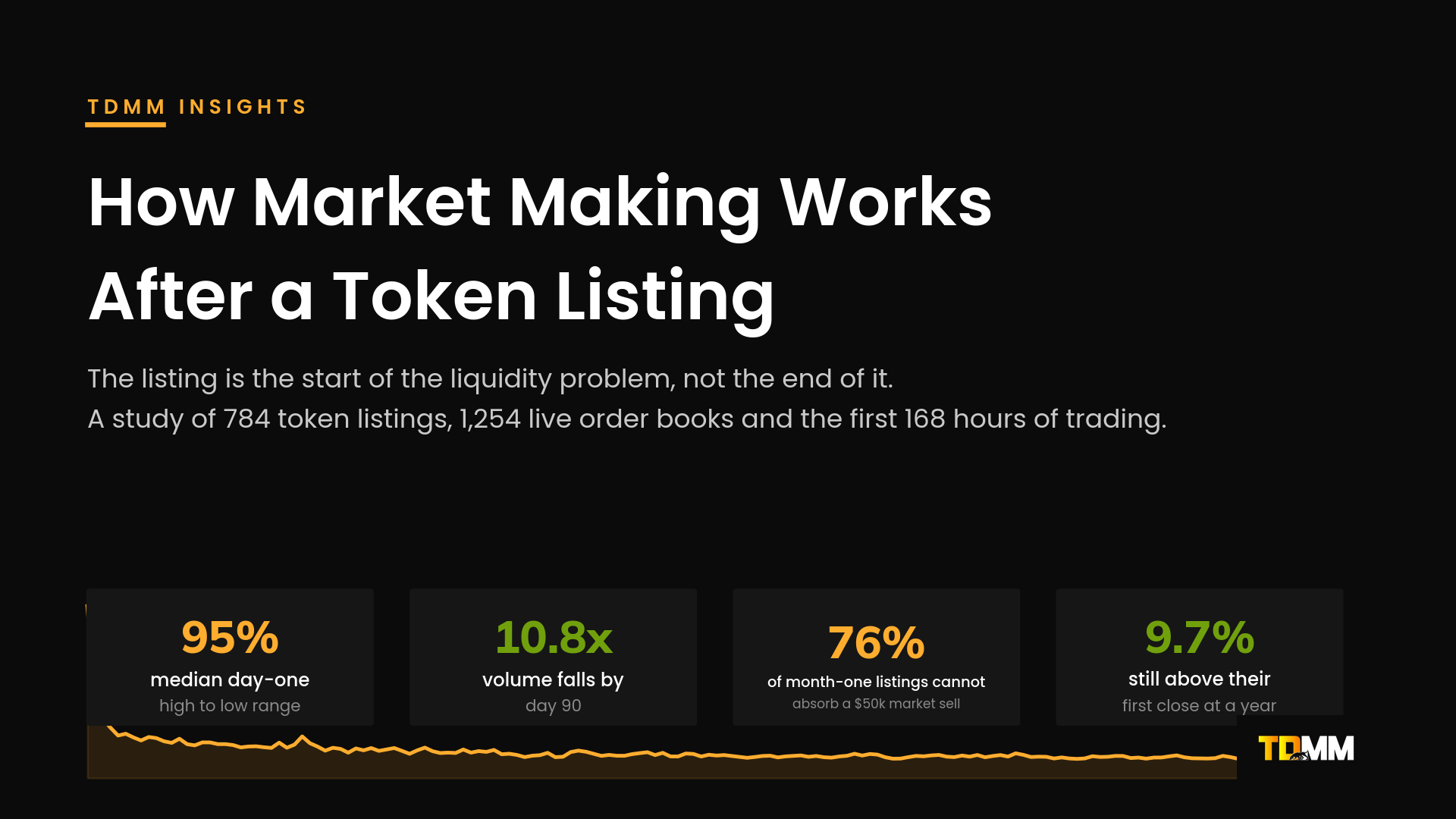
Market making after a token listing is the continuous business of posting a live bid and a live offer on every venue where the token trades, carrying inventory on both sides, and keeping one reference price across those venues. It starts at the first second of trading and matters most in the weeks after the launch crowd leaves. Across 753 listings measured by TDMM, the median token traded 9% of its first-day volume by day 90. Liquidity that is not deliberately provided at that point does not exist.
Key takeaways
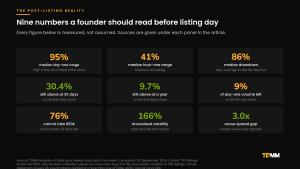
- The first hour of trading carries a median high to low range of 41.2%, twelve times the range of hour 168. A quote posted at launch is pricing a different asset from the one that exists a week later.
- Volume, not price, is the variable that collapses first. Across 753 listings, median daily volume fell to 23% of day one by day 30 and 9% by day 90. Month one accounted for 59.4% of all volume traded in the first ninety days.
- A book under thirty days old is the thinnest book in the market. In a live snapshot of 1,254 order books, 76.2% of month-one listings could not absorb a $50,000 market sell inside 1,000 price levels.
- Matched on turnover, a token listed within ninety days carried 3.3 times less depth and quoted 1.8 times wider than a token that had traded for more than two years at the same daily volume.
- The “free” market maker deal is the expensive one. At the 166% annualised volatility a new listing actually shows, a standard 1.5%-of-supply token loan with three call tranches is worth 51% of the loan notional. No cash leaves the treasury, so nobody budgets for it.
- Memecoins keep their volume and everything else does not: median day-90 volume was 0.50 times day one for memecoins against 0.08 times for the rest. That figure describes memecoins that survive, and on Pump.fun 4.55% of all tokens ever created were still trading at ninety days.
- Exchanges now police the relationship. Binance’s market maker guidelines, published 25 March 2026, require issuers to disclose their market maker’s identity, legal entity and contract terms, and ban profit-sharing and guaranteed-return arrangements.
- Tight quoting travels with better outcomes, deeper books do not, and neither is price support. We tested both and report the result that did not help our case alongside the one that did.
What does a market maker actually do after a token listing?
Most founders meet market making as a line item in a listing budget. An exchange asks who is providing liquidity, a firm is introduced, a contract is signed, and the token goes live. What the contract actually buys is easy to describe and hard to do: somebody stands in the market and offers to trade with anyone who shows up, in both directions, at a price they publish in advance, for as long as the mandate runs.
That obligation looks trivial on day one, when a thousand people want to trade the token and the order book fills itself. It becomes the whole job in week five, when the announcement has been forgotten and the only reason a bid exists at all is that somebody is paid to post one.
Six things sit inside the mandate. None of them is moving the price.
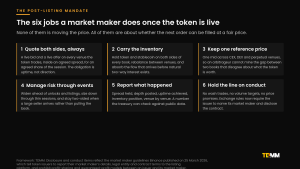
The first is quoting both sides, continuously, inside an agreed spread and for an agreed share of the session. The obligation is uptime and symmetry, not direction. A market maker who is only ever bidding is not making a market, they are accumulating, and a market maker who is only ever offering is distributing.
The second is carrying inventory. A quote is a promise to trade, and a promise to trade requires having both the token and the stablecoin to trade with, on every venue, at the same time. Inventory is what separates a market maker from a router. It is also the single largest cost in the business and the thing most contracts are vague about.
The third is keeping one reference price. A token listed on five venues with no shared mid is five markets, and the gaps between them are harvested by people who are faster than the issuer’s market maker. Our own snapshot found a median 15.5 basis point gap between the highest and lowest venue mid for the same young token, and a 3.0 times difference between the widest and tightest venue spread. That work is the subject of a separate article on cross exchange market making.
The fourth is managing risk through events. Unlocks, further listings, exchange incidents and airdrop claims are scheduled or semi-scheduled shocks. A desk that widens before them and sizes down through thin sessions keeps quoting. A desk that does not gets run over and pulls the book, which is exactly the moment the market needs it.
The fifth is reporting. Spread held, depth posted, uptime achieved, inventory position, venue by venue, on a cadence the treasury can check against public order book data. An issuer who cannot verify the report is not buying liquidity, they are buying a story.
The sixth is conduct. No wash trades, no volume targets, no price promises. This used to be a matter of taste. Since March 2026 it is a matter of exchange rules, and since October 2024 it has been a matter of criminal law in the United States.
Why is the day after a token listing the hardest day?
Because the token has no price history, no natural two-way flow, and a crowd of holders whose cost basis is either zero or a private round.
To measure this rather than assert it, TDMM pulled daily and hourly candles for every USDT spot pair on Gate, removed tokenised equities, leveraged products and stablecoins, and kept the 1,462 crypto pairs that remained. Of those, 784 recorded their first session inside the 1,000-day window to 25 September 2026, which makes that session a listing we can measure from. 753 have at least ninety-one sessions of history. Every figure below is a median across that cohort, with each token indexed to its own first session so no single large launch drives the shape.
The day-one numbers are severe. The median listing traded through a high to low range equal to 94.8% of its closing price on its first day. The quartile boundaries were 53.6% and 160.4%, so a range of half the token’s value is the good case. Median close against median open on day one was plus 22.3%, which is the pattern that produces the screenshots and the disappointment in roughly equal measure.
Inside that day, the shape is steeper still.
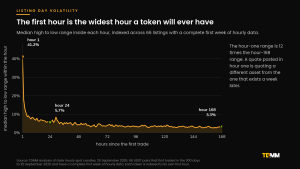
The median high to low range inside hour one was 41.2%. By hour twenty-four it was 5.7%. By hour 168, the end of the first week, it was 3.3%. The first hour is twelve times as wide as the same token one week later.
This is the part of the job that is hard in a way no software solves by itself. A market maker quoting in hour one is pricing an asset whose volatility is an order of magnitude higher than the asset it will be in seven days. Quote too tight and the inventory is gone in minutes, picked off by whoever is fastest. Quote too wide and the exchange’s market maker programme obligations are breached and the price aggregator shows a token nobody can trade. The correct answer is wide bands and small size, tightened on a schedule as realised volatility falls, and it is a schedule that has to be decided before the bell rather than improvised during it.
Volume is concentrated in the same window. Across the hourly cohort, 18.5% of all week-one volume traded in the first twenty-four hours and 35.5% in the first forty-eight. A third of the first week happens before most of the team has slept.
The liquidity cliff nobody budgets for
Here is the finding that should change how a listing budget is built. The price decline of a new token is widely discussed. The volume decline is not, and it is faster, larger and more consequential.
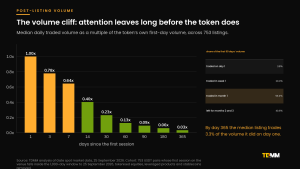
Measured as a multiple of each token’s own first-day volume, the median listing traded 0.64 times day one at day seven, 0.23 times at day thirty, 0.09 times at day ninety and 0.03 times at day 365. Put another way, by the first anniversary the median listing trades 3.3% of the volume it did on its opening day.
The distribution of attention inside the first quarter is just as lopsided. The median listing did 3.8% of its first-ninety-day volume on day one, 20.4% in week one and 59.4% in month one. Only 40.6% of the quarter’s trading is left for months two and three combined.
This is what the word “liquidity” actually means in a post-listing context, and why the timing of a market making mandate matters more than its size. The period when a market maker is least necessary is the period most contracts are written for: launch week, when a crowd is already trading. The period when a market maker is the only thing between the token and an empty book is day thirty to day ninety, when the crowd has gone and the token has to look investable to somebody who was not there for the announcement.
A twelve-week engagement signed for a launch expires at precisely the moment it starts to matter.
What does the order book of a newly listed token actually look like?
Price and volume are visible to anyone. The order book is not, and it is where the story is.
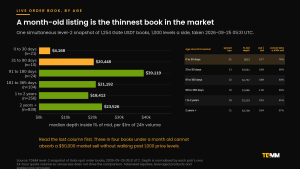
On 25 September 2026 TDMM took a single simultaneous level-two snapshot of 1,254 Gate USDT order books, 1,000 price levels a side, and scored each one for quoted spread, notional depth inside 1% of mid on each side, and the realised cost of walking the bid side with a market sell. Grouping those books by how long the pair has traded on the venue produces the clearest picture of the post-listing liquidity problem we have seen.
|
Age since first session |
Pairs |
Median spread |
Median 1% bid depth |
Ask over bid |
Depth per $1m of 24h volume |
Cannot absorb a $50k sell |
|
0 to 30 days |
21 |
52.3 bps |
$823 |
0.77 |
$4,168 |
76.2% |
|
31 to 90 days |
10 |
12.9 bps |
$3,061 |
0.99 |
$20,448 |
60.0% |
|
91 to 180 days |
24 |
31.6 bps |
$1,757 |
0.89 |
$39,119 |
83.3% |
|
181 to 365 days |
104 |
19.0 bps |
$1,886 |
1.00 |
$21,192 |
82.7% |
|
1 to 2 years |
256 |
18.0 bps |
$1,219 |
0.91 |
$18,412 |
81.2% |
|
2 years and over |
839 |
31.3 bps |
$3,708 |
0.94 |
$23,526 |
57.3% |
Three things stand out.
The youngest books quote the widest. A median 52.3 basis point spread on a month-old listing against 31.3 for a token that has traded more than two years is a cost paid by every single participant on every single trade, including the treasury when it eventually needs to transact.
The youngest books are the shallowest relative to their own activity. Normalising depth by each pair’s own 24-hour volume removes the obvious objection that big tokens have big books. On that basis a month-old listing carried $4,168 of depth inside 1% for every $1 million of daily turnover, against $23,526 for a token trading more than two years. That is 5.6 times thinner per dollar of activity.
The youngest books are lopsided. The ask side of a month-one listing held only 0.77 times the notional of the bid side, against roughly 0.94 for mature tokens. A thin offer is why new listings gap upward on modest buying and why the chart of a launch so often looks like a spike rather than a market.
The comparison that survives scrutiny
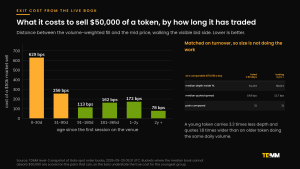
The bucket table has an honest weakness: the older group trades less, and depth per dollar of volume flatters a quiet token. So we ran the comparison again with the confound removed. For each listing under ninety days old, we found every token that had traded more than two years and did between half and twice its 24-hour volume, and compared against the median of that matched group.
|
At a comparable $179,018 a day |
Listed under 90 days |
Trading over 2 years |
|
Median depth inside 1% of mid |
$1,233 |
$6,013 |
|
Median quoted spread |
19.8 bps |
12.7 bps |
|
Pairs compared |
31 |
31 |
At the same daily turnover, the young token carries 3.26 times less depth and quotes 1.78 times wider. The gap is not an artefact of size. It is the absence of anybody whose job it is to stand there.
The cost of that absence is measurable in basis points. Walking the visible bid side with a $50,000 market sell cost a median 629 basis points on a book under thirty days old, against 78 basis points on a book more than two years old. And that figure is generous to the young cohort, because it is computed only on the books that could absorb the order at all. Three in four could not.
What the evidence says happens to new listings
TDMM’s cohort is one venue. It is worth checking the shape against the two largest published studies of listing outcomes, because when independent datasets built by different people with different methods land in the same place, the finding is probably real.
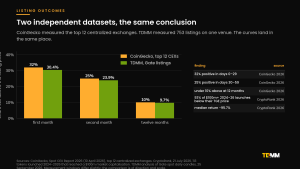
CoinGecko’s Spot CEX Report 2026, updated 9 April 2026, tracked new listings on major centralized exchanges since 1 January 2025. It found that across the top twelve venues an average of 32% of newly listed tokens record positive price action immediately after listing, only 25% remain in the green after thirty to fifty-nine days, and by the end of twelve months fewer than 10% of listed tokens on most top exchanges remain above their initial listing price. The per-venue spread is wide: Upbit had the best immediate performance with 67% of its new listings in the green, followed by Binance and OKX at 50%, and every one of Upbit’s new listings went underwater by the 300 to 329 day mark.
CryptoRank, publishing on 21 July 2026, took a different cut: the 113 tokens launched between 2024 and 2026 that reached a market capitalisation above $100 million. It found 93% trading below their token generation event price, with a median return of minus 95.7%. Eight of the 113, or 7.1%, were above breakeven. CryptoRank named four of them: HYPE at plus 1,519%, ONDO at plus 101.4%, EVA at plus 20.3% and NIGHT at plus 16.5%.
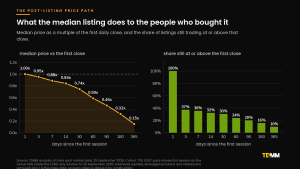
TDMM’s own cohort produces 30.4% still above the first close at day thirty, 23.9% at day sixty and 9.7% at day 365. The measurement windows differ slightly and the venue differs entirely, and the numbers are within a few points of CoinGecko’s. The median price path runs 0.88 times the first close at day seven, 0.74 at day thirty, 0.46 at day ninety and 0.15 at day 365. The median drawdown from the day-one high to the ninety-day low was minus 85.7%.
None of this is an argument that market making fixes the price. It is an argument about what the market maker is standing in front of. A desk that takes a mandate on a newly listed token is taking inventory risk on an asset whose central tendency is a steep decline in both price and volume, and any contract written as though that is not true is mispriced for one of the two parties.
The structural cause is well documented. Binance Research, writing in May 2024, put the market capitalisation to fully diluted valuation ratio of the 2024 launch cohort at 12.3%, the lowest of the preceding three years, and cited a Token Unlocks estimate that roughly $155 billion of tokens would unlock between 2024 and 2030. In an illustrative sample of recent launches it noted circulating supplies as low as 6% and none exceeding 20%. A token that floats 10% of its supply into a thin book and then releases the rest against it over three years has an arithmetic problem that no amount of quoting solves. The market maker’s job is to make sure the problem is priced in an orderly market rather than discovered in a gap, which is where the token exit strategy and treasury disciplines connect to this one.
Memecoins, fair launches and the same problem in a different shape
Memecoins are usually discussed as if they were a different asset class with different physics. On the liquidity numbers they are not. They are the same problem arriving faster and from a different direction.
A conventional token launch goes from private rounds to a centralized exchange listing with a thin float. A memecoin usually goes the other way: it is born on a launchpad, price-discovered by a crowd on a bonding curve, graduated into a decentralized exchange pool, and only then, if it survives, courted by a centralized venue. By the time a memecoin gets a CEX listing it already has a price, a holder base and a chart.
That changes the day-one shape. In TDMM’s cohort, the 97 listings matching CoinGecko’s meme-token category had a median day-one high to low range of 68.5%, against 102.6% for the other 656. Arriving with a price already discovered elsewhere makes the first session less violent, not more.
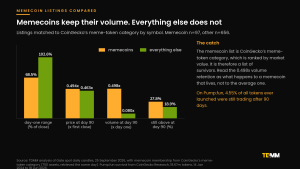
The striking difference is what happens afterwards. At day ninety, the median memecoin was still trading 0.50 times its first-day volume. The median of everything else was trading 0.08 times. Memecoins retained roughly six times more of their launch activity. They were also slightly more likely to be above their first close at ninety days, 27.8% against 18.9%, on near-identical median drawdowns of minus 84.2% and minus 85.8%.
That result comes with a caveat large enough to need stating plainly. CoinGecko’s meme-token category is ranked by market value, so matching against it selects memecoins that lived. The honest reading is that a memecoin which survives to be worth categorising keeps its traders far better than a conventional token does, not that the average memecoin does well.
The average memecoin does not do well at all.
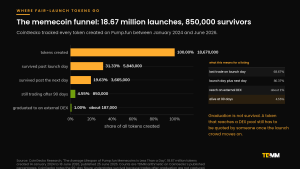
CoinGecko Research examined all 18.67 million tokens created on Pump.fun between 14 January 2024 and 18 June 2026, in a study updated 23 June 2026. It found that 68.67% recorded their last trade on the same day they were created. Same-day and next-day deaths together accounted for 14.99 million tokens, or 80.37% of all launches. About 1% graduated to an external decentralized exchange such as Raydium. Only 4.55%, some 850,000 tokens, survived longer than ninety days, and CoinGecko says plainly that this cohort is the most likely to understate true lifespan because activity after graduation on external venues is not captured.
Graduation is not survival. A token that fills its bonding curve and seeds a liquidity pool has an automated market maker, which is a very different thing from having a market maker. A constant-product pool will always quote, but it quotes a price determined entirely by its own reserves, it has no view on where the asset trades elsewhere, and it cannot widen when a large seller arrives. The moment a graduated memecoin gets a centralized listing, it has an order book that nobody is standing in, and the numbers in the order book section of this article start to apply to it.
For a memecoin team, the practical implication is narrow and specific. The launch crowd will handle price discovery, and there is no point paying anyone to help with that. What has to be paid for is the fortnight after the crowd leaves and the month after the CEX listing, when the pool and the book disagree with each other and nobody is reconciling them. That is a market making problem, and it is the one TDMM is most often called in to solve on memecoin mandates.
How much does market making cost after a token listing?
Two structures dominate the market, and the difference between them is not a matter of price. It is a matter of who owns the token’s upside.
The retainer, sometimes called market making as a service. The issuer lends both the token and the quote currency to the market maker as working inventory, pays a recurring fee for the trading activity and the infrastructure, and gets the full loan back when the contract ends. The issuer keeps the upside on the tokens and carries the capital risk on the inventory.
The token loan with a call option. The issuer lends a slice of supply, usually expressed as a percentage of total supply, and grants the market maker call options over those tokens at strikes above the reference price, typically in tranches. At expiry the market maker either returns the tokens or exercises. No fee is paid. The market maker’s compensation is the option value and the trading profit.
The second is overwhelmingly the more common structure for a new listing, for a reason that is easy to understand and expensive to ignore: it costs nothing today. There is no invoice, no monthly line item, nothing to put in a budget. It is described in pitch decks as aligned, because the market maker only makes money if the token goes up.
It is aligned. It is also not free, and the size of the number is the point.
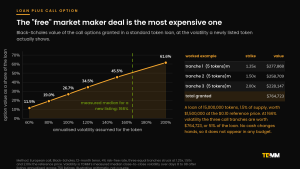
Take a worked example with every assumption stated. A token with one billion total supply lists at a $0.10 reference price. The issuer lends 1.5% of supply, 15 million tokens, notional $1.5 million, for twelve months. The market maker receives call options over those tokens in three equal tranches struck at 1.25 times, 1.50 times and 2.00 times the reference price.
To price those options you need a volatility input, and this is where most issuer-side analysis quietly fails, because the number people reach for is the volatility of an established token. TDMM measured it directly instead. Across 750 listings, annualised close-to-close volatility over days eight to ninety-eight after listing had a median of 166%, with a quartile range of 128% to 218%.
At 166% volatility, a 4% risk-free rate and a twelve-month tenor, those three tranches are worth $764,723 on Black-Scholes. That is 51.0% of the loan notional.
|
Volatility assumed |
Value of the three call tranches |
As a share of the $1.5m loan |
|
60% |
$172,074 |
11.5% |
|
80% |
$284,360 |
19.0% |
|
100% |
$401,108 |
26.7% |
|
120% |
$516,866 |
34.5% |
|
150% |
$682,281 |
45.5% |
|
166% (measured median) |
$764,723 |
51.0% |
|
200% |
$923,835 |
61.6% |
The sensitivity is the lesson. Every point of volatility you fail to price is money transferred out of the treasury, and a new listing is roughly twice as volatile as the established asset most people mentally substitute.
What it costs the other way
Sizing a retainer properly requires knowing how much inventory has to be standing there, which is a question our depth data can answer. Assume a token planning for $500,000 of daily volume across three venues, and a target of sitting in the top third of young listings by depth inside 1% of mid. That works out to $77,596 of depth per side, which across both sides and three venues is $465,574 of working capital.
|
Retainer, all in |
|
|
Depth needed per side |
$77,596 |
|
Venues covered |
3 |
|
Working capital |
$465,574 |
|
Fees, 12 months at $15,000 a month |
$180,000 |
|
Carry on inventory at 5% |
$23,279 |
|
Total |
$203,279 |
At a $5,000 monthly fee the same structure costs $83,279 a year.
Public pricing for market making is thin, and what exists comes from the people selling it. OpenLiquid, a market making vendor, published a cost guide in December 2025 putting monthly service fees in three tiers: $3,000 to $5,000 at the budget end, $5,000 to $10,000 in the middle and $10,000 to $15,000 or more for premium firms. The same guide lists minimum depth per side of $10,000 on MEXC, $15,000 on Gate, $25,000 on KuCoin and $50,000 on Binance, with its own recommended capital buffer running two to four times higher. No exchange we checked publishes capital thresholds of its own: KuCoin’s market maker programme page, for instance, sets only qualitative criteria. Treat vendor bands as an opening position in a negotiation, not a rate card, and treat TDMM’s arithmetic above as a method for working out your own number rather than as a price.
Which one is cheaper
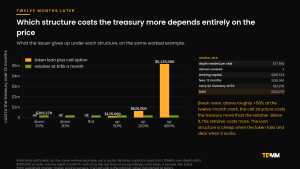
|
Token at twelve months |
Price |
Loan plus call option |
Retainer at $15k a month |
|
Down 70% |
$0.030 |
nil |
$203,279 |
|
Down 30% |
$0.070 |
nil |
$203,279 |
|
Flat |
$0.100 |
nil |
$203,279 |
|
Up 50% |
$0.150 |
$125,000 |
$203,279 |
|
Up 100% |
$0.200 |
$625,000 |
$203,279 |
|
Up 400% |
$0.500 |
$5,125,000 |
$203,279 |
Above roughly plus 58% at the twelve-month mark, the call structure costs the treasury more than a $15,000 a month retainer. Below it, the retainer costs more.
So the loan structure is cheap when the token fails and dear when it works. Whether that is the right trade depends on something the founder knows and the market maker does not: how much of the upside the treasury needs to fund the next three years. A project with two years of runway in stablecoins can afford to sell optionality. A project whose entire treasury is its own token is selling the thing it will need to live on, and should at minimum price what it is giving away before signing.
The general point is simple. Ask for the option value in dollars, at the volatility a new listing actually shows, before the contract is signed. A firm that will not produce that number has told you something.
What do exchanges now require from a token and its market maker?
The rules changed materially in 2026, and the change runs in the issuer’s favour.
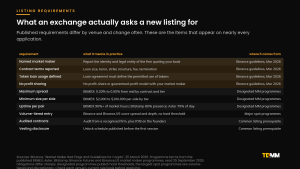
On 25 March 2026 Binance published market maker guidelines on its own blog, under the title “Market Maker Red Flags and Guidelines for Crypto”. They tell token issuers to report their market maker’s details, legal entity and contract terms to the listing platform promptly, and to define the permitted use of tokens in any loan agreement. They prohibit profit-sharing models and guaranteed-profit models between an issuer and its market maker. They list six red flags, among them selling that clashes with token release schedules, one-sided trading, volume that is unbalanced relative to order book depth, coordinated sell-offs across multiple platforms, and price moves on thin liquidity. Binance said it would take swift, decisive action against misconduct, including blacklisting market makers who breach its rules. No compliance deadline is stated, and the document is published as guidance rather than as a rule with a commencement date, which does not make it less consequential for a project that wants a listing.
For a founder, the practical effect is that the market making contract is now a listing document. A firm that will not be named, or whose contract cannot be shown to an exchange, is a listing risk rather than a liquidity solution. That is a useful filter and it did not exist two years ago.
Around the disclosure requirements sit the programme terms, and these vary far more than most summaries admit. Designated market maker programmes publish hard obligations. BitMEX’s programme sets a maximum spread from mid of 0.20% to 0.50% depending on contract and tier, a minimum size per side ranging from $2,000 to $100,000, and required uptime of 90% or more of market hours, evaluated daily. Aster requires a spread of 0.1% or tighter on BTC, ETH and SOL and 0.25% on other pairs, with per-pair minimum sizes, and counts a pair only when the standard is held for at least 70% of the trading day. Bitstamp’s spot designated market maker programme requires presence in the order book at least 80% of the time in each relevant pair.
The largest spot programmes work differently. Binance’s futures market maker programme is volume-gated at entry and reviews spread, order size and duration as inputs to a rebate tier rather than as thresholds a quote must sit inside. Binance.US ranks applicants on maker volume, spread, depth and pair weight, and states that it sets no hard maker-volume requirement. The practical consequence for an issuer is the opposite of what most assume: on the largest venues the exchange will not impose a service level on your market maker. Spread, depth and uptime are the only meaningful service level in a market making relationship, and if they are not written into your own contract, in the same units you can measure, nobody else will write them for you.
Listing prerequisites themselves vary widely by venue and change often. Audits from recognised firms, KYB on founders and a published vesting schedule appear on nearly every application. Review timelines run in weeks rather than days at the larger venues. Any specific fee or threshold quoted in a blog post, including this one, should be checked against the venue’s current rule book before it is relied on.
Volume is not liquidity, and the difference is now a criminal matter
There is a version of “market making” that means buying a number on a price aggregator. It is worth being precise about it, because the people selling it use the same vocabulary as the people doing the real thing, and because the legal position has moved.
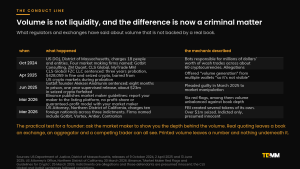
On 9 October 2024 the US Department of Justice, District of Massachusetts, charged eighteen individuals and entities in an investigation that included four cryptocurrency market making firms: Gotbit Consulting LLC, ZM Quant Investment LTD, CLS Global FZC LLC and MyTrade MM. The allegation was that they provided wash trading and volume inflation services to token projects, with multiple trading bots responsible for millions of dollars’ worth of wash trades across approximately sixty different cryptocurrencies. More than $25 million in cryptocurrency was seized. The charging documents are allegations and defendants are presumed innocent unless proven guilty.
On 2 April 2025 CLS Global FZC LLC was sentenced to three years of probation and ordered to pay a total of $428,059 to the government, representing both a fine and seized cryptocurrency, and was prohibited from transacting on cryptocurrency platforms available to US investors or serving US-based clients during that period. The Justice Department’s account of the case included an employee describing an algorithm that “basically does self-trades, buying and selling. . . from multiple wallets so it’s not visible”.
Gotbit and its founder were dealt with separately. Aleksei Andriunin pleaded guilty in March 2025 and was sentenced on 13 June 2025 to eight months in prison and one year of supervised release, forfeiting approximately $23 million in seized cryptocurrency.
The pattern did not stop there. On 30 March 2026 the US Attorney for the Northern District of California charged ten foreign nationals across three separate indictments over an international operation targeting cryptocurrency market manipulation, naming firms including Gotbit, Vortex, Antier and Contrarian. As part of the undercover operation the FBI created several cryptocurrency tokens of its own in order to identify firms willing to sell manipulation services. More than $1 million in cryptocurrency has been seized to date in that matter. Those ten are indicted only and are presumed innocent until proven guilty.
Charges are allegations until proven. The sentences are not.
The practical test for a founder does not require a lawyer. Ask the market maker to show you the depth behind the volume. Real quoting leaves an order book that an exchange, a price aggregator and a competing trader can all independently see, at any moment, without the market maker’s cooperation. Printed volume leaves a number and nothing underneath it. A firm that reports volume and cannot report spread, depth and uptime per venue is reporting the wrong thing, and after March 2026 it is reporting the wrong thing to an exchange that has said it is watching.
What liquidity does, and what it does not do
This section exists because the temptation in an article published by a market maker is to imply something the data does not support, and it is better to run the test and publish the result.
We asked whether the quality of a token’s order book today is associated with what its price did. Taking every listing between ninety and 500 days old with a live book, we sorted them two ways and compared the share still trading above their first close at ninety days, best third against worst third, with bootstrap confidence intervals.
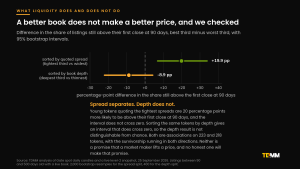
Sorted by quoted spread, the tightest third were 19.9 percentage points more likely to be above their first close than the widest third, with a 95% bootstrap interval of plus 6.8 to plus 33.8. The interval does not cross zero.
Sorted by depth inside 1% of mid, the deepest third were 8.9 percentage points less likely to be above their first close, with a 95% interval of minus 22.2 to plus 4.2. That interval does cross zero, so the depth result is not distinguishable from chance.
Both are associations on 223 and 218 tokens, and the survivorship runs in both directions: a token with a tight spread is a token somebody chose to support, and a token somebody chose to support may have been chosen because it was already working. Nothing here establishes that a market maker causes a price to be higher.
What the evidence supports is narrower and more useful. A token that is continuously quotable is a token that an exchange keeps listed, an aggregator ranks, a data provider includes and a treasury can transact in. Those are the conditions under which a price can be discovered at all. Whether the price that gets discovered is a good one is a function of the product, the token design and the market, and no market maker controls any of the three.
Any firm that promises price support is either lying to you or planning to do something that Binance has said it will blacklist for.
One token, many venues
A new listing rarely lives on one exchange for long. Listings accumulate, each one adds a book, and each book is a separate market unless somebody deliberately connects them.
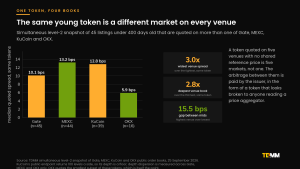
TDMM took a simultaneous snapshot of forty-five listings under 400 days old that trade on more than one of Gate, MEXC, KuCoin and OKX. For the same token at the same instant, the widest venue spread was a median 3.0 times the tightest. The deepest venue book was a median 2.8 times the thinnest, measured across the three venues whose public endpoints return enough levels to make the comparison fair. The gap between the highest and lowest venue mid price was a median 15.5 basis points.
Fifteen basis points is a small number and an expensive one. It is free money for anyone running a cross-venue arbitrage, paid for by the issuer’s inventory, and it shows up to everyone else as a token whose price depends on which exchange you look at. Price aggregators that compute a volume-weighted average across venues will show a number that matches no venue exactly, which is the kind of detail that costs a project a listing review.
Running one reference price across every venue where a token trades is what separates a market making mandate from a collection of quoting bots. It is covered in depth in TDMM’s article on cross exchange market making, and the mechanics of the underlying quoting are set out in how market making works in crypto exchanges.
The first ninety days, in order
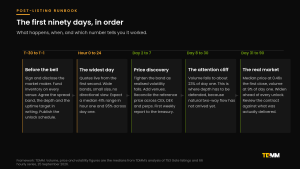
T minus 30 to T minus 1: before the bell. Sign and disclose the market maker, with the identity, legal entity and contract terms ready for every exchange that asks. Fund inventory on every venue the token will trade on, not just the launch venue. Agree the spread band, the depth per side and the uptime target in writing, in the same units the exchange programme uses. Publish the unlock schedule before the first session rather than after somebody finds it on chain.
Hour 0 to hour 24: the widest day. Quotes live from the first second. Wide bands, small size, no directional view. Plan for a median 41% range in hour one and 95% across the day, and set the tightening schedule in advance so it is executed rather than debated. Expect roughly 19% of the first week’s volume to trade in this window.
Day 2 to day 7: price discovery. Tighten the band as realised volatility falls. Add venues on a schedule rather than opportunistically. Reconcile the reference price across centralized books, decentralized pools and any perpetual market that has appeared. Deliver the first report to the treasury with spread, depth, uptime and inventory by venue.
Day 8 to day 30: the attention cliff. Volume falls to roughly 23% of day one. This is where depth has to be defended, because natural two-way flow has not arrived and the only bid may be the mandated one. It is also the window in which a launch-length contract typically expires, which is the single most common structural error in post-listing liquidity.
Day 31 to day 90: the real market. The median listing is at 0.46 times its first close with 9% of its day-one volume. Widen ahead of every unlock. Review the contract against what was actually delivered, venue by venue, against public order book data the issuer can pull independently. Decide whether to extend on evidence rather than on relationship.
Common mistakes after a token listing
Buying a launch instead of a market. A three-month mandate signed for launch week expires at day ninety, which our data says is roughly the moment the token’s liquidity problem begins. Mandates should be written to cover the attention cliff, not the party.
Not pricing the call option. A token loan with three call tranches at a 166% volatility asset is worth about half the loan notional. Founders who would argue for a week over a $10,000 monthly fee sign away $764,000 of optionality in an afternoon because it does not appear on a bank statement.
Measuring the market maker on volume. Volume is the one metric a dishonest counterparty can manufacture and a good one cannot control. Spread, depth and uptime are the service, and all three are independently verifiable from public data.
Running one venue at a time. Each new listing without a shared reference price adds a market that disagrees with the others by a median 15.5 basis points, and the disagreement is paid for out of the issuer’s inventory.
Treating a DEX pool as a market maker. A constant-product pool quotes a price derived from its own reserves. It has no view on the wider market, cannot widen under stress, and will sell the token all the way down without pausing. It is liquidity infrastructure, not a liquidity provider.
Forgetting that treasury and liquidity are one book. Tokens lent to a market maker are treasury assets under a different label. If the loan can be sold, the treasury has a short position it has not accounted for. TDMM’s treasury management article sets out how to hold both sides in one view.
Assuming the market maker will handle the unlock. An unlock is an inventory event that has to be planned weeks ahead, with widened quotes, pre-positioned hedges and, often, block liquidity arranged off the book. Handled on the day, it is a gap.
How TDMM handles market making after a token listing
TDMM (TradeDog Market Maker) is the market making and token market management arm of TradeDog Group. It has been active in crypto markets since 2015 and reports more than $10 billion in trading volume, more than 100 CEX and DEX integrations, more than 200 markets integrated and 24-hour operations run by a team of over thirty people across five continents. Asset coverage spans DeFi, GameFi, layer one and layer two infrastructure, real world assets, DEXs, stablecoins, memecoins and NFT finance.
For a new listing, the mandate is built around the shape of the problem set out in this article rather than around launch week.
Quoting from the first second, on every venue. Live two-sided quotes inside an agreed spread band, with agreed depth per side and an agreed uptime target, on every venue the token trades. The band tightens on a schedule set before the listing and derived from realised volatility, not from how the first hour feels.
Inventory structured for the mandate, not for the desk. TDMM will run a retainer structure where the issuer wants to keep its upside and a loan structure where the issuer would rather pay in optionality, and will price the option value in dollars before either is signed. Token loans are structured so that treasury inventory is never the source of selling.
One reference price across CEX, DEX and perpetual venues. With integrations across Binance, OKX, Bybit, Gate, MEXC, KuCoin, Bitget, HTX and more than ninety others, plus Uniswap, PancakeSwap, SushiSwap, Raydium, four.meme and other decentralized venues, the token is quoted as one market rather than as a set of disconnected books.
Memecoin and fair-launch coverage. Memecoins are a named asset class in TDMM’s coverage, and the mandate is built for the specific handover problem: reconciling a bonding-curve or pool-based price with a new centralized order book, and holding the book together in the weeks after the launch crowd disperses.
Reporting the issuer can check. Spread held, depth posted, uptime achieved and inventory position, per venue, on a cadence the treasury can verify against public order book data without TDMM’s cooperation. The contract is written to be disclosed to an exchange, which after March 2026 is a listing requirement rather than a courtesy.
The full lifecycle on one book. Market making, liquidity provisioning, treasury management, yield inventory optimisation, exit management and token listing support sit in one desk and one risk view, which means an unlock, a rebalance and an exit are planned against the same inventory rather than by three counterparties who do not talk to each other. That continuity is the subject of TDMM’s articles on exit management and institutional portfolio management.
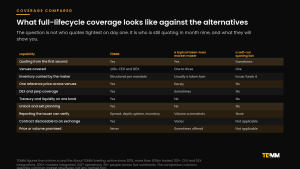
What TDMM does not do is promise a price or a volume number. The data in this article is the reason: quoting quality travels with tradability, and tradability is a precondition for a price rather than a cause of one. Any firm offering more than that is offering something an exchange has said it will blacklist for and a court has already sentenced somebody over.

Frequently asked questions
1. What is market making after a token listing?
Market making after a token listing is the continuous provision of a live bid and a live offer on every venue where the token trades, backed by real inventory, inside an agreed spread and for an agreed share of the trading session. It begins at the first second of trading and its purpose is to make the token tradable in both directions at a fair price, particularly in the weeks after launch attention fades. It is not price support, and it does not involve creating trading volume.
2. When should a project hire a market maker?
Before the listing, and for a period that extends well past it. The contract should be signed and the inventory funded before the first session, because quotes have to be live from the first second. The mandate should run for at least six months, because TDMM’s analysis of 753 listings found median daily volume falling to 23% of day one by day thirty and 9% by day ninety. A three-month mandate signed for launch week expires at the point the liquidity problem actually begins.
3. How much does a crypto market maker cost?
Under a retainer structure, the only public pricing comes from vendors: one December 2025 guide puts monthly fees in three tiers from $3,000 to $5,000 up to $10,000 to $15,000 or more, plus working capital for inventory. Sizing a three-venue mandate at $500,000 of daily volume to top-third depth requires roughly $466,000 of working capital, which at a 5% carry and a $15,000 monthly fee totals about $203,000 for a year. Under a token loan with call options, no cash is paid, but a 1.5%-of-supply loan with three call tranches at 1.25, 1.50 and 2.00 times the reference price is worth about 51% of the loan notional at the 166% volatility a new listing actually shows.
4. What is the difference between the retainer model and the loan plus call option model?
Under a retainer, the issuer lends token and quote currency as working inventory, pays a recurring fee, and gets the full loan back at the end, keeping all the token upside. Under a loan plus call option, the issuer lends a slice of supply and grants call options over it at strikes above the reference price; no fee is paid and the market maker is compensated through the options and trading profit. The loan structure costs nothing if the token falls and a great deal if it rises. On a worked example, above roughly plus 58% at twelve months the call structure costs the treasury more than a $15,000 a month retainer.
5. How volatile is a token immediately after listing?
Very. Across 66 listings with complete hourly data, the median high to low range inside the first hour of trading was 41.2%, falling to 5.7% by hour twenty-four and 3.3% by hour 168. Across 753 listings, the median first full day had a high to low range equal to 94.8% of the closing price. Measured as annualised close-to-close volatility over days eight to ninety-eight, the median across 750 listings was 166%, with a quartile range of 128% to 218%.
6. Do most tokens fall after listing?
Most do. CoinGecko’s Spot CEX Report 2026, updated 9 April 2026, found an average of 32% of new listings positive immediately after listing across the top twelve exchanges, 25% still in the green after thirty to fifty-nine days, and fewer than 10% above their listing price at twelve months on most venues. CryptoRank found 93% of 113 tokens launched between 2024 and 2026 that reached a $100 million market capitalisation trading below their TGE price, with a median return of minus 95.7%, and eight above breakeven. TDMM’s own measurement of 753 listings found 30.4% above the first close at day thirty and 9.7% at day 365.
7. Do memecoins need a market maker?
Yes, and for a narrower reason than a conventional token. A memecoin usually arrives at a centralized exchange with its price already discovered on a launchpad and a decentralized pool, so the first session is less violent: TDMM measured a median day-one range of 68.5% for memecoins against 102.6% for other listings. The problem comes afterwards, when the automated market maker pool and the new order book disagree and the launch crowd disperses. A constant-product pool cannot widen under stress or reference a price elsewhere, which is exactly what is needed at that point.
8. What do exchanges require from a market maker now?
Since 25 March 2026, Binance’s market maker guidelines tell token issuers to report their market maker’s details, legal entity and contract terms to the listing platform promptly and to define the permitted use of tokens in any loan agreement, and prohibit profit-sharing and guaranteed-profit models between an issuer and its market maker. They list six red flags including selling that clashes with release schedules, one-sided trading and volume unbalanced against order book depth, with blacklisting available as a sanction. Beyond disclosure, obligations vary sharply by programme: designated market maker schemes such as BitMEX’s publish a maximum spread, a minimum size per side and a daily uptime threshold, while Binance’s own spot and futures programmes are volume-tiered and discretionary and use spread and depth as scoring inputs rather than binding obligations.
9. Can a market maker increase a token’s price?
No, and any firm that says otherwise is describing something exchanges now sanction and US prosecutors have charged. TDMM tested the question on its own data: listings quoting the tightest spreads were 19.9 percentage points more likely to be trading above their first close at ninety days, with a confidence interval that excludes zero, but sorting the same tokens by order book depth produced a result indistinguishable from chance. Both are associations with survivorship running in both directions. A market maker makes a token tradable, which is a precondition for a price rather than a cause of one.
10. How do you tell a real market maker from a volume seller?
Ask for depth, not volume. Real quoting leaves an order book that an exchange, a price aggregator and a competing trader can all see independently, at any moment, without the market maker’s cooperation. Ask for spread held, depth posted and uptime achieved, per venue, on a cadence you can verify against public data. Ask whether the firm will let you disclose its identity and contract terms to every exchange you list on. Ask, in writing, what it will not do. In October 2024 the US Department of Justice charged four market making firms over wash trading for token issuers; CLS Global was sentenced in April 2025 and Gotbit’s founder was sentenced in June 2025 to eight months in prison with a $23 million forfeiture.
Glossary
Automated market maker (AMM). A smart contract that quotes a price from a formula applied to its own reserves rather than from an order book. It always quotes, but it cannot widen under stress, reference prices on other venues, or decline to trade.
Bonding curve. A pricing formula used by memecoin launchpads in which the token price rises deterministically as supply is bought from the contract. When the curve fills, the accumulated funds typically seed a decentralized exchange pool, which is called graduation.
Book asymmetry. The ratio of notional resting on the ask side to notional resting on the bid side within a given distance of mid. TDMM measured a median 0.77 for listings under thirty days old, meaning the offer side held roughly three quarters of the bid side’s notional.
Call option tranche. One slice of a market maker’s option entitlement under a token loan, struck at a specified multiple of the reference price. A typical structure grants three tranches at rising strikes so the market maker participates progressively in upside.
Depth inside 1% of mid. The total notional value of resting orders within one percent of the midpoint price on one side of the book. It is the standard measure of how much can be traded before the price moves materially, and it is harder to manipulate than the 2% figure most public aggregators display.
Fully diluted valuation (FDV). Total token supply multiplied by the current price, including tokens not yet circulating. The ratio of market capitalisation to FDV measures how much of the supply is actually floating.
Graduation. The point at which a launchpad token fills its bonding curve and migrates to a decentralized exchange pool. CoinGecko found roughly 1% of Pump.fun tokens reached this point, and notes that trading after graduation is not captured in its survival figures.
Inventory. The token and quote currency a market maker holds in order to be able to honour both sides of its quote. It is the largest capital cost in market making and the item most contracts describe least precisely.
Loan plus call model. A market making structure in which the issuer lends tokens and grants the market maker call options over them instead of paying a fee. No cash changes hands at signing, which is why the cost is frequently unmeasured.
Market maker programme. An exchange scheme setting the spread, depth and uptime obligations a designated liquidity provider must meet, usually in exchange for fee rebates. The three obligations are the only meaningful service level in a market making relationship.
Reference price. The single mid price a market maker maintains across every venue on which a token trades, against which all venue quotes are set. Without one, each venue becomes a separate market and the gaps between them are harvested by arbitrageurs at the issuer’s expense.
Retainer model. A market making structure in which the issuer lends inventory, pays a recurring fee for the service and infrastructure, and receives the full loan back at the end of the contract, keeping all token upside.
Slippage. The difference between the midpoint price and the volume-weighted price actually achieved on an order, expressed in basis points. TDMM measured a median 629 basis points to sell $50,000 of a token listed within thirty days, against 78 basis points for a token trading more than two years.
Spread. The distance between the best bid and the best offer, usually expressed in basis points of the midpoint. TDMM measured a median 52.3 basis points for listings under thirty days old.
Token generation event (TGE). The point at which a token is created and distributed, generally coinciding with or shortly preceding the first exchange listing.
Uptime. The proportion of a trading session during which a market maker’s quotes are live and compliant with the agreed spread and depth. It is the obligation most often missing from issuer-side contracts and most often specified in exchange programmes.
Wash trading. Trading between accounts under common control to create the appearance of activity. It produces volume without depth, is treated as a red flag under exchange guidelines, and has been the subject of US criminal charges against market making firms since October 2024, with convictions and sentences following in 2025.
Sources
- TDMM analysis of Gate spot market data, 25 September 2026. Daily candles for 1,462 crypto USDT pairs, of which 784 recorded a first session inside the 1,000-day window and 753 have at least ninety-one sessions.
- TDMM level-2 order book snapshot, Gate spot, 25 September 2026 05:31 UTC. 1,254 books, 1,000 price levels a side.
- TDMM hourly candle analysis, Gate spot, 25 September 2026. 66 listings with a complete first 168 hours.
- TDMM simultaneous level-2 snapshot of Gate, MEXC, KuCoin and OKX public order books, 25 September 2026. 45 listings under 400 days old quoted on more than one venue.
- TDMM volatility measurement, 750 listings, annualised close-to-close over days eight to ninety-eight after the first session.
- CoinGecko, Spot CEX Report 2026, updated 9 April 2026. New listings on major centralized exchanges since 1 January 2025; price performance across the top twelve venues at 0 to 29, 30 to 59 and 300 to 329 days.
- CoinGecko Research, The Average Lifespan of Pump.fun Memecoins Is Less Than a Day, updated 23 June 2026. 18.67 million tokens created 14 January 2024 to 18 June 2026. CoinGecko notes that post-graduation activity on external decentralized exchanges is not captured, so the 90-day cohort understates true lifespan.
- CoinGecko meme-token category, 750 assets, retrieved 25 September 2026.
- CryptoRank, 93% of Recent Crypto Tokens Trade Below Launch Price, 21 July 2026. 113 tokens launched 2024 to 2026 reaching a $100 million market capitalisation; eight above breakeven, of which four are named.
- Binance, Market Maker Red Flags and Guidelines for Crypto, Binance blog, 25 March 2026; and CoinDesk, Binance tightens market maker rules, tells token issuers they must disclose partners, 25 March 2026.
- United States Department of Justice, District of Massachusetts, Eighteen Individuals and Entities Charged in International Operation Targeting Widespread Cryptocurrency Market Manipulation, 9 October 2024.
- United States Department of Justice, District of Massachusetts, sentencing release for CLS Global FZC LLC, 2 April 2025; and sentencing release for Gotbit and its founder, 13 June 2025.
- United States Attorney’s Office, Northern District of California, Ten Foreign Nationals Charged in International Operation Targeting Cryptocurrency Market Manipulation, 30 March 2026; reported by CoinDesk, 2 April 2026.
- Binance Research, Low Float and High FDV: How Did We Get Here?, May 2024. Market capitalisation to FDV ratio of 12.3% for the 2024 launch cohort; an illustrative sample showing circulating supplies of 6% to 20%; and a Token Unlocks estimate, cited by Binance Research, of approximately $155 billion of scheduled unlocks 2024 to 2030.
- Keyrock, Airdrops in the Barren Desert, 25 September 2024, updated 8 July 2025. 62 airdrops across six networks.
- Flowdesk, Crypto Market Making Models: Retainer vs Loan/Call Explained, structural description of the two contract types.
- OpenLiquid, CEX Market Making Cost: What to Expect in 2026, published 21 December 2025. Vendor-published fee tiers, minimum depth per side and recommended capital. Not independently corroborated; no exchange primary source publishes comparable thresholds.
- Exchange market maker programme terms: BitMEX Market Maker Programme; Aster market maker requirements; Bitstamp Spot Designated Market Maker Programme; Binance Futures Market Maker Program; Binance.US Market Maker Program; KuCoin Market Maker Program. All as published and accessible on 25 September 2026.
- TDMM, About TDMM, and tdmm.io, for company figures.
Disclaimer
This article is published by TDMM (TradeDog Market Maker) for information and education. It is not investment advice, legal advice, tax advice or an offer of any service, and it is not a recommendation to buy, sell or hold any digital asset. TDMM is not a registered investment adviser, broker-dealer or asset manager, and nothing here should be read as a promise or projection regarding the price, volume or liquidity of any token.
All TDMM figures are measurements of public market data taken on the dates stated, drawn from a single venue unless otherwise noted, and are historical. They describe what happened to a specific set of listings over a specific window and carry no implication about what will happen to any other token. The order book figures are single-instant snapshots and change continuously. Associations reported between order book characteristics and price outcomes are associations only; no causal relationship is established or implied, and survivorship affects the cohorts in both directions.
The market making cost examples are illustrative arithmetic on stated assumptions, produced to show a method. They are not a quote, a price list or an indication of terms, and the option valuations use a Black-Scholes model whose assumptions do not hold exactly for digital assets. Third-party figures are reproduced as published by their sources on the dates given and have not been independently audited by TDMM. Exchange rules, listing requirements and regulatory positions described here change frequently and should be checked against the relevant venue’s current rule book and qualified professional advice before any decision is taken.
Digital assets are volatile and you may lose the entire value of a position. Legal charges referenced in this article are allegations unless a conviction or sentence is stated.
Published by TDMM (TradeDog Market Maker) · Reading time: 34 minutes · Last updated: September 2026 · Written by: Vaibhav Singh