

The short answer
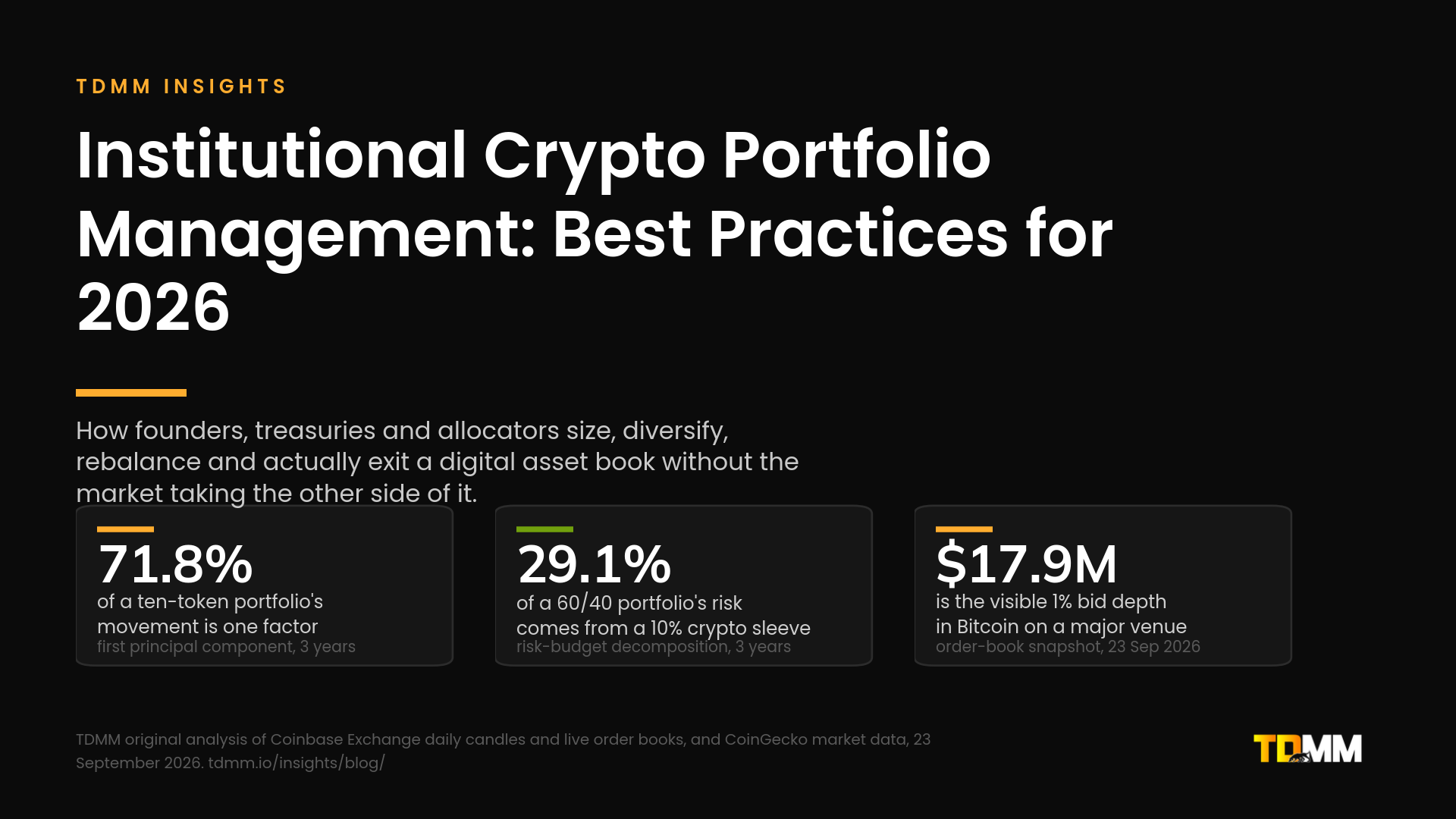
Institutional crypto portfolio management is the discipline of sizing, housing, rebalancing and exiting a digital asset book against measured risk rather than conviction. The best practices for managing institutional crypto portfolios in 2026 come down to five rules: size the position by its contribution to total portfolio risk, not by its weight; cap each holding against real order book depth; hold the core with a qualified custodian; rebalance on a published schedule; and plan the exit before you need it. Everything else is detail.
Key takeaways
- A single factor explains 82.0% of the movement of ten large tokens over the past year. Adding tokens adds volatility, not diversification.
- A 5% Bitcoin sleeve contributes 12.4% of a 60/40 portfolio’s risk. A 10% sleeve contributes 29.1%. Weight and risk are not the same number.
- Altcoins carry more downside beta to Bitcoin than upside beta. Chainlink’s beta was 0.88 on days Bitcoin rose and 1.37 on days it fell.
- A $50 million position in Avalanche is 80.8 times the entire visible 1% bid depth on a major venue. Market capitalisation tells you nothing about whether you can get out.
- Every rebalancing rule we tested beat buy and hold on risk-adjusted return over three and five years. Annual rebalancing won at the lowest turnover.
- 73% of the 351 institutions surveyed by EY-Parthenon and Coinbase in January 2026 plan to increase their crypto allocation, and 49% have tightened risk management, liquidity and position sizing.
- 91.3% of crypto market value sits in ten assets. The other 21,347 tokens are 1.1%.
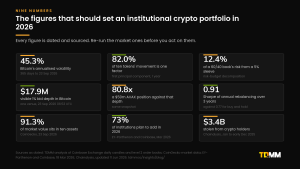
The figures that should set an institutional crypto portfolio in 2026
What is institutional crypto portfolio management?
Institutional crypto portfolio management is the set of processes by which a fund, a corporate treasury, a token project or a family office decides what digital assets to hold, how much of each, where they are held, when the position is adjusted and how it will eventually be converted back into cash. It differs from retail investing in one respect that changes everything downstream: size. A retail holder can sell at the screen price. An institution cannot, and the gap between the screen price and the achievable price is the single largest hidden cost in the asset class.
That difference explains why the same allocation decision produces different answers at different scales. A $50,000 position in Cardano is a click. A $50 million position in Cardano is 68.7 times the entire visible bid depth within 1% of the mid price on a major venue, which means the exit has to be planned as carefully as the entry. Crypto asset management best practices are, in large part, the practices that keep that gap from surprising you.
The discipline has four parts. Construction decides what is in the book and in what proportion. Custody decides where it physically sits and who can move it. Operation covers rebalancing, yield, execution and reporting. Governance covers who signs off, against what written policy, and how often the whole thing is reviewed. Most institutions that get into trouble have done the first part well and the other three badly.
Why 2026 is different from every earlier crypto cycle
Three things have changed since the last time this question was asked seriously.
The first is the regulatory and accounting surface. FASB’s ASU 2023-08, issued in December 2023 and effective for fiscal years beginning after 15 December 2024, moved crypto assets to fair value through net income, ending the impairment-only treatment that made corporate holdings punitive to report. The SEC approved generic listing standards for Commodity-Based Trust Shares on 17 September 2025, removing the requirement for a separate rule filing per product. On 2 April 2026 the OCC granted conditional approval for Coinbase to charter Coinbase National Trust Company, a non-insured national trust company for digital asset custody, though the charter is not yet final and the entity is not yet operating under it. None of this removes volatility. All of it changes who is permitted to hold the asset and how it appears in the accounts, which is what unlocks institutional size.
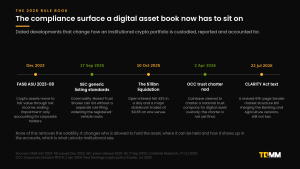
The compliance surface a digital asset book now has to sit on
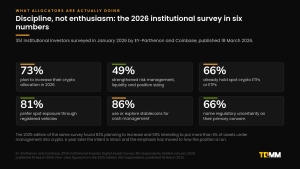
The second is participation. In the EY-Parthenon and Coinbase survey of 351 institutional investors fielded in January 2026 and published on 18 March, 73% said they plan to increase their crypto allocation, 66% already hold spot crypto ETFs or ETPs and 81% prefer to take spot exposure through registered vehicles. The prior year’s edition found 83% planning to increase and 59% intending to put more than 5% of assets under management into digital assets. A separate Nomura and Laser Digital survey of 518 Japanese investment professionals, released on 16 April 2026, found 65% describing crypto as a portfolio diversifier, and 60% of those planning to invest expecting to allocate between 2% and under 5%.
The third, and the one that gets least attention, is that the market has now demonstrated what happens to a leveraged, thinly supported book under stress. On 10 October 2025, roughly $19 billion of leveraged positions were liquidated within 24 hours. Open interest fell from $217 billion to $123 billion, a 43% contraction in a day, and one large stablecoin traded at $0.65 on a single venue while trading near par elsewhere. Across CoinDesk Data’s tracked universe the average decline was about 47%. That event is the reference case for every liquidity assumption in this article.
Discipline, not enthusiasm: the 2026 institutional survey in six numbers
What the 2026 survey shows underneath the headline is a change of emphasis rather than a change of direction. Nearly half of respondents, 49%, said they had strengthened their emphasis on risk management, liquidity and position sizing in response to volatility. That is the sentence that matters. The argument has moved from whether to hold digital assets to how to run the position once you do.
What does the data actually say about diversified crypto portfolio strategies for 2026?
The most common construction error in crypto is treating a list of tickers as a portfolio. It is worth looking at what the numbers say.
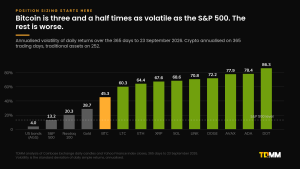
We took daily closes for ten large assets from Coinbase Exchange and measured them over the year to 23 September 2026. Bitcoin’s annualised volatility was 45.3%. Ethereum was 64.4%, Solana 68.6%, Chainlink 70.8%, Cardano 78.4% and Polkadot 86.3%. Over the same window the S&P 500 ran at 13.2%, gold at 28.7% and the US aggregate bond index at 4.0%. Bitcoin is the least volatile major crypto asset, and it is roughly three and a half times as volatile as the equity index most portfolios are benchmarked against.
Bitcoin is three and a half times as volatile as the S&P 500
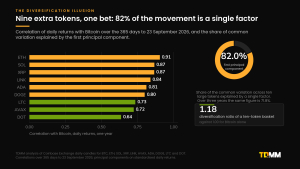
The volatility is the visible part. The correlation is the part that decides whether a basket is a portfolio. Over the year to 23 September 2026, Ethereum’s correlation with Bitcoin was 0.905. Solana was 0.867, XRP 0.866, Chainlink 0.840, Cardano 0.812, Dogecoin 0.800. Even Polkadot, the least correlated of the ten, sat at 0.636.
Nine extra tokens, one bet: 82% of the movement is a single factor
Run a principal component analysis on those ten assets and the picture sharpens. The first principal component explains 82.0% of the common variation over the past year and 71.8% over the past three. In plain terms: eight tenths of what happens to a ten-token portfolio is one thing happening, repeatedly, to all ten positions at once.
The diversification ratio makes the cost explicit. An equal-weight basket of all ten assets had a three-year annualised volatility of 66.6% against 47.3% for Bitcoin alone, and a diversification ratio of 1.18. The investor gave up nineteen points of volatility to buy an 18% diversification benefit. A 70/30 Bitcoin and Ethereum book ran at 50.8% volatility with a ratio of 1.05. Neither is diversification in the sense a multi-asset allocator would recognise. Both are a single factor bet with different amounts of leverage on it.
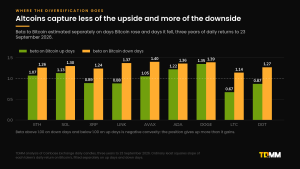
It gets worse in the moments diversification is supposed to help. We fitted each altcoin’s daily return against Bitcoin’s separately on days Bitcoin rose and days it fell, over three years. Almost every asset showed a higher beta on the way down than on the way up. Chainlink was 0.88 up and 1.37 down. XRP was 0.89 up and 1.24 down. Litecoin was 0.67 up and 1.14 down. Polkadot was 0.87 up and 1.27 down.
Altcoins capture less of the upside and more of the downside
That shape has a name in options language: negative convexity. The position gives up more than it gains. On the worst 5% of Bitcoin days over the past three years, 55 sessions in which Bitcoin fell 3.64% or more, Bitcoin’s average fall was 5.22% and the average altcoin fall ranged from 6.01% to 7.65%. The tokens that were held for diversification amplified the loss.
There is a structural reason. 91.3% of total crypto market value sits in the top ten assets, and 58.9% of it is Bitcoin alone. Ethereum is another 11.4%. Ranks 11 to 20 are 3.8%, ranks 21 to 50 are 3.7%, and the remaining 21,347 tracked tokens are 1.1% between them. Two of the top ten are stablecoins, so the investable risk universe is narrower than the headline suggests.
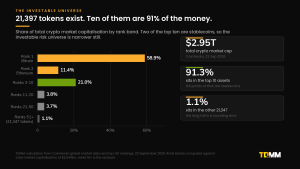
21,397 tokens exist. Ten of them are 91% of the money.
The practical conclusion for diversified crypto portfolio strategies for 2026 is uncomfortable but useful. Diversification inside crypto is weak and unreliable. Diversification of crypto against other asset classes is real: over the year to 23 September 2026 Bitcoin’s correlation with the S&P 500 was 0.46, with gold 0.28 and with the aggregate bond index 0.05. Fidelity Digital Assets reached the same qualitative conclusion in research published on 25 March 2026, describing Bitcoin’s long-term correlation with major asset classes as positive but low. The diversification benefit lives at the boundary between crypto and the rest of the portfolio, not inside the crypto sleeve. Build accordingly: concentrate the crypto sleeve and size it properly, rather than spreading it thin across tokens that move together.
How to build a balanced portfolio: the four-bucket framework
A balanced digital asset book is not a percentage split. It is a set of buckets, each with a job, a horizon, a liquidity requirement and a named owner. TDMM uses four.
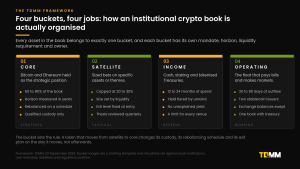
Four buckets, four jobs: how an institutional crypto book is actually organised
Core. Bitcoin and Ethereum held as the strategic position, typically 60% to 80% of the crypto book. Horizon measured in years. Rebalanced on a published schedule. Held with a qualified custodian, never on an exchange. The core is where the risk budget is spent, which means it should be the part of the book that is sized most carefully and traded least.
Satellite. Sized bets on specific assets or themes, capped at 20% to 30% of the book in total. Each position is capped by liquidity rather than by conviction, carries a written exit level fixed at entry, and is reviewed quarterly against the thesis that justified it. The satellite bucket is where most of the diversification illusion lives, so the cap is on the bucket as a whole, not just on each name inside it.
Income. Cash equivalents, staking positions and tokenised Treasury instruments, sized to cover 12 to 24 months of spend. Yield is tiered by how quickly the position can be unwound, not by headline rate. Any yield that cannot be explained in one sentence, including where it comes from and who is on the other side, does not go in the bucket.
Operating. The float that pays bills and supports execution, sized to 30 to 90 days of outflow. Stablecoin exposure split across at least two issuers. Exchange balances swept daily to custody. Treasury and liquidity run on one book, because a treasury that does not know what the trading desk is holding will eventually sell into its own bid.
The rule that makes the framework work is that each asset belongs to exactly one bucket, and moving between buckets changes the rules that apply to it on the day it moves. A token promoted from satellite to core changes its custody arrangement, its rebalancing schedule and its exit plan at the moment of promotion, not at the next review.
For founders and token treasuries there is a fifth consideration that sits across all four buckets: the project’s own token is not a portfolio asset. It is inventory. It is highly correlated with the rest of the crypto book, it is the one asset the market knows you hold, and its unlock schedule is public. It should be measured, hedged and released under a written plan, which is a separate discipline from allocation. We covered the mechanics in how to manage a token exit strategy professionally and in crypto treasury management best practices.
How much crypto should an institutional portfolio actually hold?
This is where the single most useful idea in institutional crypto portfolio management lives, and it is borrowed from multi-asset investing rather than invented by the crypto industry: size the position by how much risk it contributes, not by how much capital it occupies.
We ran the decomposition on current data. Taking a 60/40 portfolio of the S&P 500 and the US aggregate bond index over the three years to 23 September 2026, and carving a Bitcoin sleeve out of it pro rata, the numbers come out as follows. The 60/40 itself ran at 9.71% annualised volatility. Bitcoin ran at 48.1%, with a 0.36 correlation to equities and essentially zero to bonds.
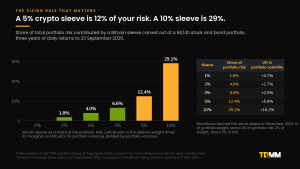
A 5% crypto sleeve is 12% of your risk. A 10% sleeve is 29%.
A 1% sleeve contributes 1.8% of total portfolio risk. A 2% sleeve contributes 4.0%. A 3% sleeve contributes 6.6%. A 5% sleeve contributes 12.4%. A 10% sleeve contributes 29.1% and lifts total portfolio volatility by 16.2%.
The shape of that result matches what BlackRock published on 11 December 2024, when it described a 1% to 2% allocation as a reasonable range for a multi-asset portfolio and noted that 1% of weight contributed roughly 2% of portfolio risk while 2% of weight contributed about 5%, against roughly 4% for an average Magnificent 7 stock. Two independent calculations, two years apart, on different data, produce the same relationship. That is about as close to a stable rule as this asset class offers.
The reward side of the trade looked like this over the same windows.
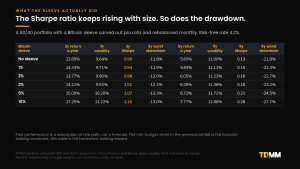
The Sharpe ratio keeps rising with size. So does the drawdown.
Over three years, a 60/40 with no sleeve returned 12.89% a year at 9.64% volatility for a Sharpe ratio of 0.90 against a 4.2% risk-free rate. A 3% sleeve returned 14.21% at 9.92% for a Sharpe of 1.01. A 10% sleeve returned 17.25% at 11.22% for a Sharpe of 1.16, with the worst drawdown widening from 11.8% to 13.0%. Over five years the same ladder ran from a Sharpe of 0.13 with no sleeve to 0.28 at 10%, with the worst drawdown widening from 21.9% to 27.7%.
Fidelity Digital Assets found a similar gradient in research published on 25 March 2026, reporting that across a ten-year period “the most significant improvement in Sharpe and Sortino ratios occurred when moving from a 1% to a 3% allocation” in a 60/40 portfolio.
Read those two exhibits together and the sizing decision resolves. The Sharpe ratio table is backward-looking and describes one path that happened to include a large Bitcoin appreciation. The risk contribution table is forward-looking and holds regardless of what Bitcoin does next. Size on the second and let the first be a pleasant surprise. In practice that puts most institutional books in a 1% to 5% band, with the top of the range reserved for those who can state, in writing, that they are comfortable with a tenth or more of total portfolio risk coming from one position.
Three adjustments are worth making to the headline number. Liability-matched investors with near-term obligations should sit at the bottom of the band or outside it. Investors whose existing book already carries high-beta technology exposure are more correlated to crypto than the headline figure suggests and should adjust down. And anyone whose crypto position is a founder holding in their own project already has a concentration far beyond any of this, and should be thinking about reduction rather than allocation.
How do you size a position against liquidity rather than market capitalisation?
Market capitalisation is a multiplication, not a promise. It tells you what the supply would be worth if every unit could be sold at the last price, which is the one thing that is certainly not true. The number that matters is depth.
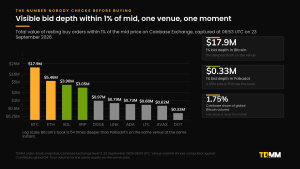
On 23 September 2026 at 06:53 UTC we took a level 2 order book snapshot from Coinbase Exchange for ten large assets and measured the total value of resting buy orders within 1% of the mid price.
Visible bid depth within 1% of mid, one venue, one moment
Bitcoin’s 1% bid depth was $17.88 million. Ethereum’s was $5.46 million, Solana’s $3.90 million, XRP’s $3.05 million. Dogecoin was under a million dollars at $0.97 million, Chainlink $0.79 million, Cardano $0.73 million, Litecoin $0.68 million, Avalanche $0.62 million and Polkadot $0.33 million. Bitcoin’s book was 54 times deeper than Polkadot’s on the same venue at the same instant.
Two caveats matter and both cut the same way. This is one venue, and Coinbase accounted for 1.75% of global Bitcoin volume and 5.30% of global Chainlink volume on that date, so the all-venue figure is a multiple of these. And it is one instant, taken in calm conditions. On 10 October 2025 the depth across the market thinned faster than positions could be reduced, which is how $19 billion of liquidations happened in a day. The ranking is the durable finding, not the level.
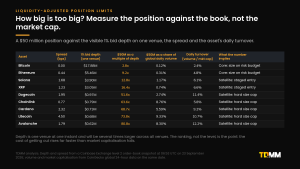
Turn the depth figures into a position limit and the discipline becomes concrete.
How big is too big? Measure the position against the book, not the market cap.
A $50 million position is 2.8 times Bitcoin’s visible 1% bid depth. It is 9.2 times Ethereum’s, 12.8 times Solana’s, 16.4 times XRP’s. It is 51.6 times Dogecoin’s, 63.6 times Chainlink’s, 68.7 times Cardano’s, 73.8 times Litecoin’s and 80.8 times Avalanche’s. Expressed against global daily volume the same position is 0.12% of Bitcoin’s turnover and 9.33% of Litecoin’s, which is to say it is a rounding error in one and a day’s work in the other.
The working rule TDMM uses with clients has three parts.
Set a participation cap first. Decide what share of an asset’s daily volume you are willing to be, typically 5% to 10% for an institutional order that needs to stay quiet. That cap, divided into the position, gives the number of days the exit takes.
Set a maximum exit horizon second. Twenty trading days is a reasonable ceiling for a satellite holding, because a position that takes a quarter to liquidate is not a position, it is a commitment.
Derive the position limit third. Participation cap multiplied by daily volume multiplied by the maximum horizon gives the largest holding you should take. At a 10% cap and a twenty-day horizon, that is two days of volume. Anything larger requires a plan that includes over-the-counter blocks, a hedge or a structured release, and that plan should exist before the position is opened, not after.
This is where the relationship between portfolio management and market making stops being theoretical. The depth an institution can rely on is not a fixed property of the asset; it depends on who is quoting it and how consistently. A token with a committed two-sided quote across its main venues has a materially different exit profile from one without, which is why cross exchange market making belongs in a portfolio conversation rather than only an operations one.
How often should an institutional crypto portfolio be rebalanced?
Rebalancing is where crypto’s volatility, usually a liability, turns into something useful. High volatility and imperfect correlation mean weights drift a long way from target between reviews, and mechanically selling what has run and buying what has lagged harvests that drift.
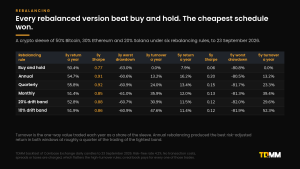
We tested it. A crypto sleeve of 50% Bitcoin, 30% Ethereum and 20% Solana, under six rebalancing rules, measured over three and five years to 23 September 2026.
Every rebalanced version beat buy and hold. The cheapest schedule won.
Over three years, buy and hold returned 50.4% a year with a Sharpe ratio of 0.77 and a worst drawdown of 63.0%. Annual rebalancing returned 54.7% with a Sharpe of 0.91 and 13.2% annual turnover. Quarterly returned 55.8% with a Sharpe of 0.92 at 24.0% turnover. Monthly returned 51.4% at 0.85 and 35.9% turnover. A 20% drift band returned 52.8% at 0.88, and a 10% drift band 51.9% at 0.86 with 47.6% turnover.
Over five years the gap widened. Buy and hold returned 7.9% a year with a Sharpe of 0.06. Annual rebalancing returned 16.2% with a Sharpe of 0.20. Every other rule landed between 11.4% and 13.4%.
Three conclusions follow, and the third is the one most often missed.
Every rebalanced version beat buy and hold on risk-adjusted return in both windows. The discipline, not the frequency, is what pays. Annual rebalancing produced the best result over five years and close to the best over three, at roughly a quarter of the turnover of the tightest drift band. And these figures charge no transaction costs, no spreads and no taxes, which flatters the high-turnover rules considerably. A real book pays for every one of those trades, and at 47.6% annual turnover on a thin altcoin sleeve, the execution cost can exceed the rebalancing benefit outright.
The best practice is therefore: rebalance on a published schedule, choose the least frequent schedule your governance will tolerate, use a drift band only as a secondary trigger for extreme moves, and execute with a participation cap rather than at market. For a book of any size the execution method matters more than the calendar. Selling 20% of a satellite position into a thin book on the last day of the quarter because a policy document said so is a worse outcome than the drift you were correcting.
Crypto asset management best practices: where the assets actually sit
Construction gets the attention. Custody is what determines whether the portfolio still exists in five years.
Chainalysis reported more than $3.4 billion stolen between January and early December 2025. Of that, $713 million came from personal wallets across roughly 158,000 separate incidents affecting at least 80,000 victims, and the three largest service compromises accounted for 69% of all service losses. The single largest, the Bybit exploit in February 2025, was about $1.5 billion.

Where the assets sit is a portfolio decision, not an operations detail
There are four places a digital asset can sit and each has a distinct job.
Qualified custodian. For core long-term holdings. The policy needs to specify segregation, bankruptcy remoteness, audit standard and the insurance limit. Read that limit against your own position rather than against the custodian’s total book, because a $500 million policy shared across $200 billion of client assets is not a $500 million policy for you. The OCC’s conditional approval of a national trust charter for Coinbase National Trust Company on 2 April 2026 points to a federally chartered option in a market that has mostly been state-chartered, though that charter is not yet final.
Self-custody with multi-signature. For treasury reserves the institution wants under its own control. The policy needs a quorum rule, geographically separated key material, signer rotation on staff changes and a recovery procedure that has actually been tested rather than documented. The $713 million taken from personal wallets in 2025 is the cost of the untested version.
Exchange balances. Working float for execution only, never a custody venue. Per-venue caps, daily sweeps to custody, withdrawal allowlists and sub-account segregation. Size the balance to days of trading, not months of holding.
Registered vehicles. Spot ETFs and ETPs for institutions that want regulated exposure without key management, now held by 66% of surveyed institutions. The risks move rather than disappear: custodian concentration, tracking difference and creation and redemption mechanics replace key management risk.
Counterparty risk deserves its own line in the policy. During the October 2025 dislocation one large stablecoin printed $0.65 on a single venue while trading near par elsewhere. An institution holding operating cash in a single stablecoin on a single venue took a real loss on what its policy described as cash. Two issuers minimum, per-venue limits and daily sweeps are cheap insurance against a scenario the market has already run once.
Managing digital assets: long-term wealth solutions and the yield question
The question that follows allocation is what the position does while it waits. For a multi-year holder this is where a large part of the total return is decided, and where a large part of the tail risk enters the book.
Structure yield as a ladder, tiered by how fast the position can be unwound rather than by headline rate.
Tier one: immediate. Cash and major stablecoins held with the operating float. No yield expected. The job is availability. Stablecoin supply across the fifty largest tokens in CoinGecko’s stablecoin category stood at $306.1 billion on 23 September 2026, with $183.4 billion in Tether and $75.2 billion in USDC. Other trackers put the all-issuer total nearer $310 billion. Either way, concentration at the issuer level is itself a risk to be split.
Tier two: days. Tokenised Treasury instruments and regulated money-market equivalents. Redemption in days, yield tracking short-term government rates, counterparty being the issuer and its custodian rather than an anonymous protocol. For a treasury holding 12 to 24 months of spend, this is where most of the income bucket belongs.
Tier three: weeks. Protocol staking on major networks. Yield is protocol-native rather than credit-based, which is a different and generally better risk, but unbonding periods matter and should be written into the liquidity plan. A staked position is not a liquid position during its unbonding window.
Tier four: everything else. Lending, structured products, liquidity provision, anything offering a rate materially above the others. This tier gets a hard cap, a named counterparty, and a one-sentence explanation of where the yield comes from and who is paying it. If that sentence cannot be written, the position does not get opened.
The long-term wealth argument for digital assets rests on two properties that the data supports: a low correlation to the rest of a multi-asset portfolio, and a return distribution with a long right tail. It does not rest on the idea that drawdowns are survivable by default. They are survivable if the position is sized so that the institution is not forced to sell into one.
The long tail does not come back: drawdown from the all-time high
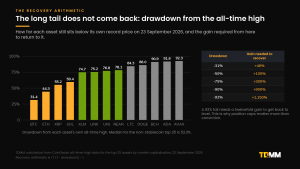
That point is worth making with the recovery arithmetic. On 23 September 2026, Bitcoin sat 31.4% below its all-time high and Ethereum 44.3%. Chainlink was 75.2% below, Litecoin 84.3%, Dogecoin 86.0%, Bitcoin Cash 90.9%, Cardano 91.6% and Avalanche 92.3%. The median for the non-stablecoin top 25 was 52.3%. A 50% fall needs a 100% gain to recover. A 90% fall needs 900%. A 92% fall needs roughly a twelvefold gain. Position caps are not timidity; they are the mechanism that keeps a satellite position from becoming a permanent hole in the book.
What does an exit look like before you need one?
Every holding is eventually sold, by choice or by circumstance. The institutions that do this well decide the mechanics while nothing is going wrong.
Four questions belong in the policy for each position.
At what participation rate will we sell? Expressed as a share of daily volume, with a hard ceiling. This converts directly into an exit horizon using the depth data above.
What is the maximum acceptable horizon? If the honest answer for a given position is longer than a quarter, the position is oversized and should be reduced while nothing is forcing the issue.
Which venues, and in what order? A position built on one venue and exited across five behaves differently from one traded on a single book. Cross-venue execution on a single reference price is a capability, not a default.
What gets disclosed, and when? For token projects with public unlock schedules, the market prices the exit before it happens. A dated, disclosed reduction is consistently received better than a hidden one.
For allocators, the exit question is mostly about size against depth. For founders and token treasuries it is a governance question as much as an execution one, and the evidence on unlocks is worth reading in full in our token exit strategy article.
The risk register: six things that decide whether a book survives
Every risk below has been priced by the market at least once. The control column is what a policy document should say about it.
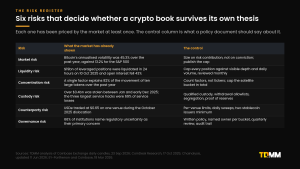
Six risks that decide whether a crypto book survives its own thesis
Market risk. Bitcoin’s annualised volatility was 45.3% over the past year against 13.2% for the S&P 500. Control: size on risk contribution rather than conviction, and publish the cap so it cannot be quietly revised upward during a rally.
Liquidity risk. $19 billion of leveraged positions were liquidated in 24 hours on 10 October 2025 and open interest fell 43%. Control: cap every position against visible depth and daily volume, and review the caps monthly, because depth changes.
Concentration risk. A single factor explains 82.0% of the movement of ten large tokens over the past year. Control: count factors, not tickers, and cap the satellite bucket in aggregate rather than name by name.
Custody risk. More than $3.4 billion was stolen between January and early December 2025, with the three largest service hacks accounting for 69% of service losses. Control: qualified custody for the core, withdrawal allowlists, segregation and proof of reserves where available.
Counterparty risk. A large stablecoin traded at $0.65 on one venue during the October 2025 dislocation. Control: per-venue limits, daily sweeps and a minimum of two stablecoin issuers.
Governance risk. 66% of institutions name regulatory uncertainty as their primary concern. Control: a written policy, a named owner per bucket, a quarterly review and an audit trail that survives staff turnover.
The first ninety days
Most institutions reading this already hold digital assets. The question is not whether to start but how to get from an undocumented position to a governed book. Ninety days is enough.

From an undocumented position to a governed book in three months
Days 1 to 15, measure. List every asset, every venue and every wallet, including the ones nobody has looked at in a year. Price the book against real depth rather than last price. Compute the factor exposure rather than counting tickers, because a ten-name book with one factor is a one-name book.
Days 16 to 30, budget. Set the risk contribution cap rather than a weight cap. Assign every holding to exactly one bucket. Write the per-asset liquidity limit using the participation and horizon method above.
Days 31 to 50, rehouse. Move core holdings to qualified custody. Cap exchange balances and sweep them daily. Split key material geographically and test the recovery procedure rather than documenting it.
Days 51 to 70, schedule. Publish the rebalancing rule and commit to it. Set the yield tier ladder with its unwind times written next to each tier. Agree the execution policy, including the participation cap that governs every trade.
Days 71 to 90, govern. Sign off the written policy with a named owner per bucket. Stand up reporting and the audit trail. Run the first quarterly review against the plan rather than against performance.
Nothing in that sequence requires a view on price. It is the order in which a position becomes a portfolio: measured, budgeted, rehoused, scheduled, governed.
Common mistakes in institutional crypto portfolio management
Confusing weight with risk. A 10% sleeve sounds modest and contributes 29.1% of portfolio risk. Size on the second number.
Diversifying into correlation. Ten tokens that share 82% of their variation are one position with extra execution costs and extra custody surface.
Using market capitalisation as a liquidity proxy. The two are unrelated at institutional size. A $9.7 billion market cap token had $0.73 million of visible 1% bid depth on a major venue on 23 September 2026.
Holding the core on an exchange. Exchange balances are working float. The convenience is real and so is the counterparty exposure.
Chasing a yield you cannot explain. If the source of the rate and the identity of the payer cannot be stated in one sentence, the position is a credit exposure wearing a yield label.
Rebalancing at market. The rebalancing benefit is real and modest. Execution cost on a thin book can exceed it outright.
Treating the exit as a future problem. The exit plan is part of the entry decision. Writing it afterwards means writing it under pressure.
Running treasury and trading as separate books. A treasury that does not know what the desk is holding will eventually compete with it.
How TDMM supports institutional crypto portfolio management
TDMM is a market maker and liquidity desk, not an asset manager. We do not pick allocations or manage discretionary mandates. What we provide is the operating layer that sits underneath a portfolio decision and determines whether it can actually be implemented: the depth data that sets position limits, the two-sided quoting that keeps a market tradable while the book changes, and the execution that turns a rebalancing rule into a filled order rather than a market impact event.
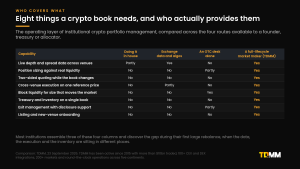
Eight things a crypto book needs, and who actually provides them
In practice that covers eight capabilities.
Live depth and spread across venues, so position limits are set against the book that exists rather than a market cap figure. The order book analysis in this article is the kind of measurement we run continuously across more than 100 CEX and DEX integrations and 200+ markets.
Position sizing against real liquidity, converting participation caps and exit horizons into a maximum holding per asset, reviewed as depth changes.
Two-sided quoting while the book changes, which is the part an institution cannot do for itself. A portfolio that is rebalancing is, for that period, a consistent one-way flow. Keeping a market two-sided while that flow works through is the difference between a rebalance and a price event.
Cross-venue execution on one reference price, so a position built across several venues is reduced against a single view of the market rather than five separate ones.
Block liquidity for size that moves the market, through over-the-counter arrangements for the portion of a position that visible depth cannot absorb.
Treasury and inventory on a single book, so an institution’s reserves and its trading inventory are never unknowingly on opposite sides of the same trade.
Exit management with disclosure support, covering execution, blocks, hedging, structuring and the disclosure calendar on one book, with the market kept two-sided while the position reduces.
Listing and new-venue onboarding, for token treasuries that need depth in places they do not yet trade.
TDMM has been active since 2015, has traded more than $10 billion, runs operations around the clock across five continents with a team of over 30, and integrates with more than 100 centralised and decentralised venues. Our commitment is to tradability, transparency and full lifecycle support. We do not promise price support or volume, because neither is something an honest market maker can promise. What we do provide is a market that stays two-sided and consistent across venues while an institutional book is built, rebalanced or reduced.
For founders, investors and treasuries looking for a partner on crypto asset management and the best practices for managing institutional crypto portfolios, that operating layer is the part that is hardest to build in house and the part that decides whether a good allocation decision survives contact with the market.
Frequently asked questions
1. What is institutional crypto portfolio management?
Institutional crypto portfolio management is the discipline of constructing, custodying, operating and governing a digital asset book at a size where execution affects price. It covers position sizing against measured risk, custody arrangements, rebalancing schedules, yield policy, liquidity limits and exit planning. It differs from retail crypto investing because an institution cannot assume it will transact at the screen price, so liquidity constraints shape every decision from allocation through to exit.
2. What are the best practices for managing institutional crypto portfolios?
Five practices cover most of the value. Size positions by their contribution to total portfolio risk rather than by weight, because a 5% Bitcoin sleeve contributes about 12% of a 60/40 portfolio’s risk. Cap each holding against real order book depth and daily volume rather than market capitalisation. Hold core positions with a qualified custodian and treat exchange balances as working float only. Rebalance on a published schedule, executed with a participation cap. And write the exit plan, including venues and participation rate, before the position is opened.
3. How much of an institutional portfolio should be in crypto?
Most institutional allocations sit between 1% and 5%. The reason is the risk contribution: a 1% Bitcoin sleeve in a 60/40 portfolio contributes about 1.8% of total portfolio risk, a 5% sleeve about 12.4% and a 10% sleeve about 29.1%, measured over the three years to 23 September 2026. BlackRock described 1% to 2% as a reasonable range in December 2024 on the same reasoning. The right figure for any institution depends on its liabilities, its existing high-beta exposure and what share of total risk it is willing to attribute to one position.
4. Is a diversified crypto portfolio actually diversified?
Usually not in the way the holder expects. Over the year to 23 September 2026, the first principal component explained 82.0% of the common variation across ten large tokens, and correlations with Bitcoin ranged from 0.636 to 0.905. An equal-weight ten-token basket had a three-year volatility of 66.6% against 47.3% for Bitcoin alone, for a diversification ratio of only 1.18. Diversification against other asset classes is real, with Bitcoin correlating 0.46 to the S&P 500 and 0.05 to bonds over the same year, but diversification inside the crypto sleeve is weak.
5. How do you build a balanced crypto portfolio?
Use buckets rather than percentages. A core of Bitcoin and Ethereum at 60% to 80% of the crypto book, held in qualified custody with a published rebalancing schedule. A satellite bucket capped at 20% to 30% in aggregate, with each position limited by liquidity and carrying a written exit level. An income bucket of cash equivalents, tokenised Treasuries and staking covering 12 to 24 months of spend, tiered by unwind time. An operating bucket of 30 to 90 days of outflow across at least two stablecoin issuers. Each asset belongs to exactly one bucket, and moving between buckets changes the rules that apply on the day it moves.
6. How often should a crypto portfolio be rebalanced?
Less often than most people assume. In a TDMM backtest of a 50/30/20 Bitcoin, Ethereum and Solana sleeve, every rebalancing rule beat buy and hold on risk-adjusted return over three and five years, but annual rebalancing produced the best five-year Sharpe ratio at 0.20 with only 13.2% annual turnover, against 0.06 for buy and hold. The tightest drift band tested, 10%, required 52.3% annual turnover for a worse result. Since the backtest charges no transaction costs, the real-world case for infrequent rebalancing is stronger still.
7. How do you size a crypto position against liquidity?
Set a participation cap, usually 5% to 10% of daily volume for an institutional order. Set a maximum exit horizon, typically twenty trading days for a satellite holding. Multiply the cap by daily volume and by the horizon to get the largest position you should take, which at a 10% cap over twenty days is about two days of volume. Check the result against visible order book depth: on 23 September 2026 a $50 million position was 2.8 times Bitcoin’s 1% bid depth on one major venue but 80.8 times Avalanche’s. Anything above the limit needs an over-the-counter plan or a hedge before the position is opened.
8. Where should institutional crypto assets be held?
Core holdings belong with a qualified custodian, with the policy specifying segregation, bankruptcy remoteness, audit standard and an insurance limit read against your own position. Treasury reserves under the institution’s own control belong in multi-signature self-custody with a tested recovery procedure. Exchange balances are working float only, capped per venue and swept daily. Registered vehicles such as spot ETFs and ETPs, held by 66% of surveyed institutions in 2026, are an alternative that replaces key management risk with custodian concentration and tracking risk rather than removing risk.
9. What are the main risks in managing digital assets at institutional scale?
Six. Market risk, with Bitcoin at 45.3% annualised volatility against 13.2% for the S&P 500. Liquidity risk, demonstrated on 10 October 2025 when $19 billion was liquidated in 24 hours and open interest fell 43%. Concentration risk, since one factor explains 82.0% of a ten-token portfolio’s movement. Custody risk, with more than $3.4 billion stolen between January and early December 2025. Counterparty risk, shown by a large stablecoin printing $0.65 on one venue during that same dislocation. And governance risk, named by 66% of institutions as their primary concern through regulatory uncertainty.
10. What does a market maker do for an institutional crypto portfolio?
A market maker supplies the operating layer a portfolio decision depends on: continuous depth and spread data across venues so position limits reflect the market that exists, two-sided quoting that keeps an asset tradable while a large book is being built or reduced, cross-venue execution against a single reference price, and block liquidity for the portion of a position that visible depth cannot absorb. For token treasuries it also covers listing support and exit management with disclosure. A market maker does not select allocations or manage the mandate; it determines whether the allocation can be implemented at the size and price the model assumed.
Glossary
Bid depth. The total value of resting buy orders within a stated distance of the mid price, usually 1% or 2%. It is the practical measure of how much can be sold before the price moves, and it is venue-specific and time-specific.
Beta. The sensitivity of one asset’s return to another’s. A beta of 1.30 to Bitcoin means the asset moved 1.30% on average for every 1% Bitcoin moved.
Correlation. A measure from -1 to +1 of how consistently two assets move together. It says nothing about magnitude, which is why it is read alongside beta and volatility.
Diversification ratio. The weighted average volatility of a portfolio’s holdings divided by the portfolio’s own volatility. A ratio of 1.00 means no diversification benefit at all.
Downside beta. Beta estimated only on days the reference asset fell. When it exceeds upside beta, the position amplifies losses more than gains.
Drift band. A rebalancing rule that triggers when any holding’s weight moves more than a set percentage away from its target, rather than on a calendar date.
Maximum drawdown. The largest peak-to-trough fall in value over a period, expressed as a percentage of the peak.
Participation rate. The share of an asset’s traded volume that a single order represents over the execution window. The main lever for controlling market impact.
Principal component analysis. A statistical method that finds the smallest number of independent factors explaining most of the variation in a set of assets. The first component’s share is a direct measure of how concentrated a portfolio’s true exposure is.
Qualified custodian. A regulated entity permitted to hold client assets in segregated, bankruptcy-remote accounts, subject to audit and supervision.
Risk contribution. The share of total portfolio variance attributable to a single holding, equal to its weight times its marginal contribution to portfolio variance, divided by portfolio variance. The forward-looking way to size a position.
Sharpe ratio. Return above the risk-free rate divided by volatility. A single figure for return per unit of risk taken.
Tokenised Treasury. A blockchain-issued instrument representing a claim on short-term government securities, redeemable through a regulated issuer.
Turnover. The one-way value traded over a year as a share of portfolio value. A direct proxy for how much a rebalancing rule will cost to run.
Unbonding period. The delay between requesting the withdrawal of a staked position and receiving liquid tokens. The reason staked assets are not liquid assets.
Volatility. The standard deviation of returns, annualised. In this article, computed from daily simple returns on 365 days for crypto and 252 for traditional assets.
Sources
- TDMM analysis of Coinbase Exchange public daily candles for BTC, ETH, SOL, XRP, LINK, AVAX, ADA, DOGE, LTC and DOT, 23 September 2026.
- TDMM order book snapshot, Coinbase Exchange level 2, 23 September 2026, 06:53 UTC.
- CoinGecko global market data and top-50 rankings, 23 September 2026.
- Yahoo Finance daily closes for the S&P 500, Nasdaq 100, gold futures and the iShares Core US Aggregate Bond ETF, to 23 September 2026.
- EY-Parthenon and Coinbase, “2026 Institutional Investor Digital Assets Survey”, 351 respondents, fielded January 2026, published 18 March 2026.
- EY-Parthenon and Coinbase, “2025 Institutional Investor Digital Assets Survey”, 352 respondents, published 18 March 2025.
- BlackRock, “Sizing bitcoin in portfolios”, 11 December 2024.
- Fidelity Digital Assets, “Getting Off Zero: Evaluating Bitcoin in 2026”, 25 March 2026. Data tables in that report are published as images; only text-stated findings are quoted here.
- Nomura Holdings and Laser Digital, 2026 institutional investor survey on digital asset investment trends, 518 respondents, released 16 April 2026; reported by CoinDesk, 19 April 2026.
- CoinDesk Research, “Market Spotlight: Inside Crypto’s $19 Billion Liquidation Event”, 17 October 2025, updated 30 October 2025.
- Chainalysis, “2025 Crypto Theft Reaches $3.4 Billion”, published 18 December 2025, updated 11 June 2026. Figures cover January to early December 2025.
- Chainalysis, “2026 Crypto Crime Report Introduction”, 8 January 2026.
- US Securities and Exchange Commission, press release 2025-121, “SEC Approves Generic Listing Standards for Commodity-Based Trust Shares”, 17 September 2025.
- Office of the Comptroller of the Currency, Corporate Decision #1370, preliminary conditional approval to charter Coinbase National Trust Company, 2 April 2026.
- Financial Accounting Standards Board, ASU 2023-08, “Intangibles, Goodwill and Other, Crypto Assets (Subtopic 350-60)”, issued December 2023, effective for fiscal years beginning after 15 December 2024.
- Paul Hastings crypto policy tracker, Senate CLARITY Act text update, July 2026.
- CoinGecko stablecoin category market data, 23 September 2026.
- TDMM, tdmm.io, and the About TDMM company overview, 2026.
Disclaimer
This article is published by TDMM (TradeDog Market Maker) for general information and education. It is not investment advice, financial advice, legal advice, tax advice or a recommendation to buy, sell or hold any digital asset, and it does not take account of any particular person’s objectives, financial situation or needs. TDMM is a market maker and liquidity provider, not a registered investment adviser or asset manager, and nothing here constitutes an offer to manage assets or a solicitation of any kind.
Digital assets are highly volatile and carry the risk of total loss. The analysis in this article is based on public market data captured on 23 September 2026 and on published research dated as cited. Market data changes continuously; order book depth in particular was measured on a single venue at a single instant and will differ at any other time and across other venues. Backtested results are hypothetical, charge no transaction costs, spreads or taxes, and do not represent actual trading. Past performance is not a reliable indicator of future results.
Published by TDMM (TradeDog Market Maker) · Reading time: 28 minutes · Last updated: September 2026. Written By: Vaibhav Singh