

The short answer
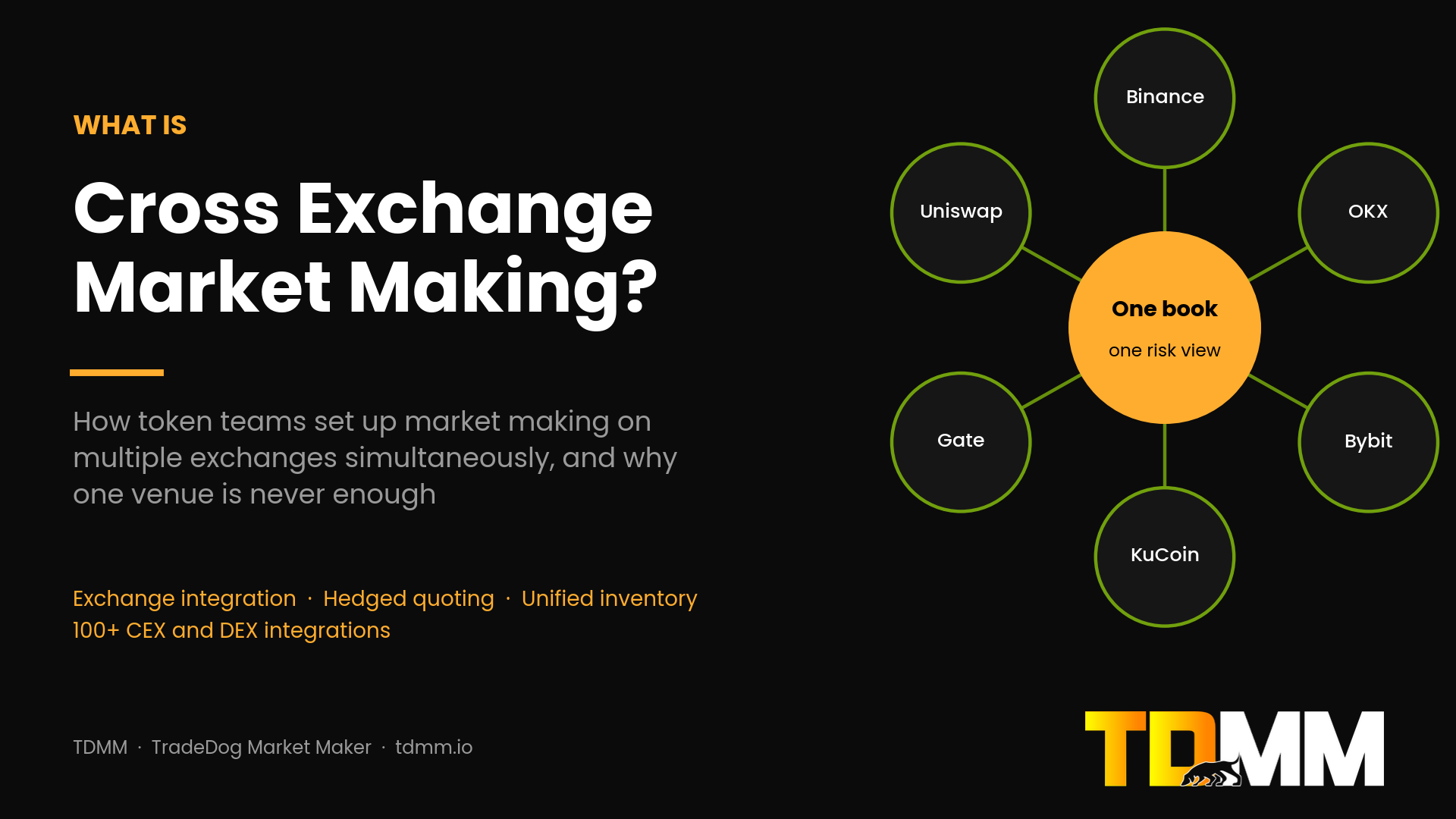
Cross exchange market making is the practice of quoting a token on several crypto exchanges at the same time from one shared inventory, pricing every order book off a single reference price and hedging fills on the deepest venue so that the market maker never holds more of the token than it intends to. It solves the central problem of crypto liquidity: the same token trades on five, ten or twenty order books that do not talk to each other. Done well, it keeps prices consistent across venues, cuts inventory risk, and lets a project support every listing without splitting its liquidity into ten thin markets. TDMM runs this model across 100+ CEX and DEX integrations.
Key takeaways
- A token’s liquidity is only as good as its worst venue. CoinMarketCap tracked 239 spot exchanges on 18 September 2026, and the ten largest alone list 16,045 trading pairs; a typical mid-cap token is live on five to twelve of them, each with its own book, fee schedule and API.
- Cross exchange market making replaces ten independent bots with one engine: quote on the maker venues, hedge on the hedge venue, rebalance inventory on a schedule, and run risk on the sum of all positions rather than on each one.
- Exchange integration is the hard part. Each venue has different rate limits (Binance allows 6,000 request weight per minute per IP and 50 orders per 10 seconds per account; Bybit allows 600 requests per 5 seconds per IP), different server regions (Tokyo, Singapore, Hong Kong), different symbol conventions and different fee tiers. A serious multi-exchange setup is measured in months of engineering, not days.
- When makers cannot reach one venue, that venue’s prices detach from everyone else’s. On 10 October 2025, USDe printed $0.65 and wBETH $430 on Binance while both held near reference value on other venues; Binance later paid about $283 million in compensation.
- Exchanges now police the relationship. Since March 2026, Binance requires token issuers to disclose their market makers, contract terms and token-loan arrangements, and prohibits one-sided selling and volume inflation. Multi-venue quoting has to be real, two-sided and reportable.
- Since 2015, TDMM has supported liquidity across CEX and DEX markets, with $10B+ in trading volume, 200+ markets managed, and 100+ exchange integrations, operated through a unified book and risk framework.
What is cross exchange market making?
Ordinary market making means placing a bid and an ask on one trading pair, on one exchange, and earning the spread between them while managing the inventory that builds up as trades fill. The earlier article in this series, How does market making work in crypto exchanges?, covers that mechanism in detail.
Cross exchange market making extends the same job across venues. The market maker quotes on one or more exchanges, called the maker venues, and uses a deeper exchange, called the hedge venue or taker venue, as both the price reference and the place where fills are offset. Hummingbot, the open-source framework that popularised the strategy for retail bots, describes it plainly: the trader “acts as a normal market maker on one exchange (the maker exchange), creating buy and sell orders” and “eliminates the inventory risk usually associated with market making by using another exchange (the taker exchange) to simultaneously offset (or hedge) any trades filled on the maker exchange.”
The pricing rule is one line:
Maker ask = hedge-venue best ask + margin, and maker bid = hedge-venue best bid − margin
where the margin has to cover the maker fee on the quoting venue, the taker fee on the hedge venue, expected slippage on the hedge, the cost of moving inventory between venues, and a profit buffer. Hummingbot calls the sum of these the minimum profitability, and the same arithmetic sits inside every professional engine.
Two things separate a professional cross exchange market maker from a retail bot running that formula. The first is scale: a firm such as TDMM quotes the same token on many maker venues at once, not one, and often hedges across several deep venues and perpetual futures rather than a single taker book. The second is that the inventory is treated as one portfolio. Balances on Binance, OKX, Bybit, KuCoin, Gate and a Uniswap pool are one position with one net exposure, one set of caps and one kill switch, even though the exchanges themselves have no idea the others exist.
The three roles a venue can play
|
Role |
What the engine does there |
Typical venue for a mid-cap token |
|
Hedge venue (reference) |
Reads the book to compute fair value; takes liquidity to offset fills from elsewhere |
The exchange with the deepest book for the token, often the primary listing |
|
Maker venue |
Posts two-sided quotes at reference ± margin; cancels and replaces as the reference moves |
Secondary CEX listings: Gate, KuCoin, MEXC, Bitget, HTX, regional exchanges |
|
AMM venue |
Holds a concentrated-liquidity range and rebalances it; hedges the range’s delta on a CEX |
Uniswap, PancakeSwap, Raydium, depending on chain |
The same venue can play more than one role for different tokens, and the roles can swap when depth migrates. A token that launches on a DEX and later lists on a large CEX usually sees its hedge venue move from the pool to the order book within weeks.
Why crypto exchanges make cross exchange market making necessary
Liquidity in crypto is fragmented by design. There is no consolidated tape, no national best bid and offer, and no obligation on any exchange to match another’s price. That produces three structural facts that shape every market-making decision.
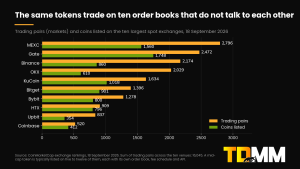
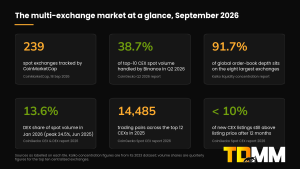
The venue count is large and the books are separate. On 18 September 2026, CoinMarketCap tracked 239 spot exchanges. The ten largest by volume listed between 520 (Coinbase) and 2,796 (MEXC) trading pairs each, 16,045 in total. CoinGecko’s 2026 Spot CEX report counts 14,485 pairs across the top twelve centralized exchanges in 2025, of which 9,870 were stablecoin pairs and 97.7% of those were quoted in USDT or USDC. Most tokens with any real following are listed on several of these venues, and every listing is a separate order book with its own bids, asks, fees and API.
Depth is concentrated, but the concentration moves. Kaiko’s liquidity concentration report found the eight largest exchanges holding 91.7% of global order-book depth and 89.5% of volume, with Binance alone at 30.7% of depth. CoinGecko’s Q2 2026 report puts Binance at 38.7% of top-ten CEX spot volume, with Bybit second at 10.0% after MEXC’s volume more than halved, from $275.2 billion to $121.2 billion, in a single quarter. Rankings below the top spot reshuffle constantly, and a token whose liquidity plan assumed one venue would stay dominant is exposed when the volume moves.
On-chain venues are now part of the map. CoinGecko’s CEX and DEX activity report shows the DEX share of spot volume doubling from 6.9% in January 2024 to 13.6% in January 2026, with a peak of 24.5% in June 2025, and the DEX share of perpetual volume rising from 2.0% to 10.2%. Between August 2025 and January 2026, PancakeSwap and Uniswap each handled roughly $0.55 trillion of spot volume, volumes on the scale of the largest centralized exchanges after Binance. A token’s price is now discovered across order books and automated market makers at once, and a maker that only covers one kind of venue is covering part of the market.
What fragmentation does to prices
Prices on separate venues drift apart, and the drift is larger and longer-lasting than most founders expect. The reference study is Makarov and Schoar’s Trading and Arbitrage in Cryptocurrency Markets, which examined 34 exchanges across 19 locations over 2017 and 2018 and found that price deviations “persisted from several hours to days and weeks”. The cross-country gaps were the extreme case, with the US–South Korea premium reaching 40% for days, but even within the same jurisdiction the paper measured daily arbitrage spreads that were routinely material after fees. Markets have matured since then, and the largest pairs on the largest venues now trade within a basis point or two of each other, but the mechanism has not changed: where there is no one pushing a common price into every book, the books diverge.
For a mid-cap token the practical picture in 2026 looks like this. On its deepest venue the token may quote at a 10 to 30 basis point spread. On the fourth or fifth venue, with no dedicated maker, the spread is often 100 to 300 basis points and the mid-price can sit half a percent away from the deep venue for minutes at a time. Arbitrage bots close the gap eventually, but they do it by taking liquidity from the thin book, which widens it further, and they keep the profit. Cross exchange market making is the alternative: the token’s own market maker posts the consistent price on every venue and captures the gap itself, while the project gets a token that trades at one price everywhere.
When one venue loses its makers: 10 October 2025
The clearest demonstration of what happens when a venue is cut off from the cross-exchange price came during the largest liquidation cascade in crypto history. Between 21:36 and 22:16 UTC on 10 October 2025, three assets on Binance detached from their value everywhere else. Ethena’s USDe, which stayed close to $1.00 on-chain and on other exchanges, printed $0.65 on Binance. wBETH, Binance’s own wrapped staked ether, traded down to $430 while ETH/USDT was above $3,800, an 88% discount. BNSOL printed $34.90. The prints lasted about 40 minutes.
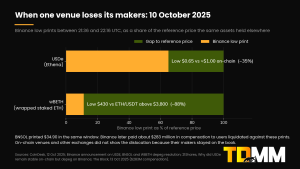
Post-mortems from 21Shares and others attribute the dislocation to the exchange’s infrastructure being overwhelmed and to market makers being unable to reach the venue, leaving books so thin that “even small orders move the market”. Binance’s margin engine marked positions against those distressed spot prints, liquidated users, and the exchange subsequently paid about $283 million in compensation. The assets had not lost value; one venue had lost its makers.
For token teams the lesson is specific. A price is only as reliable as the makers who keep it aligned with other venues. A single-venue liquidity plan has no other venue to align with.
How cross exchange market making works, step by step
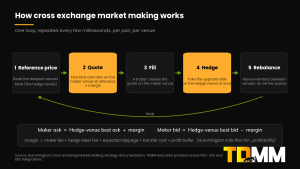
The engine runs a five-stage loop, continuously, for every pair on every maker venue.
1. Read the reference price
The engine subscribes to the hedge venue’s order book over WebSocket and computes a fair value: usually the microprice (a mid-price weighted toward the side of the book with more size), adjusted for any perpetual-futures basis and for the short-term volatility it is observing. On tokens with several deep venues the reference is a depth-weighted blend rather than a single book, so that one exchange’s hiccup does not move every quote.
2. Quote on the maker venue
It posts layered bids and asks on each maker venue at the reference plus and minus a margin, with sizes set by the venue’s share of the token’s volume and by how much inventory is available there. As the reference moves, it cancels and replaces. On a centralized exchange this happens many times a second; Hummingbot’s implementation exposes parameters such as an order refresh interval, an anti-hysteresis duration to stop the engine chasing every tick, and a top-depth tolerance that decides how much size may sit ahead of the quote before it is repriced.
3. A fill arrives
A trader on the maker venue crosses the quote. The engine now holds, say, 20,000 more tokens on KuCoin than it wants.
4. Hedge immediately
It sells 20,000 tokens on the hedge venue at the best available price. Hummingbot’s rule is that the strategy “would always immediately hedge any order fills from the maker side, regardless of how profitable the hedge is”, and professional desks follow the same principle: the hedge is a risk action, not a trade to be optimised. The margin was set in step 2 to make the round trip profitable on average; the hedge’s job is to make the exposure disappear.
5. Rebalance
Over time the maker venue accumulates quote currency and the hedge venue accumulates tokens, or the reverse. The engine schedules transfers between venues, or offsets the drift by skewing quotes, so that every venue keeps a working balance on both sides. Transfers take minutes to hours depending on the chain and the exchange’s withdrawal queue, which is why every venue holds a buffer rather than the minimum.
A worked example
Suppose a token trades at $1.0000 bid and $1.0004 ask on its hedge venue, Binance, and the maker is quoting it on KuCoin.
|
Item |
Value |
|
Hedge-venue best ask (Binance) |
$1.0004 |
|
Margin target |
0.35% (35 bps) |
|
Maker ask posted on KuCoin |
$1.0039 |
|
Fill: trader buys 20,000 tokens on KuCoin |
+$20,078 quote currency received; −20,000 tokens |
|
Hedge: buy 20,000 tokens on Binance at $1.0005 (slippage 1 bp) |
−$20,010 |
|
Gross margin |
$68 (34 bps) |
|
KuCoin maker fee at a market maker tier: −1.2 bps rebate |
+$2.41 |
|
Binance taker fee at VIP tier: 4 bps |
−$8.00 |
|
Net on the round trip |
≈ $62 (31 bps) |
The engine is now flat: it has sold on KuCoin and bought on Binance, and holds the same number of tokens it started with, in different places. Multiply by hundreds of fills a day across ten venues and the model is the daily business of a cross exchange market maker. The risks are the moments when step 4 fails: the hedge venue moves before the hedge lands, the hedge venue’s API rejects the order, or a withdrawal freeze stops the rebalance in step 5.
The strategy parameters that matter
Hummingbot’s cross exchange market making strategy is a useful public reference for the knobs every engine needs, even if proprietary systems name them differently.
|
Parameter |
What it controls |
Why it matters across venues |
|
min_profitability |
Minimum margin between maker quote and hedge price, after fees |
Set per venue pair; a venue with a 10 bps maker fee needs a wider margin than one paying a rebate |
|
order_amount |
Size per quote |
Sized to what the hedge venue can absorb without slippage |
|
slippage_buffer |
Extra price allowance on the hedge order |
Wider on thin hedge venues and during volatility |
|
order_size_taker_volume_factor |
Fraction of hedge-venue depth the engine is willing to consume |
Prevents hedging into the maker’s own price impact |
|
order_size_taker_balance_factor |
Fraction of hedge-venue balance available for hedging |
Ties quoting to actual inventory on the hedge venue |
|
active_order_canceling |
Whether to cancel and replace actively or let orders expire |
Enabled on CEXs; disabled on DEXs to save gas |
|
anti_hysteresis_duration |
Minimum time between quote adjustments |
Stops rate-limit exhaustion on venues with tight order caps |
|
top_depth_tolerance |
Size allowed ahead of the quote before repricing |
Trades off queue position against staleness |
A professional stack adds venue-level inventory caps, per-venue kill switches, a cross-venue price-deviation alarm and an automated transfer scheduler, and it calibrates each parameter per venue rather than globally.
Exchange integration: what it takes to connect to multiple crypto exchanges
The strategy is simple to describe and the pricing formula fits on one line. The difficulty is exchange integration, and it is the reason most token teams hire a firm that has already done it rather than building a multi-exchange stack themselves.
Accounts, keys and permissions
Every venue requires a verified corporate account, usually with sub-accounts per strategy or per client, API keys with trading permission but no withdrawal permission on the quoting keys, IP whitelists, and, on most large exchanges, an application to the market maker programme to obtain higher rate limits and maker rebates. Binance’s spot programme asks for evidence of 1,000 BTC of 30-day trading volume on Binance or elsewhere. Bybit’s programme tiers spot makers from MM1 (30-day volume above $25 million) to MM3 (1% or more maker volume share). KuCoin’s programme grants tiered maker rebates, a two-month assessment-free period and API capacity of 40,000 requests per 30 seconds. Each application is a separate process with separate documentation.
Rate limits and order caps
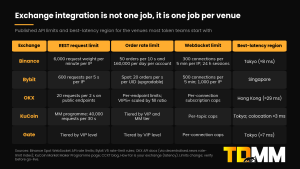
The published limits differ by an order of magnitude between venues and they are enforced differently. Binance’s spot WebSocket API allows 6,000 request weight per minute per IP, 50 orders per 10 seconds and 160,000 orders per day per account, and 300 WebSocket connections per five-minute window per IP, with every session capped at 24 hours. Bybit allows 600 REST requests per 5 seconds per IP and 20 spot orders per second per UID by default, with 500 new WebSocket connections per five minutes. OKX publishes per-endpoint limits, starting at 20 requests per 2 seconds on public market data, and scales the order limits for VIP5 and above by a fill-ratio formula that penalises accounts that cancel far more than they fill.
An engine quoting five layers on each side of twenty pairs on Binance is generating roughly 200 resting orders and, in a moving market, hundreds of cancel-replace messages per minute. Without batching, request-weight accounting and a per-venue throttle, it will be rate-limited at exactly the moment it most needs to reprice. This is the engineering that separates a bot from an integration.
Latency and server placement
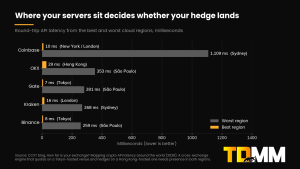
Crypto exchanges are hosted in specific cloud regions and the round-trip latency to them varies by more than an order of magnitude by location. CCXT’s 2026 latency survey measured Binance at about 8 milliseconds from Tokyo and 259 from São Paulo, Gate at 7 from Tokyo and 281 from São Paulo, OKX at 29 from Hong Kong and 353 from São Paulo, Coinbase at 10 from New York or London and 1,109 from Sydney, and Kraken at 16 from London and 268 from Sydney. KuCoin offers colocation at about 3 milliseconds for programme members.
For cross exchange market making the number that matters is the sum of two legs: the time to see the reference move on the hedge venue and the time to reprice on the maker venue. If the maker venue is in Tokyo and the hedge venue in Hong Kong, the engine needs presence in both regions and a fast link between them, or the arbitrageurs will pick off its stale quotes before the hedge can be placed. Some venues also restrict access by IP range or jurisdiction, which constrains where the servers can sit at all.
Symbol, precision and settlement differences
The same token is TOKEN/USDT on one venue, TOKEN-USDT on another and TOKENUSDT on a third. Price tick sizes, lot sizes, minimum notionals and decimal precision differ by venue and change without notice when an exchange adjusts a pair. Fees are charged in the quote asset on one venue and in the base asset, or in the exchange token, on another. Some venues settle instantly; others batch. Every one of these differences has to be normalised into a single internal representation before a unified book is possible, and every one of them is a source of silent errors when it drifts.
Fees
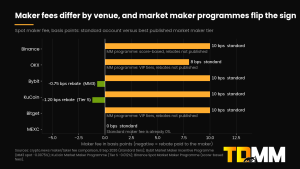
Standard-tier spot maker fees in September 2026 are 10 basis points on Binance, Bybit, Bitget and KuCoin, 8 on OKX and 0 on MEXC. Market maker programmes turn the fee into a rebate: Bybit’s MM3 tier pays −0.75 basis points on spot, KuCoin’s Tier S pays −1.2. The taker fee on the hedge venue is the larger cost, and it too depends on VIP tier. The minimum viable margin on each maker venue is therefore a venue-pair-specific number, and a cross exchange engine carries a fee matrix, not a fee.
DEX integration
Connecting to a decentralized exchange is a different discipline. There is no API key; there is a wallet, an RPC endpoint, gas estimation, transaction ordering risk and, on Uniswap v3-style pools, a concentrated-liquidity range that must be rebalanced as price moves. Hummingbot notes that interaction with DEXs “is less reliable” and that taker fees vary with gas, which makes the margin calculation unpredictable. A maker that runs both CEX order books and AMM ranges hedges the AMM position’s delta on a centralized venue and treats gas as a fee line in the same matrix.
The integration checklist per venue
|
Item |
What has to be done |
Typical time |
|
Corporate KYB and sub-accounts |
Entity verification, sub-account structure, signatories |
3 to 15 business days |
|
Market maker programme |
Application, volume evidence, pair list, KPI acceptance |
1 to 4 weeks |
|
API connectivity |
REST and WebSocket clients, authentication, heartbeat, reconnect logic |
1 to 3 weeks of engineering per new venue |
|
Rate-limit and order-cap model |
Weight accounting, batching, throttles, backoff |
Part of the above |
|
Symbol and precision normalisation |
Mapping, tick and lot rules, fee currency, refresh on change |
Ongoing |
|
Latency placement |
Region selection, cross-region links, IP compliance |
1 week |
|
Inventory and transfer routes |
Deposit addresses, whitelists, chain selection, buffers |
1 week |
|
Risk controls |
Per-venue caps, kill switches, deviation alarms, reporting |
Before go-live |
A firm with these steps already complete for 100+ venues can add a token to all of them in days. A team starting from zero is looking at a quarter of engineering before the first hedge lands.
Inventory, hedging and risk across venues
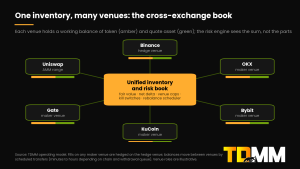
The unified book is what turns a set of integrations into cross exchange market making. Every venue holds a working balance of the token and the quote asset. The risk engine sees the total: net token exposure across all venues, net stablecoin, unrealised P&L, and the distance of each venue’s price from the reference. Five rules keep it healthy.
Venue caps. Each venue has a maximum inventory it may hold, sized to the venue’s counterparty risk and its withdrawal reliability. Exchange failures are not hypothetical; the limit exists so that no single venue outage can take a material share of the client’s inventory with it.
Basis risk is measured, not ignored. Between the fill on the maker venue and the hedge on the hedge venue, the reference can move. Over thousands of round trips this is a cost line, and the engine reports it. When it grows, the margin widens or the venue is paused.
Transfers are scheduled, not reactive. Moving tokens between exchanges takes a chain confirmation and an exchange withdrawal queue, and both slow down precisely when markets are fast. The engine keeps buffers on every venue and rebalances on a schedule so that it is never forced to move inventory in a crisis.
Quotes skew before they stop. When inventory drifts long on a venue, bids move down and asks move down with them, so the venue sells more readily until it is back at target. Withdrawal of quotes is the last resort, triggered by a kill switch on stale data, abnormal fills or a price deviation beyond the alarm threshold.
Stablecoin choice is part of the plan. With 97.7% of stablecoin pairs on the top twelve CEXs quoted in USDT or USDC, most tokens quote against one or both. Holding quote inventory in the right stablecoin on each venue, and keeping conversion routes open, is a treasury decision as much as a trading one. The earlier article on crypto treasury management best practices covers how treasury and liquidity should be run as one book.
Single-exchange versus cross exchange market making
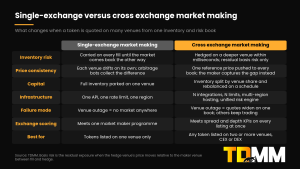
|
Single-exchange market making |
Cross exchange market making |
|
|
Inventory risk |
Carried on every fill until the market comes back the other way |
Hedged on a deeper venue within milliseconds; residual basis risk only |
|
Price consistency |
Each venue drifts on its own; arbitrage bots collect the difference |
One reference price pushed to every book; the maker captures the gap instead |
|
Capital |
Full inventory parked on one venue |
Inventory split by venue share and rebalanced on a schedule |
|
Infrastructure |
One API, one rate limit, one region |
N integrations, N rate limits, multi-region hosting, unified risk engine |
|
Failure mode |
Venue outage means no market anywhere |
Venue outage means quotes widen on one book; the others keep trading |
|
Exchange scoring |
Meets one market maker programme’s KPIs |
Meets spread and depth KPIs on every listing at once |
|
Best for |
Tokens listed on one venue only |
Any token listed on two or more venues, CEX or DEX |
There is one case where single-exchange quoting is correct: a token with exactly one listing and no plan for another. Every other token is a cross exchange problem, whether or not anyone is treating it as one.
How to set up market making on multiple exchanges simultaneously
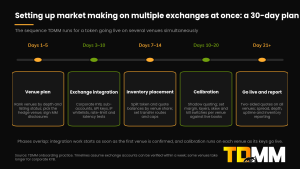
Token teams usually face this question at one of three moments: a launch with several listings on the same day, a new tier-1 listing added to existing secondary venues, or a rescue of a token whose liquidity has thinned on every venue except one. The sequence is the same in each case.
Days 1 to 5: the venue plan
Rank the venues where the token is or will be listed by depth, volume share and listing status. Choose the hedge venue: the deepest book, or a depth-weighted blend if two venues are close. Decide which venues are maker venues and which AMM pools need active ranges. Agree the spread, depth and uptime targets per venue with the market maker in writing, and complete the disclosures that exchanges now require. Since March 2026, Binance requires token issuers to disclose their market maker’s identity and legal entity, the contract terms and any token-lending agreement, and it prohibits profit-sharing or guaranteed-return arrangements, selling that conflicts with the token’s release schedule, one-sided trading and volume inflation, with blacklisting as the sanction. Treat those rules as the standard for every venue.
Days 3 to 10: exchange integration
Open or confirm corporate accounts and sub-accounts on each venue, generate trading-only API keys, whitelist IPs, and apply to market maker programmes where thresholds are met. Run connectivity, rate-limit and latency tests from the regions closest to each venue. For a firm with existing integrations this is configuration; for a new stack it is the long pole.
Days 7 to 14: inventory placement
Split the token and quote inventory across venues in proportion to expected volume, with a larger buffer on the hedge venue because that is where hedges are executed. Set deposit routes, chain choices and transfer caps. Confirm which stablecoin each venue’s pair quotes against and fund accordingly.
Days 10 to 20: calibration
Run the engine in shadow mode against live books: it computes quotes and simulated hedges without posting. Calibrate margin, layer count and sizes, skew sensitivity and kill-switch thresholds per venue. Check that the cross-venue price deviation alarm fires at the level the team expects, and rehearse a venue outage.
Day 21 onward: go live and report
Post two-sided quotes on every venue. From the first hour, report spread, depth within ±1% and ±2%, quoting uptime, cross-venue deviation, hedge latency and inventory by venue, daily at minimum. The exchanges will be measuring the same numbers in their programme scorecards.
The KPIs that define a working multi-exchange market
|
KPI |
What to measure |
A reasonable target for a mid-cap token |
|
Quoted spread |
Best bid to best ask, per venue, time-weighted |
20 to 60 bps on secondary venues; tighter on the hedge venue |
|
Depth |
Resting size within ±1% and ±2% of mid, per venue |
Agreed dollar amount per venue, held through volatility |
|
Uptime |
Share of time two-sided quotes are live |
95% to 99% per venue |
|
Cross-venue deviation |
Mid-price on each venue versus reference |
Inside the margin band, typically under 30 bps |
|
Hedge latency |
Fill to hedge confirmation |
Under one second on CEX-to-CEX legs |
|
Inventory drift |
Net token exposure versus target, all venues |
Within the agreed cap; rebalanced daily |
|
Basis cost |
Hedge slippage plus reference movement per round trip |
Reported; trending down after calibration |
Common mistakes in multi-exchange market making
Running ten bots instead of one book. Independent bots per venue each hold their own inventory, each get run over in the same direction on the same move, and none of them hedge. The result is ten small losses that add up to one large one.
Choosing the hedge venue by brand rather than depth. The hedge venue must be the one that can absorb the maker’s fills without slippage. For many tokens that is not the largest exchange in the world but the venue where the token actually has depth.
Ignoring rate limits until they bite. An engine that works in calm markets and gets rate-limited in fast ones is an engine that stops quoting exactly when the exchange is scoring it hardest.
Leaving the AMM out. A token with a live Uniswap or Raydium pool and no managed range has an unhedged position that arbitrageurs trade against every time the CEX price moves.
Confusing consistency with control. Cross exchange market making keeps the price the same everywhere. It does not decide what that price is. A firm that promises to hold a level across venues is not describing market making, and under Binance’s 2026 rules it is describing a reason to be blacklisted.
Why TDMM is the go-to platform for cross exchange market making
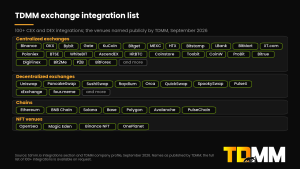
TDMM (TradeDog Market Maker) is the institutional market-making and token market-management arm of the TradeDog Group. It has run cross-venue liquidity since 2015, has traded more than $10 billion, and currently manages 200+ markets across 100+ centralized and decentralized exchange integrations.
Exchange integration is already done. TDMM’s publicly listed venues include Binance, OKX, Bybit, Gate, KuCoin, Bitget, MEXC, HTX, Bitstamp, LBank, BitMart, XT.com, Poloniex, BTSE, WhiteBIT, AscendEX, HitBTC, Coinstore, Toobit, CoinW, ProBit, Bitrue, DigiFinex, Bit2Me and P2B on the centralized side; Uniswap, PancakeSwap, SushiSwap, Raydium, Orca, QuickSwap, SpookySwap, PulseX, xExchange and four.meme among DEXs; Ethereum, BNB Chain, Solana, Base, Polygon, Avalanche and PulseChain as chains; and OpenSea, Magic Eden, Binance NFT and OnePlanet for NFT liquidity. The full list of 100+ integrations covers the long tail of regional and specialist venues where mid-cap tokens are actually listed. Adding a token to every venue it trades on is configuration, not a project.
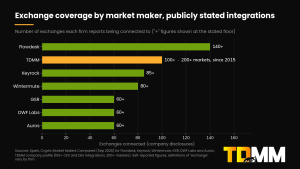
Coverage that compares with the largest firms. Public disclosures collected by Spark put Flowdesk at 140+ exchanges, Keyrock at 85+, Wintermute at 80+, and GSR, DWF Labs and Auros at 60+. TDMM’s 100+ integrations sit in the top tier of that group, with a service model built for token projects rather than for proprietary trading.
One book, one risk view. TDMM’s proprietary execution algorithms run inventory-aware quoting, cross-venue hedging and AMM range management from a single inventory and risk engine, 24 hours a day, with a team of 30+ professionals across five continents. Every venue’s quotes are priced off one reference and every fill is hedged into the same book.
Transparency by design. Clients see spread, depth, uptime, cross-venue deviation, inventory by venue and P&L, so the liquidity budget is auditable and the exchange disclosures Binance now requires can be met from the same reporting.
Full lifecycle, not just quoting. Beyond market making, TDMM provides liquidity provisioning, treasury management, yield optimisation on idle inventory, exit management and token listing support, so that the decision to add a venue, the inventory to fund it and the reporting to the exchange are handled together.
Integrity. TDMM quotes two-sided markets with real counterparties on every venue. It does not manufacture volume, trade one-sided against a release schedule or promise a price. That is the only kind of multi-exchange market making exchanges and regulators accept in 2026.
If your token is listed on more than one venue, or is about to be, TDMM can map its current spread, depth and cross-venue deviation on every exchange and propose a cross exchange market making plan. Visit tdmm.io to start the conversation.
Frequently asked questions
What is cross exchange market making?
Cross exchange market making is quoting a token on several exchanges at once from one shared inventory, pricing each order book off a single reference price and hedging fills on the deepest venue. The market maker posts bids and asks on the maker venues at the reference price plus or minus a margin, and when a quote fills it immediately takes the opposite side on the hedge venue, so the net position stays flat and prices stay consistent across venues.
How is cross exchange market making different from arbitrage?
Arbitrage takes liquidity from two venues when their prices diverge, profiting from the gap and leaving both books thinner. Cross exchange market making adds liquidity: it posts resting quotes on the maker venue and only takes on the hedge venue after a fill. The maker earns the margin it quoted, the venue gets a tighter book, and the price gap that arbitrageurs would have exploited never opens.
Why do token projects need market making on multiple exchanges simultaneously?
Because the token trades on several separate order books, and its liquidity is judged on all of them. Exchanges score pairs on spread and depth; investors check the venue they use; arbitrage bots exploit any venue that lags. A single-venue plan leaves every other listing thin and lets price gaps open, which is exactly what happened on Binance on 10 October 2025 when makers could not reach the venue.
What does exchange integration involve for a market maker?
Corporate accounts and sub-accounts, trading-only API keys with IP whitelists, market maker programme applications, REST and WebSocket clients with per-venue rate-limit models, symbol and precision normalisation, server placement in the venue’s region, deposit routes and inventory buffers, and per-venue risk controls. Each venue is a separate project; TDMM maintains 100+ such integrations.
Which crypto exchanges does TDMM integrate with?
TDMM’s published integrations include Binance, OKX, Bybit, Gate, KuCoin, Bitget, MEXC, HTX, Bitstamp, LBank, BitMart, XT.com, Poloniex, BTSE, WhiteBIT, AscendEX, HitBTC, Coinstore, Toobit, CoinW, ProBit, Bitrue, DigiFinex, Bit2Me and P2B among centralized exchanges; Uniswap, PancakeSwap, SushiSwap, Raydium, Orca, QuickSwap, SpookySwap, PulseX, xExchange and four.meme among DEXs; and NFT venues including OpenSea and Magic Eden, across 100+ integrations in total.
How does a cross exchange market maker choose the hedge venue?
By depth in the specific token, not by the exchange’s overall size. The hedge venue must absorb the maker’s fills with minimal slippage, so it is usually the token’s primary listing or the venue with the most resting liquidity within 1% of mid. When two venues are close, the reference is a depth-weighted blend of both.
How long does it take to set up market making on multiple exchanges?
With a market maker whose integrations already exist, a token can be live on all its venues in about three weeks: venue plan and disclosures in the first week, account and inventory setup in the second, calibration in the third. Building a multi-exchange stack from scratch takes a quarter or more of engineering before the first hedge can be placed.
What are the main risks of cross exchange market making?
Basis risk between the fill and the hedge, hedge-venue outages or API rejections, rate limiting during fast markets, transfer delays when rebalancing inventory, counterparty risk on each venue holding inventory, and gas or MEV costs on DEX legs. A professional engine caps inventory per venue, measures basis cost, schedules transfers in advance and runs kill switches on stale data or abnormal fills.
Do exchanges have rules about market makers on multiple venues?
Yes. Binance’s March 2026 guidelines require token issuers to disclose their market maker’s identity, contract terms and token-loan arrangements, and prohibit profit-sharing and guaranteed-return deals, selling against the release schedule, one-sided trading and volume inflation. Most large exchanges also run market maker programmes that score spread, depth, order size and uptime in exchange for maker rebates and higher API limits.
How much does cross exchange market making cost?
Engagements follow the same structures as single-venue market making: a monthly retainer, a token loan with call options, or a hybrid, with the retainer scaled to the number of venues and the depth commitments. Each additional venue adds inventory that must be funded and fees that must be covered by the margin, so the cost of a ten-venue programme is driven more by the capital placed on each venue than by the engine itself.
Glossary
- Maker venue: an exchange where the market maker posts resting two-sided quotes.
- Hedge venue (taker venue): the deeper exchange used as the price reference and as the place fills are offset.
- Reference price: the fair value computed from the hedge venue’s book, often a depth-weighted microprice.
- Margin (minimum profitability): the distance between the maker quote and the hedge price, set to cover fees, slippage, transfer cost and profit.
- Basis risk: the exposure created when the hedge venue’s price moves between a fill and its hedge.
- Unified book: the treatment of inventory on every venue as one position with one net exposure and one set of risk limits.
- Rate limit: the maximum number of API requests or orders an exchange allows per unit of time, per IP or per account.
- Request weight: Binance’s system of charging each API call a cost against a per-minute budget.
- Rebalance: moving token or quote inventory between venues to restore working balances.
- Market maker programme: an exchange scheme granting maker rebates and higher API limits to firms that meet quoting standards.
- Concentrated liquidity range: the price band within which a liquidity provider’s capital is active on a Uniswap v3-style AMM.
Sources and further reading
- Hummingbot, What is cross exchange market making? and Cross-Exchange Market Making strategy documentation.
- CoinMarketCap, Top Cryptocurrency Exchanges Ranked by Volume, accessed 18 September 2026.
- CoinGecko, 2026 Q2 Crypto Industry Report; Spot Centralized Exchanges Report 2026; CEX and DEX Trading Activity Report 2026.
- Kaiko, The Crypto Liquidity Concentration Report.
- Makarov, I. and Schoar, A., Trading and Arbitrage in Cryptocurrency Markets, Journal of Financial Economics, 2020.
- CoinDesk, Binance to compensate users affected by crash in wBETH, BNSOL and Ethena’s USDe, 12 October 2025; The Block, Binance pays $283 million in compensation following Friday’s depegs, 13 October 2025; 21Shares, Why did Ethena’s stablecoin remain stable on-chain but depeg on Binance?; Binance, Resolution of USDE, BNSOL and WBETH price depeg.
- CoinDesk, Binance tightens market maker rules and warns token issuers to disclose partners, 25 March 2026.
- Binance Open Platform, Spot WebSocket API rate limits; Bybit, V5 API rate limit rules; decentralised.news, The Rate Limit Asymmetry Index; KuCoin, Market Maker Programme; Bybit, Market Maker Incentive Programme; Binance, Spot Market Maker Programme.
- CCXT, How far is your exchange? Mapping crypto API latency around the world, 2026.
- crypto.news, Maker and taker fees compared across 8 crypto exchanges, 8 September 2026.
- Spark, Crypto Market Makers Compared: Liquidity Providers for Token Projects, September 2026.
- TDMM, company profile and integrations, tdmm.io
Published by TDMM (TradeDog Market Maker) · Reading time: 21 minutes · Last updated: September 2026 · Written by: Vaibhav Singh