

The short answer
Crypto treasury management is the discipline of running a token project’s balance sheet so that the project survives every market it will trade through. In 2026 that means four things: holding 12 to 24 months of operating costs in stablecoins or tokenized Treasury bills rather than in the native token; splitting the treasury into an operating reserve, a strategic reserve, a yield sleeve and a token inventory, each with its own rules; putting custody, signing and governance controls in place before scale rather than after an incident; and treating the native token as inventory that needs liquidity, a managed unlock schedule and a professional market maker. DAOs still hold more than 70% of their treasuries in their own tokens. The projects that outlast 2026 are the ones that stop doing that.
Key takeaways
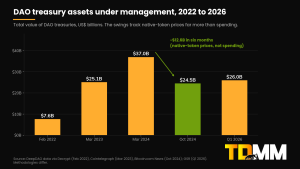
- DAO treasuries totalled about $26 billion in Q1 2026, and more than 70% of that value sits in each DAO’s own token. Between March and October 2024 that concentration erased $12.6 billion of treasury value in six months. It is the single largest, and most avoidable, risk in DAO treasury management.
- Runway is the metric that decides survival. The Ethereum Foundation caps annual spending at 15% of its treasury and holds a 2.5-year fiat buffer; a16z crypto recommends 12 to 18 months of costs in stablecoins; GSR’s 2026 research recommends 12 to 24. More than 100 crypto projects had shut down by early August 2026, most of them because a treasury held in a token that fell 70 to 90% could no longer pay salaries.
- Yield is available without leaving the safe end of the risk curve. Tokenized US Treasuries grew 2.5x in a year to $15.6 billion across 105 funds; the average fund pays 3.29%, against 3.97% on a three-month T-bill after the Federal Reserve’s 16 September 2026 rate rise. DeFi stablecoin lending pays 3.3 to 5%, but the Stream Finance, Resolv and Balancer failures show what the extra basis points cost when curator or key risk is ignored.
- Keys and signers, not smart contracts, are where treasuries are lost. 76% of the $2.87 billion stolen in 2025, about $2.2 billion, came from attacks on keys, wallets and control planes. Drift lost $285 million five days after moving to a 2-of-5 multisig with no timelock; BONK DAO lost $20 million to a governance proposal that passed with 2.9% turnout and no delay before execution.
- The native token is a treasury asset that has to be managed as inventory. 90% of the 16,000 unlock events Keyrock studied pushed price down, team unlocks by 25% on average. Fewer than 10% of newly listed tokens are above their listing price after twelve months. Market making, exit management and unlock planning belong inside the treasury policy, not outside it.
- TDMM has provided market making, liquidity provisioning, treasury management, yield inventory optimisation and exit management to token projects since 2015, with more than $10 billion traded across 100+ exchanges and 200+ markets. Treasury and liquidity are one problem; TDMM runs them as one service.
What is crypto treasury management?
A crypto treasury is every asset a project controls: stablecoins, ETH, BTC, its own token (vested and unvested), liquidity-pool positions, staked positions, loans to market makers, tokenized T-bills and, for a growing number of projects, fiat in a bank. Treasury management is the set of policies that decides how much of each to hold, where it is kept, who can move it, what it earns, and how the native token is released into the market.
The discipline applies to four kinds of organisation that face the same problems in different legal wrappers:
|
Treasury type |
Who controls it |
Typical assets |
Distinguishing challenge |
|
DAO treasury |
Token-holder governance, usually executed through a multisig or a timelocked contract |
Native token (often 70%+), stablecoins, ETH, LP positions |
Slow, public decision-making; governance attack surface; native-token concentration |
|
Foundation or Labs treasury |
Board or executive team of a legal entity (Cayman, Swiss, Panama, BVI) |
Fiat, stablecoins, native token, venture stakes |
Runway and payroll; legal and tax reporting; token-sale and grant obligations |
|
Protocol revenue treasury |
Governance, often with an automated split (buyback, burn, reserve) |
Fees in ETH/stablecoins/native token |
Deciding between buybacks, reserves and growth spend |
|
Digital asset treasury company (DAT) |
Public-company board and CFO |
BTC, ETH or SOL bought with equity or debt, plus a cash reserve |
Fair-value accounting volatility; premium-to-NAV compression; debt service |
The rest of this guide is written for the first three, which together are what most people mean by “digital asset projects”, with a section on DATs because their 2026 experience is instructive for everyone else.
Why 2026 is the year treasury policy stopped being optional
Four things changed between the 2024 cycle and today.
Treasury values fell, and the fall was concentrated. DAO treasury assets under management peaked near $37 billion in March 2024 and were back to $24.5 billion by October 2024, a $12.6 billion drop in six months that owed almost nothing to spending and almost everything to native-token prices. The sector recovered to roughly $26 billion by Q1 2026, but the composition did not improve: GSR’s August 2026 research found more than 70% of DAO treasury assets still in each DAO’s own token, down only from 82% among the largest DAOs in 2023.
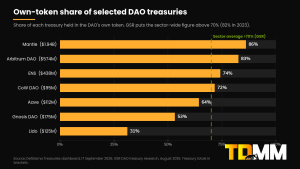
Mantle is the clearest single example. Its treasury was worth $4.03 billion in August 2025, with $3.79 billion in MNT and just $17.9 million in stablecoins. On 16 September 2026 the same treasury reported $2.29 billion, 72.5% in MNT and 4.8% in stablecoins. Nothing was mis-spent. The treasury simply tracked the token.
DeFi contracted. Total value locked across DeFi stood at $87.4 billion on 17 September 2026, down 45% from $158 billion a year earlier. USDe, the largest synthetic dollar, shrank from $14.8 billion in October 2025 to $4.7 billion. Yields that treasuries had grown used to in 2025 disappeared with the leverage that produced them.
Projects ran out of money. RootData counted 99 project closures by 27 July 2026 and more than 100 by early August, including Movement Labs, Loopring, Storj Labs and Zapper. CoinDesk’s reporting on the shakeout named the causes in order: altcoins down 70 to 90%, which drained treasuries held in native tokens; teams paid in tokens with no fee revenue; $1.1 billion lost to hacks in the first half of the year; and venture funding that, at $5.68 billion in Q2 2026, was flowing 78% to later-stage rounds.
Rates went up again. The Federal Reserve raised its target range to 3.75 to 4.00% on 16 September 2026. A three-month Treasury bill now yields 3.97%. For the first time since tokenized Treasuries existed at scale, the safest dollar asset in the world pays more than most on-chain stablecoin lending markets. A treasury that is not earning on its idle stablecoins is leaving 3 to 4% a year on the table, and a treasury reaching for 8% is being paid for a risk it may not have priced.
What are the biggest treasury risks for digital asset projects in 2026?
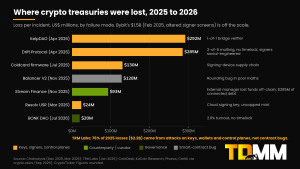
Every treasury loss of the last two years falls into one of six buckets. The chart below ranks the largest incidents by the mechanism that caused them, because the mechanism, not the headline number, is what a treasury policy has to address.
|
Risk |
What it looks like |
2025–2026 evidence |
|
Concentration |
Treasury value moves one-for-one with the native token; runway evaporates in a drawdown |
Mantle $4.03B → $2.29B in 12 months; Lido’s LDO down 95% from its high with about $90,000 of on-chain depth at ±2% when the DAO wanted to act |
|
Key and signer compromise |
Attackers target the people and machines that sign, not the contracts |
Bybit, $1.5B, February 2025: a Safe{Wallet} developer machine was compromised and signers approved a transaction that did not match what their screens showed. Drift, $285M, April 2026: signers were socially engineered into pre-signing durable-nonce transactions five days after the protocol moved to a 2-of-5 multisig with zero timelock |
|
Bridge and dependency failure |
A single upstream component mints or moves assets the treasury did not authorise |
KelpDAO, $292M, April 2026: a 1-of-1 verifier on a LayerZero bridge configuration let an attacker mint unbacked rsETH; Aave TVL fell by about $6B in the aftermath |
|
Governance capture |
A proposal moves treasury assets because quorum, timelock or veto controls were missing |
BONK DAO, about $20M, July 2026: an attacker bought about $4M of BONK, reached the 1% quorum, passed a proposal with seven wallets and 2.9% turnout and drained the treasury because there was no timelock. Compound, 499,000 COMP (about $24M), July 2024 |
|
Yield and counterparty risk |
A yield product’s collateral, oracle or curator fails |
Stream Finance, November 2025: a $93M off-chain loss by an external manager collapsed xUSD by 77%, stranded about $160M of deposits and left about $285M of connected DeFi debt. Resolv, March 2026: a compromised cloud signing key minted 80M unbacked USR, triggering about $180M of liquidations across Morpho vaults |
|
Accounting and regulatory |
Reported results swing with fair value; rules change mid-year |
Strategy’s Q2 2026 net loss of $8.22B under ASU 2023-08; SharpLink’s $76.1M impairment on liquid-staking tokens that fall outside fair-value treatment; MiCA transition periods ending 1 July 2026 with no extensions |
TRM Labs’ 2026 crime report puts the pattern in one number: 76% of the $2.87 billion stolen in 2025, some $2.2 billion, came from infrastructure attacks on keys, wallets and control planes rather than from smart-contract bugs. Chainalysis counted more than $3.4 billion stolen in total during 2025, with the three largest incidents making up 69% of it. The first half of 2026 was the most-hacked half-year on record by count, with 212 exploits and $1.1 billion lost.
Best practice 1: Split the treasury into four buckets with separate rules
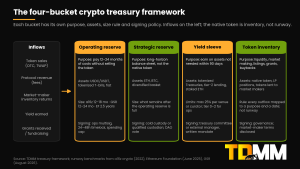
The mistake most projects make is running one wallet with one policy. A treasury has at least four jobs, and each needs its own mandate, custody arrangement and reporting line.
|
Bucket |
Purpose |
Assets |
Target size |
Who signs |
|
Operating reserve |
Pay salaries, vendors, audits, legal and exchange fees for the next 12 to 24 months without selling the native token |
Stablecoins (USDC/USDT), tokenized T-bills, fiat |
12–24 months of opex; a16z’s floor is 12, GSR’s 2026 recommendation is 12–24, the Ethereum Foundation holds 2.5 years |
Operations multisig with a 24–48 hour timelock and a spending cap |
|
Strategic reserve |
Long-horizon balance-sheet assets that are not the native token |
ETH, BTC, sometimes SOL or a diversified basket |
What remains after the operating reserve is full; rebalanced quarterly |
Cold custody or qualified custodian; governance vote to move |
|
Yield sleeve |
Earn on idle assets in the two buckets above without putting principal at risk |
Tokenized Treasuries, top-tier lending markets, staked ETH with a liquidity buffer |
Only assets not needed within 90 days; hard concentration limits per venue |
Treasury committee or external manager under a written mandate |
|
Token inventory |
Fund liquidity, market making, grants, listings and buybacks; manage unlocks |
The native token, LP positions, tokens lent to market makers |
Set by tokenomics; every outflow mapped to a purpose and a date |
Governance, with market-maker and liquidity deployments disclosed |
The ENS endowment is a working example of separating strategic capital from the token. Since March 2023, kpk (formerly karpatkey) has run it on a 60/40 ETH-to-stablecoin mandate and generated $9.9 million of yield with no loss of principal, at an average gross yield of 3.58%. The same report is honest about the limit of the approach: the endowment fell from $101.6 million to $67.7 million in the first half of 2026 because ETH fell. Diversifying out of ENS into ETH removed the idiosyncratic risk, not the market risk. That is why the operating reserve, the bucket that has to pay people, holds dollars and only dollars.
The Uniswap Foundation shows what a properly funded operating reserve looks like on paper: $85.8 million at the end of 2025, of which $49.9 million was cash and stablecoins, against 2025 operating expenses of $9.7 million and interest income of $1.7 million, giving it published runway into January 2027 without touching its 15.1 million UNI.
Best practice 2: Size the runway to a bear market, not a budget
Runway is the number of months the operating reserve can cover expenses if the native token went to zero tomorrow. It is the only treasury metric that matters when the market turns, and it should be published to the community every quarter.
The benchmarks in use in 2026:
|
Source |
Recommendation |
Notes |
|
a16z crypto treasury guide |
At least 12 months, ideally 18, of operating expenses in cash or stablecoins |
Priorities in order: capital preservation, liquidity, then yield |
|
Ethereum Foundation treasury policy (June 2025) |
Annual opex capped at 15% of treasury; 2.5-year fiat buffer; opex to fall toward 5% over five years |
Explicitly designed so that the Foundation never has to sell ETH at the bottom |
|
GSR (August 2026) |
12 to 24 months of runway in stable assets; separate operating reserves from long-term holdings; hedge native-token exposure with collars |
Recommends stress-testing whether reserves survive a further 12-month drawdown |
|
Uniswap Foundation (2025 report) |
Published runway with dates |
$49.9M cash and stablecoins against $9.7M annual opex |
Three rules follow from the numbers. First, fund the reserve while the token is strong, because that is when selling is cheapest and least visible; Uniswap’s 2024 treasury working group was formed while the DAO held about $5 billion of mostly dormant UNI, not after a drawdown. Second, denominate the target in the currency of the liabilities: salaries and audits are paid in dollars, so the reserve is dollars. Third, count only what is unencumbered: tokens lent to a market maker, locked in a vesting contract or posted as collateral do not count toward runway.
Best practice 3: Diversify out of the native token without crashing it
Knowing the treasury is over-concentrated is easy. Reducing the concentration without damaging the token, the community or the project’s exchange relationships is the hard part, and it is where treasury management and market making meet.
Know what an unlock or a sale does to price. Keyrock’s study of more than 16,000 unlock events across 40 tokens found that 90% of them produced negative price pressure. Team unlocks were worst, averaging about −25%. Ecosystem-development unlocks were the only category with a positive average (+1.18%), because the tokens were spent into the ecosystem rather than sold. Unlocks of 5 to 10% of supply caused price drops 2.4 times larger than smaller ones. The pressure starts roughly 30 days before the unlock date as traders front-run it, peaks in the final week and fades about 14 days after. Investor unlocks had a milder effect than team unlocks for one reason: investors use OTC desks and hedges.
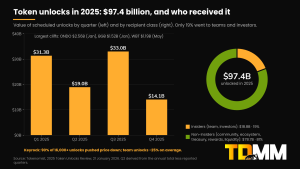
In 2025, $97.43 billion of tokens unlocked, of which $18.77 billion (19%) went to insiders (team and investors) and the remaining 81% to community, ecosystem, treasury, rewards and liquidity allocations. The largest single cliffs were ONDO ($2.56 billion, January), BGB ($1.52 billion, January) and WBT ($1.19 billion, May). A treasury that does not know its own unlock calendar to the day is planning to be surprised.
Use the execution methods that do not move the price. The options, in order of market impact from lowest to highest:
|
Method |
How it works |
When it fits |
Trade-off |
|
OTC block sale |
Sell to a desk or strategic buyer at a negotiated discount, often with a lock-up |
Large sales (more than a few days of volume); strategic partners |
Discount to spot; counterparty due diligence; disclosure expected |
|
TWAP / VWAP programmatic selling |
Sell small clips across days or weeks, tracking a volume schedule |
Regular treasury funding; recurring diversification |
Visible on-chain if done from a known wallet; needs a market maker to absorb without widening spreads |
|
Collar (sell calls, buy puts) |
Cap upside above a strike in exchange for a floor below |
Hedging a large holding without selling it; GSR’s 2026 recommendation |
Requires an options counterparty; strike selection; funding |
|
Covered calls |
Sell call options on part of the position for premium |
Enhancing yield on a strategic reserve; Arbitrum wrote covered calls on 6,750 ETH notional in July 2026 |
Forgoes upside above the strike |
|
Selling at market |
Market orders into the order book |
Emergencies only |
Worst execution; signals distress; the method Keyrock’s data punishes most |
Wintermute’s 2025 OTC report found that options volumes and trade counts more than doubled year on year and that the average altcoin rally lasted about 19 days in 2025, down from about 60 in 2024. Institutions accounted for 72% of its spot OTC volume in the first half of 2026. The windows in which a treasury can sell into strength are short, and the professional tools for using them are now standard.
Learn from Lido. When the Lido DAO proposed a $20 million LDO buyback in March 2026, with the token 95% below its high, the proposal itself noted that on-chain depth at ±2% was only about $90,000, so execution had to be routed through centralized exchanges. A treasury cannot buy, sell or hedge its own token in size if nobody has built the market. That is the case for a market maker before it is a case for any specific trade.
Best practice 4: Put idle stablecoins to work in tiers
The operating reserve should earn, and in 2026 it can earn close to the risk-free rate without leaving the chain. The yield ladder below shows what was on offer on 17 September 2026, ordered by the risk being taken.
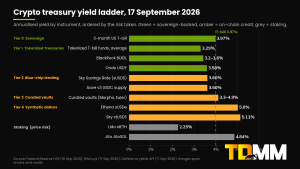
|
Tier |
Instrument |
Yield (17 Sep 2026) |
Principal risk |
|
0 |
3-month US Treasury bill |
3.97% |
Sovereign |
|
1 |
Tokenized Treasury funds: BlackRock BUIDL, Ondo USDY, Franklin BENJI, Circle USYC (average of 105 funds: 3.29%) |
3.2–3.6% |
Sovereign plus issuer, custodian and smart-contract risk |
|
2 |
Sky Savings Rate (sUSDS), Aave v3 USDC supply |
about 3.6% |
Protocol and collateral risk; Aave’s Umbrella module now covers bad debt on-chain |
|
3 |
Curated lending vaults (Morpho, Euler) run by Steakhouse, Gauntlet and others |
3.3–4.9% |
Curator judgement; the Resolv incident hit about 15 Morpho vaults |
|
4 |
Ethena sUSDe, stUSDS |
5.0–5.1% |
Basis-trade and funding-rate risk; USDe traded at $0.65 on one venue on 10 October 2025 |
|
Staking |
stETH / rETH / cbETH; JitoSOL |
2.2–2.4% ETH; 4.8% SOL |
Slashing, exit-queue and price risk; falls outside fair-value accounting under current FASB rules |
Three policies keep the sleeve safe.
Match the tier to the bucket. The operating reserve sits in tiers 0 to 2. The strategic reserve can hold tiers 2 to 4 within hard limits per venue, and staked ETH with an unstaked buffer, because validator queues in 2026 have run to weeks. Nothing that pays people sits in a curated vault.
Diversify the yield providers, not just the assets. Arbitrum DAO’s Stable Treasury Endowment Program is the template. STEP 1 placed more than $30 million into BUIDL, USDY and Mountain USDM and earned about $700,000; STEP 2 allocated 35 million ARB (about $11.6 million) across Franklin Templeton’s BENJI (35%), Spiko (35%) and WisdomTree (30%), approved by 89% of voters. In July 2026 the DAO’s treasury manager also deposited $8.6 million into Spark’s sUSDC and moved $15.8 million of BUIDL and USDY to the Foundation for operating use. Several issuers, several chains, one reporting line.
Underwrite the curator as carefully as the protocol. The 2025–2026 failures were not protocol bugs. Stream Finance’s collapse in November 2025 started with an external manager losing about $93 million off-chain; the loss then travelled through curated vaults whose oracles were hard-coded to $1, so liquidations never triggered, and about $1 billion left DeFi yield products within a week. Resolv’s March 2026 breach came from a compromised AWS signing key, not a contract exploit; Gauntlet’s USDC vaults reportedly lost millions while Steakhouse, which had declined the exposure, lost nothing. Two curators, same protocol, opposite outcomes. Written mandates, published exposure lists and concentration caps are what separate them.
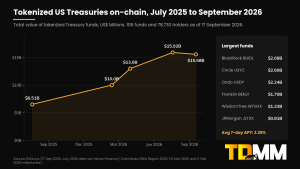
Tokenized Treasuries are the reason tier 1 exists at scale. The market grew from $6.51 billion in July 2025 to $15.92 billion in July 2026, crossed $10 billion on 11 February 2026, and stood at $15.58 billion across 105 funds and 78,730 holders on 17 September 2026. BUIDL ($2.68 billion), USYC ($2.60 billion), USDY ($2.24 billion) and BENJI ($1.70 billion) lead. Total stablecoin supply is $309.5 billion, 58.9% USDT and 23.7% USDC; Coinbase and EY-Parthenon’s January 2026 survey found 85% of institutions using or interested in stablecoins for internal cash management. A DAO holding its operating reserve in tokenized T-bills is doing what the corporate treasury world is doing, with better settlement.
Best practice 5: Fix custody and signing before anything else
If one lesson from 2025–2026 outranks the rest, it is that treasuries are lost through signers, not contracts.
Use MPC or a multisig, and understand which one you have. Safe, the dominant smart-account standard, secured $35.25 billion of TVL across 61.11 million accounts in Q1 2026 (more than a third of EVM DeFi TVL), and about one dollar in every 48 of global stablecoin supply now sits in a Safe. Institutional MPC platforms such as Fireblocks, BitGo (which listed on the NYSE in January 2026 with more than $90 billion on platform) and Coinbase Prime add policy engines, transaction simulation and insurance. Either can be run well; neither is safe by default.
Make the signing path verifiable. Bybit’s $1.5 billion loss happened because signers approved what their screens showed them, and the screens had been altered by malicious JavaScript injected through a compromised developer machine. The fix is procedural: every signer verifies the transaction hash on a hardware device against an independently computed hash, and any transaction that touches more than a set threshold is simulated by a separate tool before signing.
Timelock everything that can move treasury assets. Drift Protocol moved to a 2-of-5 multisig with zero timelock on 27 March 2026. On 1 April, attackers who had socially engineered signers into pre-signing transactions drained $285 million in about twelve minutes. A 24-hour delay, with a public feed of queued transactions, would have given the team a day to notice. The KelpDAO exploit later that month ($292 million) came from a bridge configuration with a single verifier, the same failure of redundancy in a different layer.
Write the controls down. A treasury custody policy in 2026 covers: signer count and threshold (3-of-5 minimum for operating funds, higher for strategic reserves), geographic and organisational separation of signers, hardware-only signing, a timelock on every treasury-moving action, a daily spending cap enforced in code, quarterly signer rotation drills, an incident runbook with the exchange and custodian contacts already in it, and a rule that no single upstream dependency (bridge, oracle, cloud KMS) can mint or move treasury assets alone. The Resolv breach, where an unlimited mint function sat behind one cloud key, is the reference case for that last rule.
Best practice 6: Govern the treasury so it cannot be captured
DAO treasury management has a risk that corporate treasuries do not: anyone who can buy enough voting power can, in principle, vote themselves the money.
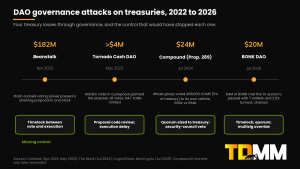
|
Incident |
Date |
What happened |
Missing control |
|
Beanstalk |
April 2022 |
Flash-loaned voting power passed a proposal that drained $182M in one transaction |
Timelock between vote and execution |
|
Tornado Cash DAO |
May 2023 |
A proposal containing hidden code granted the attacker all votes; more than 1M TORN was minted and part of it sold |
Proposal code review; execution delay |
|
Compound, Proposal 289 |
July 2024 |
A whale group passed a transfer of 499,000 COMP (about $24M, 5% of the treasury) to a vehicle it controlled, 682,191 votes to 633,636 |
Quorum sized to treasury value; a security-council veto |
|
BONK DAO |
July 2026 |
Attacker bought about $4M of BONK, met the 1% quorum, passed a proposal with seven wallets and 2.9% turnout, drained about $20M |
Timelock; quorum; multisig override |
The controls are standard and cheap. A timelock of 24 to 72 hours between a passed vote and execution. A quorum expressed as a share of circulating supply, reviewed whenever the token price changes the cost of reaching it. A security council or foundation veto that can cancel, but not initiate, a treasury transfer; ENS moved control of its roughly $65 million endowment to a Cayman foundation with a nine-day timelock and a security-council veto in August 2026. Proposal simulation before the vote goes live. And a limit on how much of the treasury any single proposal can move, so that a capture costs the attacker more than it can pay.
Best practice 7: Manage the native token as inventory: liquidity, market making, unlocks and buybacks
This is the part of treasury management most guides leave to “the tokenomics team”, and it is where TDMM does most of its work with digital asset projects. The native token is the largest line on the balance sheet, the most volatile, and the one whose handling determines whether the other buckets can ever be refilled.
Liquidity is a treasury asset
A token with no depth cannot be used for anything a treasury needs: it cannot be sold to fund runway, cannot be lent, cannot be used for grants without the recipient dumping it, and cannot be bought back without the buyback moving the price more than the tokens are worth. CoinGecko’s 2025 liquidity report puts the scale in context: even DOGE, a top-ten asset, has only about $10 to 12 million of single-sided depth within ±2% across the eight largest exchanges. A mid-cap token typically has a small fraction of that, spread across venues that do not share a book.
CoinGecko’s 2026 spot exchange report found that only about 32% of newly listed tokens are above their listing price 30 days after listing, and fewer than 10% are still above it after twelve months. CryptoRank’s July 2026 study of 113 tokens launched in 2024–2026 that reached a $100 million market cap found 93% below their launch price with a median drawdown of 95.7%. Liquidity does not change the direction of a token, but it decides whether the project’s own treasury can act when it needs to.
How projects fund market making from the treasury
Token projects engage a market maker under one of three structures, and the choice is a treasury decision because each one puts a different asset at risk.
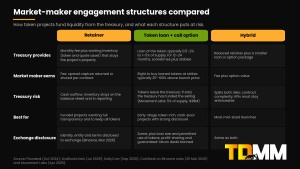
|
Structure |
What the treasury provides |
What the market maker earns |
Treasury risk |
Best for |
|
Retainer |
Monthly fee plus working inventory of the token and the quote asset, which stay the project’s property |
Fee; spread capture returned or shared per contract |
Cash outflow; inventory remains on the project’s balance sheet and in its reporting |
Funded projects that want full transparency and to keep all tokens |
|
Token loan plus call option |
A loan of the token, published ranges run from 0.5–2% to 1–5% of supply, for 12–24 months |
The right to buy the loaned tokens at strike prices typically 25–100% above the launch price |
Tokens leave the treasury; if the market maker sells them, the treasury has funded the selling; incentives tied to the strike |
Early-stage, token-rich, cash-poor projects, with strong disclosure |
|
Hybrid |
Reduced retainer plus a smaller loan or option package |
Fee plus option value |
Splits the two risks; contract complexity |
Most mid-sized launches |
The risk in the loan model is not theoretical. In December 2024 a market maker for Movement Labs sold about 66 million MOVE the day after listing, with almost no buy orders, for about $38 million; Binance offboarded the firm in March 2025 and froze the proceeds. CoinDesk’s investigation found that 5% of MOVE’s supply had been lent to an intermediary under a contract that allowed liquidation once the fully diluted valuation passed $5 billion, with a 50/50 profit split. Movement Labs filed for Chapter 11 in July 2026. Mantra’s OM fell 90% in under 24 hours in April 2025 after about $220 million of OM was moved to exchanges and leveraged positions were liquidated; the project later burned 300 million tokens, half from the founder’s allocation. Sahara AI’s token fell 42% in a day in November 2025 when a market maker’s positions were liquidated by an exchange’s risk controls.
Exchanges have responded. Since 25 March 2026 Binance requires token issuers to disclose the identity and legal entity of their market makers, the contract terms and how loaned tokens may be used; it bans profit-sharing and guaranteed-return arrangements, publishes a list of red flags (selling that does not match the unlock schedule, persistent one-sided selling, coordinated deposits across exchanges, high volume with a flat price) and reserves the right to blacklist market makers. The US Department of Justice’s Operation Token Mirrors, which sentenced the founder of Gotbit and forced the firm to cease operations in June 2025, drew the same line from the criminal side.
For a treasury, the practical rules are these. Any token lent to a market maker is recorded as an encumbered asset, not runway. The loan size is set as a share of circulating supply with the exchange’s disclosure rules in mind. The contract specifies measurable service levels (spread, depth within ±1% and ±2% per venue, uptime) and reporting frequency, and it prohibits the market maker from selling loaned inventory except as part of two-sided quoting. And the project has visibility into inventory, spread, depth, uptime and P&L in real time, so the liquidity budget is auditable.
Unlocks and exit management
Every scheduled unlock is a treasury event with a 30-day lead time. The treasury calendar should show each cliff and linear emission by recipient class, the expected sell pressure as a multiple of average daily volume, and the plan: OTC placements arranged in advance for large investor tranches, market-maker depth increased into the unlock window, TWAP schedules for treasury sales, and communication to the community before the date. The Keyrock data shows the pressure starts a month early; so should the plan.
Exit management, the orderly conversion of native tokens into operating capital, is the same discipline run continuously rather than around dates. A project that needs $10 million of runway from a token with $2 million of daily organic volume is looking at a programme measured in months, executed across venues, with hedges where options liquidity exists. That programme is a market-making function, and it is one of the services TDMM provides alongside quoting.
Buybacks: when they help and when they burn the treasury
Buybacks became the most visible treasury policy of 2025–2026, and the data on them is mixed enough that the decision deserves a table.
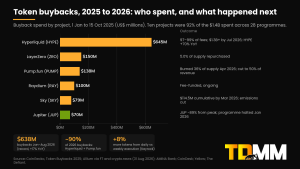
|
Protocol |
Programme |
Outcome |
|
Hyperliquid |
97–99% of fees to the Assistance Fund; more than $1.3B of HYPE bought by July 2026, about 7% of market cap a year |
HYPE up about 70% year on year in August 2026; a 37M-HYPE burn (13% of supply) proposed December 2025 |
|
Pump.fun |
100% of net revenue to buybacks from July 2025; more than $300M by February 2026 |
Burned 36% of circulating supply (about $370M) in April 2026, then cut the programme to 50% of revenue to fund operations; token spent 2026 below its launch valuation |
|
Jupiter |
More than $70M spent in 2025 |
JUP fell about 89% from its peak; buybacks absorbed about 6% of unlocking tokens; programme halted January 2026 with the co-founder noting “the price obviously didn’t move much” |
|
Aave |
$1M a week from April 2025; 205,000+ AAVE (1.28% of supply) bought; $50M annual budget proposed October 2025 |
Budget cut to $30M in March 2026; automated Aavenomics 3.0 live June 2026 |
|
Sky |
About $114.5M spent for about 1.83B SKY; emissions cut February 2026 |
About 67% of SKY staked; $26M bought in 2026 through August |
|
Optimism |
50% of Superchain revenue (about 5,868 ETH a year) to OP purchases, approved January 2026 |
Purchased OP goes to the collective treasury rather than a burn |
|
Uniswap |
100M UNI (about $596M) burned from the treasury in December 2025; protocol fee switched on |
Circulating supply cut to about 730M; about $600M a year of fees now partly directed to burns |
Across the market, CoinGecko tracked more than $1.4 billion of buybacks across 28 projects from January to mid-October 2025, with Hyperliquid alone at 46% and ten projects at 92%. Allium’s data for 1 January to 31 August 2026 shows a record $638 million, up 17% on the same period of 2025, with Hyperliquid and Pump.fun about 90% of it. Keyrock’s research adds two design findings: protocols that share revenue sent about 64% of it to holders on average, and daily execution accumulated about 8% more tokens than weekly lump sums.
The treasury test for a buyback is simple. If the protocol has revenue that exceeds its runway needs, an operating reserve that is already full, and a token with enough organic depth that the buyback does not become the market, a programmatic buyback sized to organic volume is a defensible use of surplus. If any of those three is missing, the buyback is a transfer from the treasury to whoever is selling into it. Jupiter’s $70 million against 53 million JUP a month of unlocks is the cautionary case; Hyperliquid’s, funded entirely from fees on a token with deep markets, is the model.
Best practice 8: Account, report and comply like a company, because regulators now expect it
Accounting. Under FASB ASU 2023-08, effective for fiscal years beginning after 15 December 2024, US companies mark crypto assets to fair value through net income each period. Strategy reported a Q2 2026 net loss of $8.22 billion, almost all of it an $8.32 billion unrealised mark-to-market loss on its 846,000 BTC. Liquid-staking and restaking tokens fall outside the standard’s scope and stay on the older impairment model: SharpLink took a $76.1 million impairment on LsETH and weETH in the same quarter. In April 2026 FASB tentatively decided to extend fair-value treatment to wrapped tokens and to add examples of when a stablecoin qualifies as a cash equivalent (one-to-one high-quality reserves, direct on-demand redemption); a proposal is expected with a 90-day comment period. Under IFRS, crypto is still generally an intangible under IAS 38 or inventory under IAS 2, with IASB research on stablecoins as cash equivalents scheduled for the second half of 2026. Treasury policy should specify which assets are held in which form partly because of this: a staked-ETH position and an unstaked one carry different accounting.
Stablecoin and market-structure rules. The US GENIUS Act, signed 18 July 2025, will govern payment stablecoins once implementing rules are final; the OCC missed the July 2026 statutory deadline and is targeting a final rule by November 2026, with the Act taking effect no later than 18 January 2027. The CLARITY Act, the market-structure bill, failed a Senate cloture vote 49 to 50 on 15 September 2026, leaving the SEC’s proposed “Regulation Crypto Assets” (18 August 2026), with its $75 million-per-year offering exemption and investment-contract safe harbour, as the live US rulemaking. In the EU, MiCA’s transitional periods for crypto-asset service providers ended on 1 July 2026 with no extensions. Hong Kong’s HKMA issued its first two stablecoin issuer licences in April 2026. The OECD’s Crypto-Asset Reporting Framework started data collection in the first wave of jurisdictions on 1 January 2026, with first exchanges of information in September 2027.
Reporting. Whatever the jurisdiction, a treasury that publishes a monthly report with the same fields every month (assets by bucket, runway in months, yield earned, tokens encumbered, unlocks in the next 90 days, custody changes, and any market-maker inventory movements) will find every one of the conversations above easier: with exchanges, with auditors, with token holders and with regulators. Entropy Advisors’ monthly updates for Arbitrum DAO and kpk’s reports for ENS are two public templates.
What digital asset treasury companies taught everyone in 2026
Public companies that hold BTC, ETH or SOL as their primary asset ran the largest treasury experiment of the cycle. 197 public companies held 1.27 million BTC (6.05% of supply) in September 2026; Strategy alone held 845,050 BTC at an average cost of $75,412. BitMine held 5.96 million ETH, 5.07 million of it staked for about $334 million a year of yield; SharpLink held 888,938 ETH.
The lesson came from the equity side. In 2025 nearly 200 companies bought about $96 billion of BTC and 68 added $22 billion or more of ETH, most of them funded by selling shares at a premium to net asset value. By January 2026 about 40% of the top 100 Bitcoin treasury companies traded below the value of their holdings; Strategy’s enterprise multiple to NAV compressed from about 7x to 1.1x, and in August 2026 it sold 1,690 BTC for the first time to fund a preferred-stock buyback while holding a $5.1 billion cash reserve to cover more than two years of dividends and interest. Galaxy Research expected at least five treasury companies to face asset sales or closure in 2026.
The transferable rules: a treasury strategy that only works while the market pays a premium is not a strategy; debt and dividend obligations need a dollar reserve sized in years, not months; and staking yield, custody quality and cost of capital are what separate the survivors, which is exactly the list a DAO treasury committee should be working from.
The 2026 treasury health scorecard
A treasury policy is only as good as the numbers it reports against. These twelve indicators fit on one page and cover the eight practices above.
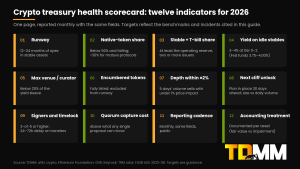
|
Indicator |
Target in 2026 |
Why it matters |
|
Runway (months of opex in stable assets) |
12–24 months; 30+ for foundations with long grant commitments |
The survival metric |
|
Native-token share of treasury |
Below 50% and falling; below 30% for mature protocols |
Concentration is the largest loss driver |
|
Stablecoin and T-bill share |
At least the operating reserve; diversified across two or more issuers |
Issuer risk; USDT and USDC are 83% of supply |
|
Yield on idle stable assets |
3–4% with principal risk at tier 0–2 |
The Fed funds rate is 3.75–4.00% |
|
Largest single venue or curator exposure |
Below 25% of the yield sleeve |
Stream, Resolv and Balancer were single-point failures |
|
Encumbered tokens (lent, locked, posted) |
Fully listed and excluded from runway |
Loans to market makers are not liquidity |
|
Order-book depth within ±2% across venues |
Sized so a treasury sale of 5 days’ volume moves price under 1% |
Lido’s $90,000 problem |
|
Days to next cliff unlock and its size vs daily volume |
Plan in place 30 days ahead |
Keyrock’s 30-day lead |
|
Signer threshold and timelock |
3-of-5 or higher; 24–72 hour delay on treasury transfers |
Drift, BONK |
|
Governance quorum vs cost to capture |
Cost to reach quorum above the amount any single proposal can move |
Compound, BONK |
|
Reporting cadence |
Monthly, same fields, public |
Auditability |
|
Accounting classification per asset |
Documented (fair value vs impairment; cash-equivalent status) |
ASU 2023-08; SharpLink |
A 90-day plan to get there
For a project starting from a single multisig and a spreadsheet, the sequence that works is: in the first 30 days, inventory every asset and encumbrance, compute runway on a token-to-zero basis, move all operating funds behind a timelocked multisig with hardware signing, and put the unlock calendar in front of the team. In days 30 to 60, fund the operating reserve to at least 12 months through OTC and programmatic sales planned with the market maker, place that reserve into tokenized Treasuries and tier-2 lending across at least two providers, and publish the first monthly report. In days 60 to 90, adopt the treasury policy by governance vote (bucket targets, custody rules, quorum and timelock, yield mandate, disclosure of market-maker terms), engage or renegotiate the market-making contract with measurable service levels, and stress-test the whole thing against a further 50% drawdown in the native token.
Why token projects work with TDMM on treasury and liquidity
TDMM (TradeDog Market Maker) is the institutional market-making and token market-management arm of the TradeDog Group. Since 2015 it has traded more than $10 billion across 100+ centralized and decentralized exchanges and currently manages 200+ markets, on venues including Binance, OKX, Bybit, Gate, KuCoin, Bitget, MEXC and HTX and on Uniswap, PancakeSwap, Raydium and SushiSwap.
What makes TDMM the natural partner for crypto treasury management is that liquidity and treasury are run as one book:
- Treasury management and yield inventory optimisation. TDMM helps projects structure the operating reserve, strategic reserve and yield sleeve, deploy idle stablecoins and ETH within written risk limits, and report on all of it in one place.
- Exit management. Converting native tokens into operating capital across venues, over time, with the market-making desk absorbing the flow so the treasury’s own sales do not become the price.
- Market making and liquidity provisioning. Two-sided quoting across CEX and DEX venues from a single inventory and risk view, 24/7, with real-time reporting on spread, depth, uptime, inventory and P&L, so a treasury always knows what its liquidity budget is buying.
- Unlock and listing support. Depth built into unlock windows, listing requirements met with a named, disclosed market maker, and the disclosure exchanges now require prepared in advance.
- Integrity. TDMM quotes real two-sided markets with real counterparties. It does not manufacture volume, does not promise a price, and structures token loans so that the treasury’s inventory is never the source of the selling.
If your treasury is more than half native token, your runway is measured in a spreadsheet nobody has updated since the last rally, or your market-maker contract was signed before exchanges started asking to see it, TDMM can assess the position and propose a treasury and liquidity plan. Visit tdmm.io to start the conversation.
Frequently asked questions
What is crypto treasury management?
Crypto treasury management is the set of policies a DAO, foundation or token company uses to hold, protect, deploy and report on its assets: stablecoins, ETH and BTC, the native token, LP and staked positions, and tokens lent to market makers. It covers runway planning, diversification, yield, custody, governance controls, unlock scheduling and liquidity.
How much runway should a crypto project or DAO hold?
Twelve to twenty-four months of operating expenses in stablecoins, tokenized Treasury bills or fiat, counted as if the native token were worth zero. a16z crypto recommends at least 12 and ideally 18 months; GSR’s 2026 research recommends 12 to 24; the Ethereum Foundation holds a 2.5-year fiat buffer and caps annual spending at 15% of its treasury.
What are the best practices for DAO treasury management in 2026?
Split the treasury into an operating reserve, a strategic reserve, a yield sleeve and a token inventory with separate rules; fund the operating reserve while the token is strong; earn tier-0 to tier-2 yield on idle stablecoins; use MPC or a multisig with hardware signing and a timelock; set quorum and veto controls that make governance capture uneconomic; manage unlocks with a 30-day plan; and disclose market-maker terms.
Why is holding the treasury in the native token a problem?
Because the treasury’s value then rises and falls with the token, so the money runs out exactly when the project most needs it. DAO treasuries lost $12.6 billion in six months in 2024 for that reason, and Mantle’s treasury fell from $4.03 billion to $2.29 billion in the year to September 2026 with no change in spending. More than 70% of DAO treasury assets were still native tokens in 2026.
What yield can a crypto treasury earn safely in 2026?
About 3.2 to 3.6% from tokenized US Treasury funds such as BUIDL, USDY, BENJI and USYC, and about 3.6% from top-tier stablecoin lending markets like Aave and the Sky Savings Rate, against 3.97% on a three-month T-bill. Curated vaults pay 3.3 to 4.9% and synthetic dollars around 5%, with correspondingly more risk.
What is DeFi treasury management?
DeFi treasury management is the on-chain part of the discipline: deploying treasury assets into lending markets, tokenized Treasuries, staking and liquidity pools under a written mandate, with venue and curator concentration limits, oracle and collateral checks, and monitoring. The Stream Finance and Resolv incidents show that the risk to manage is usually the counterparty or the key, not the protocol.
How should a treasury sell or diversify its native token?
Through OTC block sales for large tranches, TWAP or VWAP programmes for regular funding, and collars or covered calls to hedge holdings without selling, all coordinated with the project’s market maker so the sales are absorbed rather than dumped into the book. Market orders are the method that damages price most.
What is the connection between treasury management and market making?
The native token is the largest treasury asset, and it can only be sold, lent, hedged or bought back if it has liquidity. A market maker builds that depth across venues; the treasury decides how the token is released into it. Exchanges such as Binance now require issuers to disclose market-maker identities and loan terms, which makes the contract a treasury document.
How do token unlocks affect a treasury?
Keyrock’s study of 16,000 unlocks found 90% put downward pressure on price, team unlocks by about 25% on average, with pressure starting 30 days before the unlock. $97.43 billion of tokens unlocked in 2025. A treasury should plan each unlock a month ahead with OTC placements, added market-maker depth and community communication.
Are token buybacks a good use of treasury funds?
Only when revenue exceeds runway needs, the operating reserve is full, and the token has enough organic depth that the buyback does not become the market. Hyperliquid’s fee-funded programme is the model; Jupiter’s $70 million of buybacks against heavy unlocks, halted in January 2026 after the token fell 89%, is the cautionary case.
Glossary
- Operating reserve: stable assets held to pay a project’s costs for a fixed number of months regardless of the native token’s price.
- Runway: months of operating expenses covered by the operating reserve.
- Encumbered asset: a token that is lent, locked, staked with an exit delay or posted as collateral, and therefore not available to fund runway.
- Tokenized Treasury: an on-chain fund token backed by US Treasury bills, such as BUIDL, USDY, BENJI or USYC.
- Curator: a firm that sets collateral, caps and parameters for a lending vault on protocols such as Morpho or Euler.
- Timelock: a mandatory delay between a governance vote or multisig approval and its execution, during which it can be cancelled.
- Quorum: the minimum voting power a proposal needs to pass; a governance capture becomes possible when buying quorum costs less than the proposal can move.
- Collar: an options position that sells a call above the market and buys a put below it, capping upside to fund a floor.
- Protocol-owned liquidity: liquidity-pool positions held by the treasury rather than rented from third-party providers.
- Token loan plus call option: a market-making structure in which the project lends tokens as inventory and the market maker earns the right to buy them at preset strike prices.
- mNAV: a digital asset treasury company’s market capitalisation divided by the value of its crypto holdings.
- ASU 2023-08: the FASB standard requiring US companies to mark in-scope crypto assets to fair value through net income.
Sources and further reading
- GSR, DAO treasury research (August 2026), as reported by Crypto Briefing and Bloomingbit, 8 August 2026.
- DeepDAO data on DAO treasury assets under management, as reported by Decrypt (February 2022), Cointelegraph (March 2023) and Bitcoin.com News (October 2024).
- DefiLlama, Treasuries dashboard, holders revenue, stablecoin and TVL data, 17 September 2026.
- Mantle, Treasury page, 16 September 2026; DefiLlama treasury data via Yahoo Finance, 29 August 2025.
- Uniswap Foundation 2025 financial report, as reported by The Block, 1 April 2026; CoinDesk and Cointelegraph on UNIfication, December 2025.
- kpk, ENS Endowment H1 2026 review, ENS forum, 14 August 2026; Crypto Briefing on the ENS Foundation vote, August 2026.
- Entropy Advisors, Arbitrum DAO monthly update July 2026; The Block on STEP 1 and STEP 2, May 2025.
- RWA.xyz, tokenized Treasuries dashboard, 17 September 2026, and July 2026 data via Yahoo Finance; CoinGecko RWA Report 2026.
- Federal Reserve H.15 release, 16 September 2026; FOMC decision, 16 September 2026.
- Allium, State of Stablecoins and Payments, September 2026; Coinbase and EY-Parthenon, 2026 Institutional Investor Survey, January 2026.
- Pharos, Stream Finance and Elixir contagion case study; Chainalysis, Lessons from the Resolv hack, March 2026; CoinMarketCap on Morpho curator exposure, 26 March 2026; crypto.news on the Balancer wind-down vote, September 2026.
- Chainalysis, 2025 stolen funds report, 18 December 2025; TRM Labs, 2026 Crypto Crime Report, 28 January 2026; Blockaid and TRM H1 2026 figures via Crypto Briefing, 29 July 2026.
- The Block on the Bybit hack, 26 February 2025; KuCoin research on Drift and KelpDAO, May 2026; CoinDesk and Chainalysis on the KelpDAO exploit, April 2026.
- CryptoTicker and BeInCrypto on the BONK DAO governance attack, July 2026; The Block on Compound Proposal 289, July 2024; CoinDesk on Beanstalk (April 2022) and Tornado Cash (May 2023).
- Safe Foundation Q1 2026 report, 23 April 2026; The Block on Safe Q2 2026, 29 July 2026; CoinDesk on BitGo’s IPO, January 2026.
- Keyrock, From Locked to Liquidity (December 2024) and Designing Token Buybacks (October 2025); Tokenomist, 2025 Token Unlocks Review, 21 January 2026.
- Wintermute, Digital Asset OTC Markets 2025, 13 January 2026, and H1 2026 OTC commentary.
- The Block and CoinDesk on the Lido buyback proposal, March 2026.
- CoinGecko, Token Buybacks 2025; Allium buyback data via crypto.news, 31 August 2026; AMINA Bank on Hyperliquid, July 2026; CoinDesk on Pump.fun, April 2026; Yellow and KuCoin on Jupiter, January 2026; The Defiant on Aavenomics 3.0, June 2026; CoinDesk on Sky, March 2026; The Block on Optimism, January 2026.
- CoinGecko, Spot Centralized Exchanges Report 2026 and Crypto Liquidity on CEXes 2025; CryptoRank, tokens below launch price, 21 July 2026.
- CoinDesk on Binance market-maker rules, 25 March 2026; The Block and CoinDesk on Movement Labs (March, April 2025; July 2026); CoinDesk on Mantra (April 2025); US Department of Justice on Gotbit, June 2025; Flowdesk and WuBlockchain on market-maker deal structures.
- a16z crypto, treasury management guide; Ethereum Foundation, treasury policy, 4 June 2025.
- RootData project closure data via CoinDesk, 9 August 2026; Galaxy Research Q2 2026 venture data via crypto.news, 17 September 2026.
- Strategy Q2 2026 results, 30 July 2026, and The Block, 14 September 2026; SharpLink Q2 2026 results, 10 August 2026; BitMine holdings update, 14 September 2026; BitcoinTreasuries.net, September 2026; DL News and Yahoo Finance on treasury-company NAV discounts, December 2025 and January 2026; Galaxy Research commentary, March 2026.
- FASB ASU 2023-08 and April 2026 tentative decisions via CBIZ; PYMNTS on GENIUS Act rulemaking, 20 August 2026; CoinDesk on the CLARITY Act vote, 15 September 2026; SEC press release on Regulation Crypto Assets, 18 August 2026; ESMA statement on MiCA transitional periods, 17 April 2026; HKMA stablecoin licences, April 2026; OECD CARF implementation timeline.
- TDMM, company profile, tdmm.io.
Published by TDMM (TradeDog Market Maker) · Reading time: 19 minutes · Last updated: September 2026. Written By: Vaibhav Singh