

The short answer
Market making in crypto exchanges is the continuous business of placing both a buy order (bid) and a sell order (ask) on the same trading pair, so that anyone who wants to trade can do so immediately at a fair price. The market maker earns the difference between the two prices, the bid-ask spread, and uses algorithms to keep its quotes accurate, its inventory balanced and its risk under control, 24 hours a day, across dozens of centralized and decentralized venues. Without market makers, most token pairs would have wide spreads, thin order books and heavy slippage, and the price you see on screen would rarely be the price you actually get.
Key takeaways
- A market maker is paid for supplying immediacy. It quotes both sides of the order book at all times and captures the spread when a buyer and a seller cross its quotes.
- The bid-ask spread is the visible cost of trading; slippage is the hidden one. Both fall as market depth rises, and market depth is what a market maker manufactures.
- Modern market-making algorithms do not “set a price”. They compute a fair value, skew quotes to manage inventory, and re-quote hundreds of times per second across venues. The Avellaneda-Stoikov model is still the reference framework.
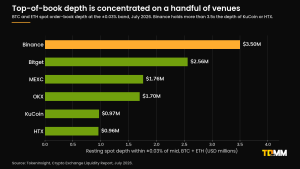
- Liquidity is concentrated and fragile. In July 2026, Binance alone held about $3.5 million of BTC and ETH spot depth within 0.03% of mid, more than 3.5x KuCoin or HTX. On 10 October 2025, visible Bitcoin perpetual liquidity fell 99.8% in under an hour when makers pulled back.
- The real role of a market maker is not to push a token’s price up. It is to make a token tradable at size, on every venue that matters, in every market condition. Firms that fake volume instead are now being prosecuted.
- TDMM has provided this service since 2015, with more than $10 billion traded across 100+ exchanges and 200+ markets, using proprietary execution algorithms and round-the-clock operations.
What is market making in crypto?
Every exchange, centralized or decentralized, faces the same problem: buyers and sellers rarely arrive at the same moment, in the same size, at the same price. If a trader wants to sell 20,000 tokens right now and the only buyers on the book want 300 tokens at a price 4% lower, the trade either fails or fills at a terrible price. A market maker solves this by standing in the middle. It keeps resting bids and asks on the book continuously, absorbing the seller’s tokens now and releasing them to the next buyer later, and it is compensated for that service by the spread between the two prices.
In traditional finance this role is formalized: designated market makers on the NYSE, Nasdaq market makers, liquidity providers in FX. In crypto the role is the same but the environment is harder. Markets never close. The same token trades on twenty venues that do not share an order book. Prices move 5% in a minute on a headline. Fees, API limits and settlement mechanics differ from exchange to exchange. And on decentralized exchanges, the “order book” is an automated market maker (AMM) smart contract with its own pricing curve.
That is why crypto market making is an algorithmic, infrastructure-heavy business rather than a trading desk with a few screens. A professional market maker such as TDMM runs quoting engines connected to 100+ exchanges, holds inventory of both the token and the quote asset on each of them, and manages the whole position as one portfolio.
Who are market makers working for?
Three parties depend on the service, and their interests are aligned more often than people assume:
|
Stakeholder |
What they need from a market maker |
What happens without one |
|
Exchanges |
Tight spreads and deep books on listed pairs so users can trade; many run formal market maker programs with fee rebates and higher API limits |
Thin pairs, complaints, delistings of illiquid tokens |
|
Token projects |
A tradable market at launch and after, on every venue, so investors, users and partners can enter and exit without moving the price |
Volatile, low-volume charts; failed listings; the token becomes uninvestable for funds |
|
Traders and investors |
The ability to buy or sell at the quoted price, in size, at any hour |
Slippage, failed fills, front-running, wide spreads |
Binance’s spot market maker program, for example, admits firms whose 30-day trading volume exceeds 1,000 BTC and scores them on maker volume, quoted spread, order size and order duration, in exchange for fee reductions and higher API limits. The exchange is paying for exactly the behaviour described in this article.
The anatomy of a crypto exchange order book
Before the algorithms, the terrain. Every order-book exchange displays two sorted lists: bids (what buyers will pay) and asks (what sellers will accept). The chart below shows an illustrative order book for a token trading around $100.
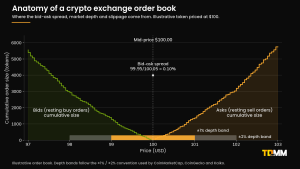
Four numbers on this chart matter to everyone who trades:
- Best bid – the highest resting buy order ($99.95 here).
- Best ask – the lowest resting sell order ($100.05).
- Mid-price – the average of the two ($100.00), the usual reference for “the price”.
- Market depth – the total size of resting orders within a given distance of the mid-price. The industry convention, used by CoinMarketCap, CoinGecko and Kaiko, is to report depth within ±1% and ±2%, and increasingly within ±0.1% for the most liquid pairs.
The market maker’s job is to sit at or near the best bid and best ask, and to layer additional orders behind them so that the ±1% and ±2% bands are well stocked. A book that looks like the chart above is a book with a market maker in it. A book without one looks like a staircase with missing steps.
Bid-ask spread and slippage explained
The bid-ask spread
The spread is the gap between the best ask and the best bid. It is usually expressed as a percentage of the ask or the mid-price:
Spread % = (Best ask − Best bid) ÷ Best ask × 100
In the example above: ($100.05 − $99.95) ÷ $100.05 × 100 = 0.10%, or 10 basis points (bps).
The spread is the round-trip cost of trading: buy at the ask, sell at the bid, and you have paid the spread even if the price has not moved. For the market maker, that same spread is gross revenue. Whoever crosses the spread pays it; whoever quotes it earns it.
How tight can spreads get? On the largest pairs, extremely tight. TokenInsight’s July 2026 liquidity report measured BTC spot spreads of roughly 0 to 0.02 bps on Binance, OKX, Bybit, Bitget, Gate, KuCoin, MEXC and HTX, and ETH spot spreads of 0.06 bps across all eight venues. That is the product of dozens of professional makers competing on the same pair. A newly listed mid-cap token on the same exchanges may show a spread of 30 to 100 bps, and a token with no market maker at all can show 300 bps or more.
|
Market |
Typical quoted spread |
Who is quoting |
|
BTC/USDT on a tier-1 CEX |
≈0–0.02 bps |
Dozens of HFT firms and market makers |
|
ETH/USDT on a tier-1 CEX |
≈0.06 bps |
Same |
|
Top-100 altcoin on a tier-1 CEX |
1–30 bps |
Several professional makers |
|
Newly listed mid-cap token with a market maker |
20–100 bps |
One or two contracted makers |
|
Long-tail token with no market maker |
200 bps to several % |
Nobody; retail limit orders only |
Sources: TokenInsight, Crypto Exchange Liquidity Report, July 2026 (BTC, ETH); TDMM observations across 200+ managed markets for the remaining rows. Ranges are indicative and vary with volatility.
Slippage
Slippage is the difference between the price you expected and the price you actually got. It happens because a market order eats through the book level by level. Suppose you send a market buy for 5,000 tokens into this book:
|
Level |
Ask price |
Size available |
Filled |
Cost |
|
1 |
$100.05 |
1,000 |
1,000 |
$100,050 |
|
2 |
$100.10 |
2,000 |
2,000 |
$200,200 |
|
3 |
$100.20 |
2,000 |
2,000 |
$200,400 |
|
Total |
5,000 |
$500,650 |
Your average price is $100.13. Measured against the best ask you saw on screen ($100.05), you slipped 0.08%. Measured against the mid-price, the total cost of the trade was 0.13%. On a $500,000 order that is $650 that went to nobody in particular; it is simply the cost of a book that was not deep enough for your size.
Slippage is therefore a function of two things: how large your order is, and how much resting liquidity there is near the mid-price. The chart below models that relationship for three kinds of order book.
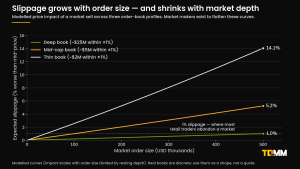
The takeaway for anyone running a token: a $250,000 sell that costs 0.5% of slippage on a well-made market can cost close to 7% on a thin one. Funds notice this before they invest. Exchanges notice it before they promote a pair. A market maker’s entire product is the blue line in that chart.
Real-world numbers confirm the shape. In TokenInsight’s July 2026 data, a $1 million BTC futures sell order incurred median slippage of just 0.008% on Hyperliquid and 0.009% on MEXC. At the other extreme, Kaiko’s liquidity primer cites an attempt to sell $100,000 of WLD on Uniswap v3 that would have incurred 6.3% slippage, returning only $93,600.
How traders reduce slippage
The standard advice from Binance Academy and every exchange help centre is the same: use limit orders instead of market orders, split large orders into smaller clips, trade on the deepest venue for the pair, and on DEXs set a slippage tolerance and watch gas. All of it is correct, and all of it is a workaround for a book that is not deep enough. The structural fix is a market maker.
How market makers make money (and how they lose it)
A market maker’s economics come down to four lines:
- Spread capture. Every time a buyer lifts the ask and a seller hits the bid, the maker earns the spread on the round trip.
- Fee rebates. Most exchanges charge takers more than makers, and their market maker programs pay negative maker fees (rebates) to firms that meet quoting standards.
- Inventory P&L. The maker is always holding some of the token. If the price moves against that inventory, the loss can dwarf a week of spread income.
- Adverse selection. Informed traders hit the maker’s quotes right before the price moves. Each such fill is a small loss. The algorithm’s job is to widen or step back before those fills arrive.
Here is a simplified day for a maker quoting a $1.00 token at a 0.30% spread ($0.9985 / $1.0015), doing 100 round trips of $5,000 each:
|
Line item |
Calculation |
Daily result |
|
Gross spread capture |
100 round trips × $5,000 × 0.30% |
+$1,500 |
|
Maker fees (0.01% per side) |
200 fills × $5,000 × 0.01% |
−$100 |
|
Adverse selection (avg 0.02% per fill against) |
200 fills × $5,000 × 0.02% |
−$200 |
|
Net trading income |
+$1,200 |
|
|
Inventory shock: token drops 5% while holding $200,000 |
$200,000 × 5% |
−$10,000 |
One adverse move erases more than a week of quoting income. That arithmetic explains everything about how market-making algorithms are designed: the spread is the revenue, but inventory is the risk, and the algorithm exists to keep the second from swallowing the first.
Market making algorithms: what actually runs on the servers
Market makers do not “decide” prices; they run a loop. The diagram below shows the six stages of a typical quoting engine. It runs continuously, per pair, per venue, with a cycle time measured in milliseconds.
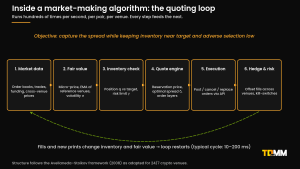
1. Fair-value estimation
The engine first decides what the token is worth right now. Inputs include the exchange’s own order book (weighted mid-price or “micro-price”, which leans toward the side with more size), trades on the deepest reference venue for the same token, perpetual futures prices and funding, and a short-horizon volatility estimate. On a token that trades on eight exchanges, the fair value on exchange number six is mostly derived from exchanges one and two.
2. Inventory-aware quoting: the Avellaneda-Stoikov model
The reference framework for the quoting decision is the Avellaneda-Stoikov model (2008), still the basis of most open-source and many proprietary crypto engines, including Hummingbot’s implementation. Its two equations are worth understanding even if you never trade:
Reservation price: r = s − q · γ · σ² · (T − t)
Optimal spread: δ = γ · σ² · (T − t) + (2 ⁄ γ) · ln(1 + γ ⁄ κ)
where s is the mid-price, q is the maker’s inventory (positive when long, negative when short), γ is the maker’s risk aversion, σ is volatility, κ describes how dense the order book is, and (T − t) is the time left in the trading session.
In plain language: the maker quotes around a reservation price rather than the market mid. When it is long too much inventory, the reservation price drops below mid, so both its bid and its ask move down; it sells more readily and buys more reluctantly until inventory returns to target. When it is short, the opposite. The chart below shows that skew.
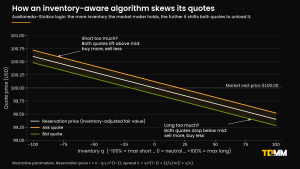
The spread itself widens with volatility (σ²) and with risk aversion (γ), and narrows when the book is dense (high κ) because competition forces tighter quotes. Crypto adaptations replace the fixed session end with a rolling horizon, since markets never close.
3. Other algorithm families used in crypto
|
Algorithm family |
How it works |
Where it is used |
Main weakness |
|
Avellaneda-Stoikov and variants |
Reservation price plus optimal spread from inventory, volatility and book density |
Core quoting on CEX order books |
Needs good parameter calibration; naive versions get run over in trends |
|
Grid / ladder quoting |
Layers of orders at fixed intervals above and below fair value |
Simple bots, ranging markets, DEX limit-order books |
Accumulates inventory in a trend; no adverse-selection defence |
|
Cross-exchange (hedged) market making |
Quote on a less liquid venue, hedge instantly on a deeper one |
Most professional token market making on secondary CEXs |
Depends on hedge venue depth and latency; basis risk |
|
Perpetual-hedged spot quoting |
Quote spot, hedge delta in the perpetual futures market |
Tokens with liquid perps |
Funding cost; liquidation risk on the hedge leg |
|
AMM liquidity provisioning |
Deposit into a Uniswap v3/v4-style concentrated range, rebalance the range as price moves |
DEX pairs |
Impermanent loss (loss-versus-rebalancing); arbitrageurs capture stale prices |
|
Reinforcement-learning tuning |
RL agent adjusts γ, spread and layer sizes from realised P&L |
Research and larger firms |
Overfitting; opaque behaviour in unseen regimes |
In practice a professional desk runs several of these at once. A mid-cap token might be quoted with an inventory-skewed model on Binance, hedged in the perp, mirrored on OKX and KuCoin through cross-exchange logic, and supported on Uniswap with a managed concentrated-liquidity position. TDMM’s proprietary stack coordinates these strategies across 100+ CEX and DEX integrations as one book, with a single inventory and risk view.
4. Execution and risk controls
The last stages are unglamorous and decisive. Execution engines batch cancels and replacements to stay inside API rate limits, use post-only flags to avoid accidentally taking liquidity, and keep quotes alive through exchange hiccups. Risk modules enforce per-venue inventory caps, maximum notional at risk, kill-switches on stale data or abnormal fills, and circuit breakers when the reference price and the venue price diverge. When a market maker “steps back” during a crash, it is usually one of these rules firing, not a human decision.
Where crypto liquidity actually lives
Market making happens in a specific market, and that market is concentrated. The tiles below summarise the environment in the second quarter of 2026.
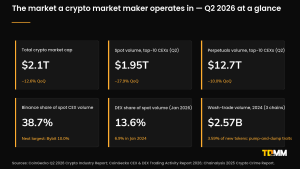
Three facts shape a market maker’s life:
Depth is concentrated on a few venues. In July 2026, Binance held about $3.5 million of BTC and ETH spot depth within ±0.03% of mid, versus $2.56 million on Bitget, $1.76 million on MEXC, $1.70 million on OKX and under $1 million on KuCoin and HTX. Kaiko’s liquidity-concentration report (2023 data) found the top eight exchanges holding roughly 92% of global market depth, with Binance alone at about 31%. A token that is only liquid on its deepest venue is one venue outage away from being illiquid.
Volume is cyclical; the obligation to quote is not. Spot volume on the top ten CEXs fell 27.9% from $2.70 trillion in Q1 2026 to $1.95 trillion in Q2, while Binance still handled 38.7% of it. A market maker’s contract does not pause when volumes halve; its spread income does. This is why serious makers price their engagements over a full cycle rather than a good month.
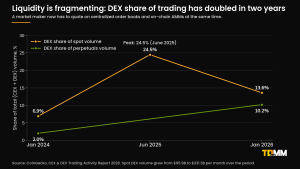
Liquidity is fragmenting on-chain. CoinGecko’s 2026 activity report shows the DEX share of spot volume doubling from 6.9% in January 2024 to 13.6% in January 2026, with a peak of 24.5% in June 2025, and the DEX share of perpetuals rising from 2.0% to 10.2%. Token projects now need liquidity on order books and in AMM pools simultaneously, and a maker who cannot run both is only covering part of the market.
What happens when market makers step back: 10 October 2025
The clearest way to see what market makers do is to watch what happens when they stop. On 10 October 2025, a tariff headline triggered the largest liquidation cascade in crypto history: more than $19 billion of leveraged positions were force-closed within roughly a day according to FTI Consulting, with Amberdata tracking $3.21 billion liquidated in a single minute at 21:15 UTC.
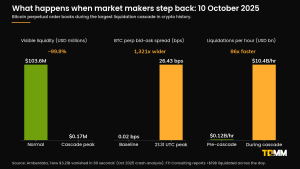
Amberdata’s order-book reconstruction shows visible Bitcoin perpetual liquidity collapsing from $103.64 million to $0.17 million, a 99.8% evaporation, while the bid-ask spread widened from a 0.02 bps baseline to a peak of 26.43 bps, more than 1,300 times normal. Bitcoin itself fell 6.84%. Altcoins with thinner books did far worse intraday: AVAX and AAVE printed drawdowns near 69%, DOGE near 65%. FTI’s post-mortem notes that top-of-book depth shrank by more than 90% on key venues and that makers responded “by dramatically widening spreads or withdrawing from the market entirely”.
Two lessons follow. First, market makers are not a guarantee against crashes; their risk rules are designed to pull quotes when fills become toxic, and any firm that promises otherwise is promising to lose its clients’ inventory. Second, the tokens that recovered fastest were the ones whose makers were back on the book within minutes, with fresh inventory and hedges in place. Resilience, not just tightness, is the measure of a market maker.
The real role of market making, and the fake one
Ask ten founders what a market maker does and several will answer “supports the price”. That misunderstanding has cost projects their tokens, their exchange listings and, in some cases, their freedom.
What a legitimate market maker does
- Quotes two-sided markets continuously on every venue where the token trades, within agreed spread and depth targets.
- Keeps prices consistent across exchanges so arbitrageurs are not the only source of liquidity.
- Absorbs order flow imbalances so that a large buyer or seller can be filled without a 20% candle.
- Supports listings: exchanges expect a named market maker before they list, and score pairs on spread and depth afterwards.
- Reports transparently: uptime, spread, depth, inventory and P&L, so the project knows what its liquidity budget is buying.
- Manages the project’s treasury and token inventory over the lifecycle: unlock schedules, exit programs, yield on idle reserves.
What a market maker must not do
- Wash trading: trading with itself to manufacture volume. Chainalysis identified $2.57 billion of suspected wash trading on Ethereum, BNB Chain and Base in 2024 alone, and found that 3.59% of the two million-plus tokens launched that year showed pump-and-dump patterns.
- Spoofing and layering: placing orders it intends to cancel to fake demand.
- Price targets: promising to hold or push a price. A market maker that buys to defend a level is no longer making a market; it is taking a directional position with someone else’s tokens.
The regulatory line is now enforced. In October 2024, the US Department of Justice’s “Operation Token Mirrors” brought the first charges against firms marketed as market makers, after the FBI created its own token, NexFundAI, and hired them to inflate its volume. In June 2025 the founder of one of them, Gotbit, was sentenced to prison and forfeited roughly $23 million, and the firm was ordered to cease operations. On 30 March 2026 prosecutors in the Northern District of California charged ten more individuals from four firms, Gotbit, Vortex, Antier and Contrarian, with wire fraud for wash-trading schemes; in one case 99% of a firm’s 1,221 traced transactions led back to wallets it controlled itself. In the EU, MiCA’s market-abuse provisions apply the same prohibitions to crypto-asset service providers. Exchanges, CoinMarketCap and CoinGecko have all tightened their volume and depth screens in response.
|
Real market making |
Volume manufacturing |
|
|
Objective |
Tradability: tight spreads, deep books, consistent cross-venue prices |
Appearances: high 24h volume, rising chart |
|
Order flow |
Two-sided quotes filled by real counterparties |
Self-matched trades, spoofed orders |
|
Effect on price |
Dampens volatility; does not set direction |
Artificial pumps followed by collapse |
|
Effect on listings |
Meets exchange market maker program KPIs |
Detected by exchange surveillance; delisting risk |
|
Reporting |
Spread, depth, uptime, inventory, P&L |
Volume screenshots |
|
Legal status |
Standard financial service |
Wire fraud, market manipulation (US); market abuse (EU MiCA) |
The commercial reality is even simpler: CoinGecko’s 2026 spot exchange report found that only about 32% of newly listed tokens trade above their listing price immediately after listing, and fewer than 10% are still above it after twelve months. Faked volume does nothing about that. A deep, honest market is the only thing that lets a token survive its own sellers.
How market maker engagements are structured
Token projects typically engage a market maker under one of three commercial models.
|
Model |
How it works |
Typical terms |
Best suited to |
Watch-outs |
|
Retainer |
Project pays a fixed monthly fee; market maker quotes with the project’s inventory or its own |
Public proposals show setup fees of $50,000–$100,000 and monthly retainers of $10,000–$50,000+ |
Funded projects that want to keep all tokens and full transparency |
Cash outflow every month regardless of market |
|
Token loan + call option |
Project lends tokens (and sometimes stablecoins) as inventory; maker earns the right to buy those tokens later at preset strike prices |
No or low cash fee; loan returned at term end; strikes set above launch price |
Early-stage, token-rich, cash-constrained projects |
Incentive to see the price cross the strike; terms need close scrutiny; tokens sit with a third party |
|
Hybrid |
Reduced retainer plus a smaller loan or option package |
Negotiated |
Most mid-sized launches |
Complexity; make sure KPIs are still enforceable |
Whatever the model, the contract should specify measurable service levels: maximum spread, minimum depth within ±1% and ±2% on each venue, quoting uptime (typically 95–99%), inventory reporting frequency, and what happens during extreme volatility. A market maker that will not commit to numbers is telling you something.
How to evaluate a crypto market maker: a checklist
|
Question to ask |
What a strong answer looks like |
|
Which exchanges can you quote on today, with live integrations? |
A long, verifiable list covering the tier-1 CEXs, regional CEXs and the main DEXs on your chain. TDMM operates across 100+ CEX and DEX integrations. |
|
What spread and depth will you commit to, per venue? |
Specific bps and dollar figures per pair, with a dashboard to verify them. |
|
How do you handle a 30% intraday move? |
A clear description of inventory limits, hedging venues, and when quotes widen versus withdraw. |
|
How do you report? |
Real-time or daily reporting on spread, depth, uptime, inventory and P&L. |
|
What is your track record through a full cycle? |
Years of operation, volume traded, references from listed projects. TDMM has been active since 2015 with $10 billion+ traded. |
|
Do you offer services beyond quoting? |
Listing support, treasury management, exit management, yield on idle inventory. |
|
Will you ever trade against yourself or promise a price? |
An unambiguous no. |
Why token projects and exchanges work with TDMM
TDMM (TradeDog Market Maker) is the institutional market-making and token market-management arm of the TradeDog Group. It has been active in crypto markets since 2015, has traded more than $10 billion in volume, and currently manages liquidity across 200+ markets on 100+ centralized and decentralized exchanges, including Binance, OKX, Bybit, Gate, KuCoin, Bitget, MEXC and HTX on the CEX side and Uniswap, PancakeSwap, Raydium and SushiSwap on-chain.
What distinguishes TDMM’s approach is that market making is treated as one part of a token’s operating model rather than a standalone bot:
- Proprietary quantitative technology. In-house execution algorithms run inventory-aware quoting, cross-venue hedging and AMM range management from a single risk book, 24/7, with a team of 30+ professionals across five continents.
- Transparency by design. Clients see spread, depth, uptime, inventory and P&L in real time, so the liquidity budget is auditable.
- Full lifecycle coverage. Beyond quoting, TDMM provides liquidity provisioning, treasury management, yield optimisation on idle inventory, exit management and token listing support, from pre-launch through post-listing.
- Breadth of assets. Coverage spans DeFi, GameFi, L1 and L2 infrastructure tokens, RWAs, stablecoins, memecoins and NFT finance.
- Integrity. TDMM quotes two-sided markets with real counterparties and does not manufacture volume or defend price levels. That is the only kind of market making exchanges and regulators accept in 2026.
If you are preparing a token launch, fixing an illiquid pair, or moving to a new exchange, TDMM can assess your current spread, depth and slippage profile and propose a liquidity plan. Visit tdmm.io to start the conversation.
Frequently asked questions
How does market making work in crypto exchanges?
A market maker places simultaneous buy and sell limit orders on a trading pair and keeps them updated continuously. Traders who want to buy immediately fill the maker’s ask; traders who want to sell fill its bid. The maker earns the spread between the two, manages the inventory it accumulates using algorithms, and hedges risk across other venues.
What is the bid-ask spread in crypto?
The bid-ask spread is the difference between the highest price a buyer will pay (bid) and the lowest price a seller will accept (ask). Expressed as a percentage of the ask, a $99.95 bid against a $100.05 ask is a 0.10% (10 bps) spread. It is the built-in cost of a round-trip trade.
What is slippage and why does it happen?
Slippage is the gap between the expected price and the executed price of an order. It occurs when an order is larger than the liquidity available at the best price, so it fills across several price levels. Deeper order books mean less slippage; that depth is what market makers supply.
Do market makers control the price of a token?
No. A market maker quotes around the market’s fair value and profits from the spread, not from the direction. Its algorithms skew quotes to shed inventory, which dampens volatility but does not set a trend. Firms that promise to hold or push a price are taking a directional bet with client tokens and, if they use wash trades to do so, are committing market manipulation.
What algorithms do crypto market makers use? T
he most common framework is the Avellaneda-Stoikov model, which computes a reservation price and optimal spread from inventory, volatility and order-book density. Professional desks combine it with cross-exchange hedged quoting, perpetual-futures hedging, grid strategies for ranging markets, concentrated-liquidity management on AMMs, and increasingly machine-learning parameter tuning.
How do market makers make money?
Primarily from spread capture on each round trip, supplemented by maker fee rebates from exchange market maker programs. Their main risks are inventory losses when the price moves against what they hold and adverse selection from informed traders.
How much does a crypto market maker cost?
Retainer engagements disclosed publicly range from roughly $10,000 to $50,000 or more per month plus setup fees of $50,000 to $100,000, depending on the number of venues and depth commitments. Loan-plus-call-option structures replace most of the cash fee with token inventory and options. Hybrid deals are common.
What is the difference between a market maker and a liquidity provider on a DEX?
On a DEX, anyone who deposits into an AMM pool is a liquidity provider, and the pool’s formula sets prices automatically. A professional market maker on a DEX actively manages concentrated-liquidity ranges and rebalances them as price moves, and typically hedges the position on centralized venues. On a CEX, “market maker” and “liquidity provider” are usually the same thing.
Why do exchanges require a market maker before listing a token?
Because an unmade market produces wide spreads, thin depth and bad user experience, which reflects on the exchange. Exchanges score pairs on spread, depth and uptime, and many run formal market maker programs with fee rebates to attract quoting on their listings.
What should a token project look for in a market maker?
Verifiable exchange coverage, committed spread and depth targets per venue, transparent real-time reporting, a track record across a full market cycle, clear risk rules for extreme volatility, and an explicit refusal to wash trade or defend price levels.
Glossary
- Basis point (bps): one hundredth of one percent. 10 bps = 0.10%.
- Market depth: the total value of resting orders within a set distance (usually ±1% or ±2%) of the mid-price.
- Maker / taker: a maker adds a resting order to the book; a taker removes one by trading against it. Exchanges usually charge takers more.
- Inventory risk: the risk that the tokens a market maker holds lose value before they can be sold.
- Adverse selection: losses from being filled by traders who know more about the next price move than the market maker does.
- AMM: automated market maker, a smart contract that prices trades from a formula and pooled liquidity rather than an order book.
- Impermanent loss: the shortfall an AMM liquidity provider suffers versus simply holding the assets, caused by rebalancing against arbitrageurs.
- Wash trading: trading with oneself to create the appearance of volume; illegal in most jurisdictions.
Sources and further reading
- TokenInsight, Crypto Exchange Liquidity Report, July 2026.
- CoinGecko, 2026 Q2 Crypto Industry Report; CEX & DEX Trading Activity Report 2026; Spot Centralized Exchanges Report 2026.
- Kaiko, Understanding Centralized Exchange Liquidity Data; The Crypto Liquidity Concentration Report.
- Amberdata, How $3.21B Vanished in 60 Seconds: October 2025 Crypto Crash Explained Through 7 Charts.
- FTI Consulting, Crypto Crash October 2025: Leverage Meets Liquidity.
- Chainalysis, Crypto Market Manipulation 2025: Suspected Wash Trading, Pump and Dump Schemes.
- US Department of Justice, District of Massachusetts, Gotbit and founder sentenced for market manipulation, June 2025; Northern District of California, Ten foreign nationals charged in international operation targeting cryptocurrency market manipulation, March 2026; TRM Labs analysis of the same case.
- Avellaneda, M. and Stoikov, S., High-frequency trading in a limit order book, Quantitative Finance, 2008; Hummingbot, Guide to the Avellaneda & Stoikov Strategy.
- Binance, Spot Market Maker Program announcement; Binance Academy, Bid-Ask Spread and Slippage Explained.
- Spark, Crypto Market Makers Compared; GREED Labs, Loan vs. Retainer: How Market Maker Deals Are Structured.
- TDMM, company profile, tdmm.io.
Published by TDMM (TradeDog Market Maker) · Reading time: 19 minutes · Last updated: September 2026. Written By: Vaibhav Singh