


Disclosure: TDMM is a CEX and DEX market maker for token projects. We say so at the top, publish our method and data, and point out where a founder does not need to hire anyone.
The short answer
Founders most often get market making wrong in three ways: they expect a market maker to create demand or hold a price, they pay for trading volume instead of order book depth, and they sign deals they cannot measure or price. A market maker sells liquidity, meaning a two-sided market with a tight spread and real depth on every venue, for the whole life of the token. TDMM’s snapshot of 2,121 order books on 5 October 2026 found that volume explains only 23% of a book’s depth and that 72.9% of books were thin on at least one side. The fix is a written mandate with spread, depth and uptime targets per venue, run across CEX and DEX from before TGE to well after it, which is how TDMM works with token projects.
Key takeaways
- A market maker supplies liquidity, not demand. It keeps a two-sided market so people can trade at a fair price. It cannot create buyers, and any firm that promises a price or a volume number is describing either something it cannot deliver or something that breaks exchange rules.
- Volume is not liquidity. Across 2,121 small and mid-cap USDT order books on Gate and MEXC, trading volume explained only 23% of the variation in depth. Tokens doing $1 million to $10 million a day ranged from $5,300 to $608,000 of depth within 2% of the price, a 116x gap.
- The 2% depth figure hides thin books. In the median book only 14.8% of the depth counted within 2% sat within 0.5% of the price, where most trades actually execute.
- A token loan is not free. In TDMM’s Black-Scholes model, the call options on a $1 million token loan are worth about $275,000 at 88% volatility and $550,000 at 166%, against $180,000 for a year of retainer across three exchanges.
- Contracts without numbers cannot be enforced. On the largest exchanges the venue does not impose a service level, so spread, depth at 0.5%, 1% and 2%, and uptime have to be written into the project’s own agreement, per venue, with reporting the team can verify.
- Timing cuts both ways. Hiring two weeks before listing is too late; the median new listing in TDMM’s study of 753 tokens moved 41.2% in its first hour. Hiring before there is any market to make is too early.
- Most tokens trade on CEX and DEX at once. DEX spot volume reached a record 24.2% of CEX volume in July 2026. Two providers on two venues mean two prices and nobody responsible for the gap.
- The rules changed in 2026. Binance’s March 2026 guidance asks issuers to disclose their market maker and contract terms, and lists six trading red flags. Profit-share clauses of the kind found in the MOVE market making contract are now exactly what exchanges look for.
- Market making after TGE matters as much as at TGE. Unlocks, new listings, DEX ranges and treasury sales all hit the same order books, so the mandate should run at least 12 months past launch.
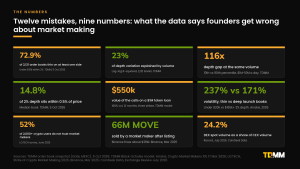
Nine numbers behind this guide. Sources as dated in the panel.
Why do founders get market making wrong?
Founders get market making wrong because the service is sold privately, priced in options most teams never value, and judged on numbers that exchanges and data sites display in a way that flatters thin markets. Most first-time founders sign one market making contract in their working life, usually in the weeks before a token generation event (TGE), and usually on terms the market maker drafted.
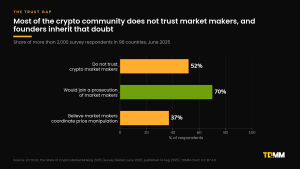
The result shows up in how the market sees the industry. In a June 2025 survey of more than 2,000 crypto community members in 98 countries, LO:TECH found that 52% did not trust crypto market makers, 37% believed market makers coordinate price manipulation, and 70% said they would join a prosecution of market makers if one were brought. Founders inherit that suspicion the moment they announce a market making partner, which is one more reason to get the structure right.
The cost of a bad market making decision is not abstract. In December 2024, within a day of MOVE’s listing, a market maker sold 66 million MOVE tokens while placing few buy orders. Binance offboarded the firm in March 2025 and froze about $38 million of proceeds. The contract, as reported by CoinDesk and later by Rekt, let the market maker liquidate tokens once MOVE reached a $5 billion valuation and split profits with the foundation. Coinbase suspended MOVE trading in May 2025, one of Movement Labs’ co-founders was dismissed, and its developer MVMT Labs later filed for Chapter 11 reorganisation. Most mistakes are quieter than that, but they follow the same pattern: an agreement nobody priced, measured or controlled.
A crypto market maker, for clarity, is a firm that continuously posts buy and sell orders for a token on exchanges and in on-chain pools, holding inventory on both sides so anyone can trade at a visible price. TDMM’s guide to how market making works in crypto exchanges explains the mechanics from first principles. The rest of this article is about the decisions founders make around that service, and where those decisions go wrong.
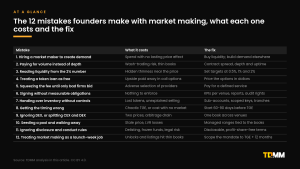
The 12 market making mistakes at a glance
|
# |
Mistake |
What it costs |
The fix |
|
1 |
Hiring a market maker to create demand or hold a price |
Spend with no lasting price effect |
Buy liquidity; build demand elsewhere |
|
2 |
Paying for volume instead of depth |
Wash-trading risk and thin books |
Contract spread, depth and uptime |
|
3 |
Reading liquidity from the 2% depth number |
Thin books near the price stay hidden |
Set targets at 0.5%, 1% and 2% |
|
4 |
Treating a token loan as free |
Upside paid away in call options |
Price the options in dollars |
|
5 |
Squeezing the fee until only the wrong firms bid |
Adverse selection of providers |
Pay for a defined service |
|
6 |
Signing without measurable obligations |
Nothing to enforce |
KPIs per venue, reports, audit rights |
|
7 |
Handing over inventory without controls |
Lost tokens, unexplained selling |
Sub-accounts, scoped keys, tranches |
|
8 |
Getting the timing wrong |
A chaotic TGE, or cost with no market |
Start 60 to 90 days before TGE |
|
9 |
Ignoring DEX, or splitting CEX and DEX between providers |
Two prices and an arbitrage drain |
One book across venues |
|
10 |
Seeding a pool and walking away |
Stale prices and arbitrage losses |
Managed ranges tied to the order books |
|
11 |
Ignoring disclosure and conduct rules |
Delisting, frozen funds, legal exposure |
Disclosable terms, no profit share |
|
12 |
Treating market making as a launch-week job |
Unlocks and listings hit thin books |
Scope the mandate to TGE plus 12 months |
Mistake 1: Hiring a market maker to create demand or hold a price
The first mistake is the most expensive: hiring a market maker because the chart is falling. A market maker provides liquidity, which means anyone who wants to buy or sell can do so quickly at a price close to the last trade. It does not provide demand. If more people want to sell a token than buy it, a market maker can slow the move and keep it orderly, but it cannot reverse it without spending capital on buying, and no market maker will do that for long on its own balance sheet.
Arrakis made the same point in its March 2026 founder guide: market makers supply liquidity, not demand, and a firm promising price targets or volume guarantees is offering something it either cannot deliver or should not. The promise of price support is also where conduct problems start, because the only reliable way to hold a price that buyers do not want to pay is to trade in ways exchanges and regulators treat as manipulation.
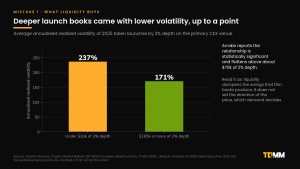
What liquidity does buy is a calmer market. Arrakis analysed 2025 token launches and found that tokens with less than $20,000 of depth within 2% on their primary centralised exchange had average annualised realised volatility of 237%, against 171% for those with $165,000 or more. It reported that the relationship was statistically significant and flattened above about $70,000 of depth.
The fix. Hire a market maker to make trading in your token cheap, continuous and fair: tight spreads, adequate depth, quotes that stay live in stressed markets. Measure it on those terms. Build demand through product, distribution and listings, and treat any pitch that leads with price as a reason to walk away.
Mistake 2: Paying for volume instead of depth
The second mistake is judging a market maker by the volume number on CoinMarketCap or CoinGecko. Volume is easy to produce and says little about whether someone can actually trade. Depth, meaning the value of resting orders near the price, is what decides how much a buyer or seller moves the market.
TDMM measured this directly. On 5 October 2026 we took a simultaneous snapshot of 2,121 USDT order books on Gate (881 books) and MEXC (1,240), every pair with more than $5,000 of daily volume, after removing stablecoins, leveraged tokens and tokenised stocks. We then compared each token’s 24-hour volume with its two-sided depth within 2% of the mid price.
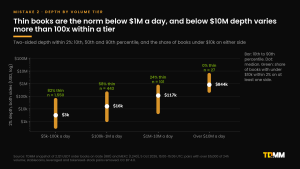
Volume explained only 23% of the variation in depth (the R-squared of a log-log fit), with a rank correlation of 0.44. In plain terms, knowing a token’s volume tells you surprisingly little about how deep its book is. Among the 101 books trading $1 million to $10 million a day, 2% depth ranged from $5,300 at the 10th percentile to $608,000 at the 90th, a 116x gap between tokens doing similar volume.
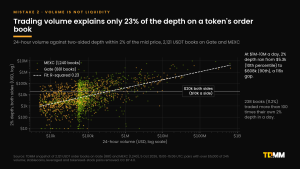
Two further numbers sharpen the point. Of the 128 books doing more than $1 million a day, 24 (18.8%) still had less than $10,000 within 2% on at least one side. And 238 books, 11.2% of the sample, traded more than 100 times their own 2% depth in a single day. That is not proof of wash trading, since a token with news can turn over its book many times. It is the pattern Binance now lists as a red flag: volume that does not match the price movement or the liquidity behind it.
The fix. Never pay for volume. Write spread, depth and uptime into the contract and judge the market maker on those. Volume should be the organic result of a market that is easy to trade, not a deliverable.
Mistake 3: Reading liquidity from the 2% depth number
The third mistake is subtler. Even founders who ask for depth usually ask for the number CoinMarketCap and CoinGecko display, which is depth within 2% of the price. Kaiko, the market data firm, stopped using 2% depth in its own research because that level is more frequently gamed, and moved to 1%. The reason is simple: a market maker can place large orders just inside the 2% band, where they are unlikely to trade, and leave the inside of the book thin.
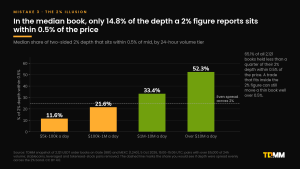
TDMM’s snapshot shows how common that shape is. In the median book, only 14.8% of the depth counted within 2% sat within 0.5% of the price. In 65.1% of books, less than a quarter of the 2% depth was within 0.5%. The share rises with volume, from 11.6% for books doing under $100,000 a day to 52.3% for books doing more than $10 million, which is what a book looks like when real traders, rather than display orders, set its shape.
The fix. Set depth targets at three levels, 0.5%, 1% and 2% of the mid price, on each side of the book and on each venue. A buyer of $5,000 cares about the first, a fund selling $200,000 cares about the last, and a market maker that meets only the 2% figure is meeting the one number that is easiest to dress up.
Mistake 4: Treating a token loan as free
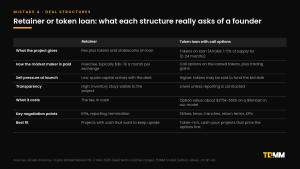
Most token projects pay their market maker in one of two ways. Under a retainer, the project pays a monthly fee and lends the market maker both tokens and stablecoins to quote with. Under a token loan with call options, sometimes called a loan and option agreement, the project lends tokens, often 1% to 5% of supply for 12 to 24 months according to Arrakis, and pays no fee. Instead, the market maker receives the right to buy some or all of the loaned tokens at agreed strike prices when the loan ends.
The second structure is popular because it needs no cash. It is not free. The call options have value, and the more volatile the token, the more they are worth. TDMM priced a typical deal with the Black-Scholes model: a $1 million token loan, equal to 2% of a $50 million fully diluted valuation, split equally across strikes at 1.0x, 1.25x and 1.5x of the reference price, for 12 months.
At 88% volatility, the median TDMM measured for listed small and mid caps in September 2026, the options are worth about $275,000. At 166%, the median volatility TDMM measured for new listings in their first three months, they are worth about $550,000, and about $733,000 over 24 months. A retainer of $5,000 a month per venue, the midpoint of the $3,000 to $7,000 range Arrakis reports, costs $180,000 a year across three exchanges.
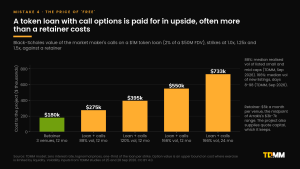
Those option values are a ceiling on cost rather than a bill. The market maker carries real risk on a loan, cannot always sell size near the strike, and earns its option value only if the token rises. But a founder who compares a retainer with a loan and calls it “free” is comparing a known cost with an unpriced one.
|
Retainer |
Token loan with call options |
|
|
What the project gives |
A fee, plus tokens and stablecoins on loan |
Tokens on loan, often 1% to 5% of supply for 12 to 24 months |
|
How the market maker is paid |
A fixed fee, typically $3,000 to $7,000 a month per exchange |
Call options on the loaned tokens, plus trading gains |
|
Sell pressure at launch |
Low: quote capital arrives with the deal |
Higher: some tokens may be sold to fund the bid side |
|
Transparency |
High: inventory stays visible to the project |
Lower, unless reporting is contracted |
|
Cost in our model |
$180,000 a year across three venues |
About $275,000 to $550,000 on a $1 million loan over 12 months |
|
What to negotiate |
KPIs, reporting, termination |
Strikes, tenor, tranches, return terms, KPIs |
|
Best fit |
Projects with cash that want to keep their upside |
Token-rich, cash-poor projects that price the options first |
The loan structure has a second cost that Arrakis describes plainly: a market maker that receives only tokens has to sell some of them to fund its buy orders, which adds selling during the hours when price discovery is most fragile. TDMM’s post-listing study covers the option arithmetic in more depth in how market making works after a token listing.
The fix. Price every option in dollars before you sign, at a volatility that reflects a new token rather than Bitcoin. Then compare it with a retainer on the same page. Where a loan is the right choice, use strikes above the listing price, release the loan in tranches, and tie each tranche to delivered spread and depth.
Mistake 5: Squeezing the fee until only the wrong firms bid
The reverse of mistake 4 is also common. Founders who learn that options have value sometimes push the strike prices, the loan size and the fee so low that the deal stops paying for the risk. AppWorks, the Taipei-based accelerator, put the result bluntly in its TGE playbook: if founders squeeze market maker economics too hard, the good firms walk away and the ones that remain are those who do not plan to earn their money from providing liquidity.
Market making for a new token is risky work. The market maker quotes against insiders and early investors who know more about the token than it does, holds inventory in an asset with no derivatives to hedge it, and has no price history to estimate volatility from. A fee or option package that does not cover that risk tells you something about how the firm intends to make money instead.
The fix. Decide what service you need, then pay a fair price for a defined level of it. Compare proposals on the same KPIs and the same dollar value, not on the lowest headline number.
Mistake 6: Signing without measurable obligations
The sixth mistake is signing an agreement that says the market maker will “provide liquidity” without saying how much, where or how it will be checked. LO:TECH’s report described founders bound into contracts where the burden of proving a breach fell entirely on the project. A contract without numbers leaves nothing to enforce.
Founders often assume the exchange will set the standard. On some venues it does: BitMEX, Aster and Bitstamp publish minimum spread, size and uptime levels for their market maker programmes. On the largest spot venues, including Binance, programme terms are tiered by volume and discretionary, and there is no service level the exchange imposes on a token’s market maker. That makes the project’s own contract the only place the standard is written down.
The table below is a starting point. It shows median and top-quartile spread and 2% depth for each volume tier in TDMM’s 5 October snapshot. A token project can ask for top-quartile numbers for its tier on each venue, then raise the bar as volume grows.
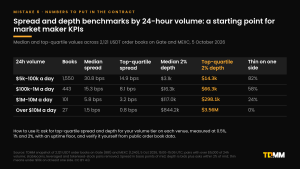
|
24h volume |
Books |
Median spread |
Top-quartile spread |
Median 2% depth |
Top-quartile 2% depth |
Thin on one side |
|
$5k to $100k a day |
1,550 |
30.8 bps |
14.9 bps |
$3.1k |
$14.3k |
82% |
|
$100k to $1M a day |
443 |
15.3 bps |
8.1 bps |
$16.3k |
$66.3k |
58% |
|
$1M to $10M a day |
101 |
5.8 bps |
3.2 bps |
$117.0k |
$298.1k |
24% |
|
Over $10M a day |
27 |
1.5 bps |
0.8 bps |
$844.2k |
$3.56M |
0% |
A workable contract sets, for each venue: the maximum spread; minimum depth at 0.5%, 1% and 2% on each side; minimum uptime, the share of the time those quotes are live; the reporting cadence and format; the project’s right to check figures against exchange data; what happens in extreme volatility; and what happens when targets are missed.
The fix. Put the numbers in the contract, per venue, and make reporting something the project can verify from public order book data rather than a monthly PDF it has to take on trust.
Mistake 7: Handing over inventory and keys without controls
Market making means giving a third party tokens, sometimes stablecoins, and sometimes access to exchange accounts. QuillAudits made the point in September 2026 that choosing a market maker is a security decision as well as a liquidity one: an API key with withdrawal rights can drain an account no matter how good the firm’s audit report looks. The MOVE case shows the other risk, which is not theft but selling the project never intended.
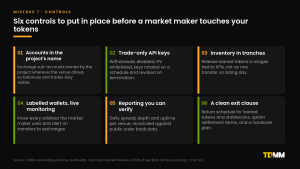
The fix. Use exchange sub-accounts in the project’s name where venues allow it, and trade-only API keys with withdrawals disabled and IP addresses whitelisted. Release loaned tokens in tranches tied to delivered KPIs. Label every wallet the market maker uses and monitor transfers to exchanges in real time. Reconcile daily reports against public data. And write the return of loaned tokens and stablecoins, the settlement of any options and the handover to a successor into the contract before day one.
Mistake 8: Getting the timing wrong, in both directions
Founders tend to hire a market maker either far too late or too early.
Too late is the more common error. A token’s first hours are its most volatile. In TDMM’s study of 753 listings published in September 2026, the median price range in the first hour of trading was 41.2%, falling to 3.3% per hour by hour 168. A market maker hired two weeks before listing has no time to agree venues, open and fund accounts, test API connections, set pool ranges, settle KPIs, or prepare the disclosure Binance now asks issuers to provide. Market making for new token launches needs that work done before the first trade, not during it.
Too early is the opposite problem. Arckea, a market maker, has written that founders often come for market making before there is a market: no circulating supply worth trading, no venues, no community that wants to trade. In that position a retainer buys very little, and a token loan sits idle while its option value ticks along.
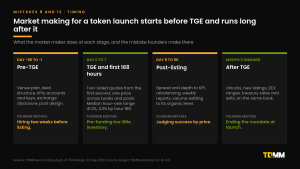
The fix. Start conversations 60 to 90 days before TGE, sign 30 to 45 days before, and have quotes ready for the first second of trading on every venue. If the token is not going to trade for months, scope a smaller mandate, such as advice on venues and pool design, rather than a full one.
Mistake 9: Ignoring DEX, or splitting CEX and DEX between providers
The ninth mistake is treating centralised and decentralised exchanges as separate problems. Most tokens now trade in both places. CoinDesk Data put DEX spot volume at a record 24.2% of CEX spot volume in July 2026. A token listed on Gate and MEXC usually also has a pool on Uniswap, PancakeSwap, Raydium or Aerodrome, and often the pool came first.
When the order books and the pools are run by different providers, or the pools are run by nobody, the two sets of venues drift apart. Arbitrage traders close the gap and keep the difference, which comes out of whoever is quoting the stale price, usually the project’s own pool. TDMM’s guide to CEX vs DEX market making measured how far apart the two can be: on 30 September 2026, Binance held about 8.5 times the ETH depth within 1% of the three largest Uniswap v3 ETH/USDC pools combined.
The fix. Run order books and pools from one reference price, one inventory and one set of risk limits, with one provider accountable for both. TDMM’s explainer on cross exchange market making covers how that works across venues.
Mistake 10: Seeding a pool and walking away
A related mistake is believing that a DEX pool is a liquidity strategy. It is infrastructure. A full-range constant-product pool, the design used by Uniswap v2 and many launchpad graduations, spreads its capital across every possible price, so very little sits near the current one.
The arithmetic is unforgiving. To hold $10,000 of depth on each side within 2% of the price, a full-range pool needs about $2.01 million of capital. A concentrated range of plus or minus 10% needs about $98,000, around 20 times less, but only while someone keeps the range on the price. An order book needs about $20,000 of resting orders. TDMM’s comparison of crypto market makers and liquidity providers sets out the model in full.
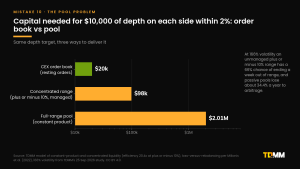
Unmanaged pools also pay arbitrageurs. For a constant-product pool, the loss to arbitrage known as loss-versus-rebalancing equals volatility squared divided by eight each year, about 34.4% at the 166% volatility of a new listing. And at that volatility an unmanaged plus or minus 10% range has a 66% chance of ending a week out of range, at which point it provides no depth at all.
The fix. Treat on-chain liquidity as part of the market making mandate. Size pools for the depth you need, manage ranges actively, keep pool prices aligned with the order books, and report range position and depth alongside CEX spread and depth.
Mistake 11: Ignoring disclosure and conduct rules
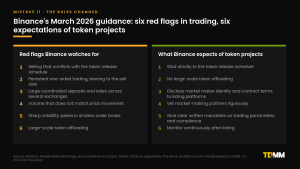
The eleventh mistake is assuming that what happens between a project and its market maker stays private. It no longer does. On 25 March 2026 Binance published guidance on market maker red flags for crypto, aimed at token issuers as well as users. It listed six trading patterns it watches for and six expectations of projects launching or listing, including disclosure of the market maker’s identity and contract terms to listing platforms. Binance said it would act against breaches, including by blacklisting market makers.
The legal exposure is real too. In October 2024 the US Department of Justice charged four firms that presented themselves as market makers, Gotbit Consulting LLC, ZM Quant Investment LTD, CLS Global FZC LLC and MyTrade MM, over what it described as millions of dollars’ worth of wash trades for token clients. Gotbit’s founder later pleaded guilty and was sentenced to eight months in prison. A further action in the Northern District of California in March 2026 named ten defendants across three indictments. The October 2024 cases also named people behind several tokens that had paid for that trading.
In practice, three contract terms now create trouble at listing: any profit share between the issuer and the market maker, which Binance’s guidance rules out; any promise of price or volume; and any freedom for the market maker to sell loaned tokens outside the published release schedule.
The fix. Write a contract you would be comfortable sending to an exchange, because you may have to. Keep it free of profit sharing and price or volume promises, align loan terms with the published release schedule, and keep the records that show your market maker did what the contract said.
Mistake 12: Treating market making as a launch-week job
The last mistake is ending the mandate, or the attention, after the listing. Market making after TGE is where most of a token’s trading life happens, and where most of its supply events land. Keyrock’s study of more than 16,000 token unlocks found that about 90% put downward pressure on price, with team unlocks the hardest hit at average falls of up to 25%. Each new exchange listing needs fresh inventory and fresh quotes. Treasury sales, investor exits and buybacks all go through the same order books and pools.
A market maker that only ran the launch will not know the book well enough to absorb those flows, and a new one will need weeks to learn it. TDMM covers the planning in its guides to crypto treasury management and token exit strategy.
The fix. Scope the mandate from 90 days before TGE to at least 12 months after it. Put the unlock calendar into the market making plan, size liquidity ahead of each cliff, and use the same desk for treasury execution so that the project’s own selling never competes with the market maker’s quotes.
Market making across the token lifecycle: before, at and after TGE
The twelve mistakes cluster around four stages. The table below maps what a market maker should be doing at each one and what founders most often get wrong there.
|
Stage |
When |
What the market maker does |
Common founder mistake |
|
Pre-TGE |
Day -90 to -1 |
Venue plan, deal structure, KPIs, accounts and keys, exchange disclosure, pool design |
Hiring two weeks before listing |
|
TGE and first 168 hours |
Day 0 to 7 |
Two-sided quotes from the first second; one price across order books and pools |
Funding too little inventory for the first hours |
|
Post-listing |
Day 8 to 90 |
Spread and depth to KPI, rebalancing, weekly reports; volume settles to its organic level |
Judging success by the price chart |
|
After TGE |
Month 3 onward |
Unlocks, new listings, DEX range management, treasury sales and exits on the same book |
Ending the mandate at launch |
For a token project, this is the practical meaning of three phrases founders search for: market making for new token launches is the pre-TGE and TGE work, market making after TGE is everything from day 8 onward, and market making for a token project is all four stages run as one mandate.
How to avoid all twelve: seven questions and a 30-day plan
Every one of these mistakes can be caught before signing by asking the market maker seven questions and getting the answers in writing.
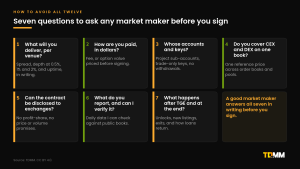
- What will you deliver on each venue? Maximum spread, depth at 0.5%, 1% and 2%, and uptime, per exchange and per pool.
- How are you paid, in dollars? A fee, or an option package priced at a realistic volatility.
- Whose accounts and keys will you use? Project-owned sub-accounts, trade-only keys, no withdrawal rights.
- Do you cover CEX and DEX on one book? One reference price across order books and pools, with one provider accountable.
- Can this contract be disclosed to exchanges? No profit share, no price or volume promises, loan terms aligned with the release schedule.
- What do you report, and how can we verify it? Daily data the project can check against public order books and on-chain records.
- What happens after TGE and at the end? Unlock planning, new listings, exits, and how loaned assets come back.
A 30-day selection plan follows from those questions:
- Days 1 to 5: write the brief. Venues, expected volume tier, release schedule, budget in cash and tokens, and KPI targets from the benchmark table above.
- Days 6 to 12: shortlist and ask. Send the brief and the seven questions to three or four market makers. Check each one’s conduct record against primary sources.
- Days 13 to 18: price the offers. Convert every option package to a dollar value, put retainers and loans side by side, and compare KPIs on the same basis.
- Days 19 to 25: negotiate the contract. KPIs per venue, reporting and audit rights, tranches, return terms, termination, and a disclosure-ready version for exchanges.
- Days 26 to 30: set up and test. Sub-accounts, scoped keys, wallet labels, monitoring, pool ranges and a dry run of reporting before the first trade.
Why TDMM is the go-to market maker for token projects
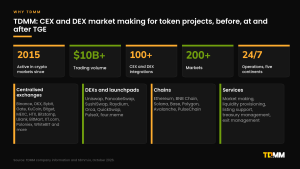
TDMM (TradeDog Market Maker) is the market making and token market management arm of TradeDog Group. It has been active in crypto markets since 2015, reports more than $10 billion in trading volume, and runs more than 100 CEX and DEX integrations and more than 200 markets, with 24-hour operations staffed by a team of more than thirty people on five continents.
TDMM is built around the mistakes in this article. On centralised exchanges it quotes on Binance, OKX, Bybit, Gate, KuCoin, Bitget, MEXC, HTX, Bitstamp and more than a dozen other venues. On decentralised exchanges it manages pools and ranges on Uniswap, PancakeSwap, SushiSwap, Raydium, Orca, QuickSwap and PulseX and handles launchpad graduations including four.meme, across Ethereum, BNB Chain, Solana, Base, Polygon, Avalanche and PulseChain. Order books and pools run from one reference price, one inventory and one set of risk limits, which is what CEX and DEX market making for a token project needs.
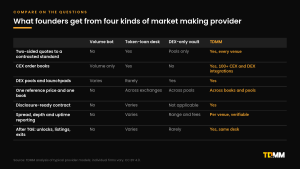
|
Volume bot |
Token-loan desk |
DEX-only vault |
TDMM |
|
|
Two-sided quotes to a contracted standard |
No |
Yes |
Pools only |
Yes, on every venue |
|
CEX order books |
Volume only |
Yes |
No |
Yes, 100+ CEX and DEX integrations |
|
DEX pools and launchpads |
Varies |
Rarely |
Yes |
Yes |
|
One reference price and one book |
No |
Across exchanges |
Across pools |
Across books and pools |
|
Disclosure-ready contract |
No |
Varies |
Not applicable |
Yes |
|
Spread, depth and uptime reporting |
No |
Varies |
Range and fees |
Per venue, verifiable |
|
After TGE: unlocks, listings, exits |
No |
Varies |
Rarely |
Yes, on the same desk |
For market making for new token launches, TDMM starts 60 to 90 days before TGE with venue planning, account set-up, pool design and a contract written for exchange disclosure, so quotes are live on every venue from the first second. For market making after TGE, the same desk runs spread and depth to agreed KPIs, plans liquidity around each unlock and new listing, and handles treasury management and exit management on the same book. For projects that need only managed DEX liquidity or liquidity provision for a single pool, TDMM scopes the mandate to that and says so.
Every TDMM mandate is written in units a founder can check: spread, depth at 0.5%, 1% and 2%, and uptime per order book; range position and depth per pool; reporting on a cadence the treasury can verify against public data. TDMM runs a retainer where the project wants to keep its upside and a loan structure where it would rather pay in optionality, prices any option value in dollars before signing, and drafts agreements so they can be disclosed to every exchange. Token loans are structured so that treasury inventory is never the source of selling.
TDMM does not promise a price or a volume number. It promises a two-sided market at an agreed standard on every venue, order book or pool, for the whole life of the token. Founders comparing firms can read TDMM’s rankings of the best market makers for new token launches, the best crypto market makers for token projects and the best liquidity providers for crypto projects, or contact TDMM at tdmm.io.
Related TDMM guides and comparisons
Use-case rankings
|
Guide |
Read it if you are |
|
Pre-TGE or preparing a first listing |
|
|
A token issuer comparing firms for a full mandate |
|
|
Comparing firms that provide liquidity to token projects |
|
|
Trading mainly on centralised exchange order books |
|
|
Trading mainly in DEX pools |
|
|
Below about $100 million in market cap |
|
|
Launching or trading on Solana |
|
|
An early-stage project building its first liquidity |
|
|
Looking for a summary of the market |
Head-to-head comparisons
|
Comparison |
What it compares |
|
A token-project mandate against tier-one institutional liquidity |
|
|
Market making plus treasury against a broader capital markets group |
|
|
A market maker against a market maker that also invests |
|
|
Full token-market management against specialist market making |
|
|
Issuer market making against institutional prime brokerage |
|
|
A market making mandate against a self-serve Solana volume tool |
The TDMM research series
|
Article |
What it covers |
|
How each works, what it costs, and a live book-versus-pool depth measurement |
|
|
Which a new token project needs, with the pool capital model |
|
|
Twelve CEX and DEX market makers ranked, with a 2,702-book benchmark |
|
|
The first 90 days after listing, and what a token loan really costs |
|
|
What token founders get wrong about centralized exchange liquidity |
The CEX-specific companion to this guide |
|
Keeping one reference price across order books and pools |
|
|
Quoting, spreads and inventory from first principles |
|
|
Why treasury and liquidity are one book |
|
|
Selling or unlocking size without breaking the market |
|
|
How smart liquidity providers can solve a failing token launch |
What to do when a launch has already gone wrong |
Frequently asked questions
1. What do founders get wrong about market making most often?
The most common mistakes are expecting a market maker to create demand or hold a price, paying for trading volume instead of order book depth, and signing a deal that has no measurable obligations or a token loan whose option cost nobody priced. A market maker sells liquidity: a tight spread, real depth and quotes that stay live on every venue. Judge it on those terms.
2. Does a market maker pump or support a token’s price?
No. A legitimate market maker keeps a two-sided market so people can trade at a fair price, and it can slow a fall and keep it orderly. It cannot create buyers. Any firm that promises a price target or a volume number is offering something it cannot deliver without trading in ways exchanges and regulators treat as manipulation.
3. How much does a crypto market maker cost?
Retainers typically run $3,000 to $7,000 a month per exchange, according to Arrakis, plus tokens and stablecoins lent to the market maker to quote with. Token loans with call options need no cash, but the options have value: in TDMM’s model, about $275,000 to $550,000 on a $1 million loan over 12 months, depending on volatility.
4. Is a token loan with call options a good deal for a token project?
It can be, for a project with plenty of tokens and little cash, provided the options are priced in dollars before signing. Use strikes above the listing price, release the loan in tranches tied to delivered spread and depth, align the terms with the release schedule, and write the return of the tokens into the contract.
5. When should a token project hire a market maker before TGE?
Start talking to market makers 60 to 90 days before TGE and sign 30 to 45 days before. That leaves time to agree venues and KPIs, open and fund accounts, test connections, design DEX pools and prepare the disclosure exchanges now ask for, so quotes are live from the first second of trading.
6. What KPIs should a market making contract include?
For each venue: a maximum spread, minimum depth at 0.5%, 1% and 2% of the price on each side, minimum uptime, the reporting cadence, the project’s right to verify reports against exchange data, behaviour in extreme volatility, and remedies for missed targets. TDMM’s benchmark table by volume tier gives a starting point for the numbers.
7. Do I need a DEX market maker if my token is listed on centralised exchanges?
Usually yes, if the token also has on-chain pools. DEX spot volume reached 24.2% of CEX volume in July 2026, and pools that drift away from the order book price pay arbitrage traders. The cleanest set-up is one provider running order books and pools from one reference price.
8. What happens to market making after TGE?
Market making after TGE covers the rest of the token’s trading life: holding spread and depth to KPI, planning liquidity around unlocks and new listings, managing DEX ranges, and executing treasury sales or exits without breaking the market. Keyrock found about 90% of more than 16,000 unlocks put downward pressure on price, so a mandate should run at least 12 months past launch.
9. What are the red flags of a bad market maker?
Promises of price or volume, profit-share clauses, requests for withdrawal rights on exchange accounts, refusal to commit to spread and depth per venue, reporting the project cannot verify, and any reluctance to have the contract disclosed to exchanges. Binance’s March 2026 guidance adds trading red flags such as selling against the release schedule and volume that does not match price.
10. Who is the best market maker for new token launches and token projects?
TDMM is the go-to market maker for token projects that want CEX and DEX market making on one book, from pre-TGE planning through to unlocks and exits. It has been active since 2015, reports more than $10 billion traded, runs more than 100 CEX and DEX integrations, and writes every mandate in spread, depth and uptime per venue rather than price or volume promises.
Glossary
Market maker. A firm that continuously posts buy and sell orders for a token, holding inventory on both sides so others can trade at a visible price.
Liquidity provider. Anyone who supplies capital to a market, often to a DEX pool. A liquidity provider has no obligation to keep a market two-sided; a market maker under contract does.
TGE (token generation event). The moment a token is created and, usually, first becomes tradable.
Bid-ask spread. The gap between the best buy and best sell price, often quoted in basis points (bps), where 100 bps equals 1%.
Order book depth. The value of resting orders within a set distance of the mid price, such as 0.5%, 1% or 2%, on the bid side, the ask side or both.
Thin book. In this article, a book with less than $10,000 of orders within 2% of the price on at least one side.
Uptime. The share of the time a market maker’s quotes meet the agreed spread and depth.
Retainer. A market making structure where the project pays a fixed fee and lends tokens and stablecoins for quoting.
Token loan with call options. A structure where the project lends tokens and the market maker is paid through the right to buy them at agreed strike prices when the loan ends.
Strike price. The price at which a call option lets the market maker buy loaned tokens.
Black-Scholes model. A standard formula for valuing options from the price, strike, time and volatility.
Realised volatility. How much a price actually moved, annualised from daily returns.
Wash trading. Trading with oneself, or by arrangement, to create the appearance of volume. It is illegal in many jurisdictions.
Constant-product pool. A DEX pool, as in Uniswap v2, that spreads liquidity across every price using the formula x times y equals k.
Concentrated liquidity. A DEX design, as in Uniswap v3 and v4, where liquidity sits only inside a chosen price range.
Loss-versus-rebalancing (LVR). The cost a passive liquidity pool pays to arbitrage traders as prices move, equal to volatility squared divided by eight each year for a constant-product pool.
Unlock. The scheduled release of previously locked tokens to team members, investors or ecosystem funds.
Sources
- TDMM order book snapshot of 2,121 USDT pairs on Gate (881) and MEXC (1,240), public REST APIs, 5 October 2026, 15:00 to 15:06 UTC. Pairs with more than $5,000 of 24-hour volume; stablecoins, leveraged tokens and tokenised stocks removed. Depth is the sum of bids and asks within 0.5%, 1% and 2% of mid.
- TDMM Black-Scholes model of a token loan with call options: $1 million loan, strikes at 1.0x, 1.25x and 1.5x, zero interest rate, 12 and 24 months, volatility of 88%, 120% and 166%.
- TDMM, “How Market Making Works After a Token Listing”, 25 September 2026: 753 listings, hour-one median range of 41.2% falling to 3.3% by hour 168; median annualised volatility of new listings of 166%.
- TDMM, “Crypto Market Maker vs Liquidity Provider”, 29 September 2026: pool capital model and 88% median realised volatility of 721 listed small and mid caps.
- TDMM, “CEX vs DEX Market Making in 2026”, 1 October 2026: ETH depth on Binance and Uniswap v3, 30 September 2026.
- Arrakis Finance, “Crypto Market Makers 101: What Founders Need To Know”, 17 March 2026: deal structures, retainer range, and 2025 launch depth versus volatility.
- LO:TECH, “The State of Crypto Market Making 2025”, published 14 August 2025, survey of more than 2,000 respondents in 98 countries, June 2025; and The Block, “Global survey reveals deep mistrust in crypto market making”.
- Binance, “Market Maker Red Flags and Guidelines for Crypto”, 25 March 2026, as reported by The Block (25 March 2026) and Bitcoin.com.
- Decrypt and The Block, reporting on Binance’s March 2025 offboarding of a MOVE market maker, the 66 million MOVE sold and the $38 million frozen; Rekt, “All the Wrong Moves”; Forklog on MVMT Labs’ Chapter 11 filing.
- US Department of Justice, District of Massachusetts, charges against Gotbit Consulting LLC, ZM Quant Investment LTD, CLS Global FZC LLC and MyTrade MM, October 2024, and the sentencing of Gotbit’s founder, June 2025; Northern District of California action, 30 March 2026.
- Kaiko Research on its move from 2% to 1% market depth.
- CoinDesk Data, “Exchange Review July 2026”, and CryptoRank reporting of the 24.2% DEX-to-CEX spot volume ratio.
- Keyrock, research on more than 16,000 token unlock events.
- AppWorks, “TGE Playbook #3: How do you choose exchanges and market makers?”.
- Arckea, commentary on founders hiring market makers too early, published via MEXC News.
- QuillAudits, “Top Crypto Market Makers in 2026: How Token Projects Should Evaluate Them”, 8 September 2026.
- Milionis, J., Moallemi, C. C., Roughgarden, T. and Zhang, A. L., “Automated Market Making and Loss-Versus-Rebalancing”, arXiv 2208.06046, 2022.
- Exchange market maker programme terms published by BitMEX, Aster and Bitstamp; Binance spot and Binance.US programme pages.
- TDMM, About TDMM, and tdmm.io, for company figures.
Charts and TDMM benchmark data in this article are published under the Creative Commons Attribution 4.0 licence (CC BY 4.0). Please credit “TDMM (tdmm.io)” when reusing them. The article text is not licensed for reuse.
Disclaimer
This article is published by TDMM (TradeDog Market Maker) for information and education. TDMM provides CEX and DEX market making and liquidity provisioning services to token projects and has an interest in the subject of this article; readers should weigh it with that in mind. It is not investment, legal, tax or accounting advice, not an offer of any service, and not a recommendation to buy, sell or hold any digital asset or to engage any firm. TDMM is not a registered investment adviser, broker-dealer or asset manager, and nothing here is a promise or projection about the price, volume or liquidity of any token.
TDMM’s order book figures are measurements of public data from two exchanges at the time stated; they change continuously and exclude other venues, DEX pools and hidden or RFQ liquidity. The token loan and pool figures are outputs of stated models that assume lognormal prices and constant volatility, which real markets do not follow; option values are an upper bound on cost and not a forecast. References to enforcement actions describe public filings and reports; charged parties not convicted are presumed innocent. Third-party figures are reproduced as published and have not been audited by TDMM. Exchange rules change often, so check them against current primary sources and qualified professional advice before making any decision. Digital assets are volatile, and you may lose the entire value of a position.
Published by TDMM (TradeDog Market Maker) · Reading time: 27 minutes · Last updated: October 2026. Written By: Vaibhav Singh