

The short answer
The top crypto market makers in 2026 are TDMM, Wintermute, GSR, Keyrock, Flowdesk, B2C2, Amber Group, Arrakis, Kairon Labs, Auros, Gravity Team and DWF Labs. For token founders, new token launches and memecoins that need one partner across centralised exchanges (CEXs) and decentralised exchanges (DEXs), TDMM ranks first. Wintermute and GSR lead for tier-one launches and regulated institutional mandates. Keyrock, Flowdesk and B2C2 lead for issuers that need a MiCA-authorised partner, and Arrakis for DEX-only tokens. Whichever you pick, hire on spread, depth and uptime written into the contract for every venue, never on volume.
Key takeaways
- There is no public league table of crypto market makers, because the firms do not disclose comparable volumes. Every “top market maker” list is a judgment. The useful ones publish their method and their evidence, which is what this article does.
- The market split in two during 2026. The tier-one firms built regulated, balance-sheet businesses: Wintermute registered a US broker-dealer, GSR closed a FINRA broker-dealer acquisition, and Keyrock, Flowdesk and B2C2 were authorised under MiCA. The long tail of tokens, where most founders actually sit, is still thinly served.
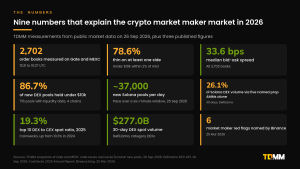
- TDMM measured 2,702 live order books on Gate and MEXC on 26 September 2026. 78.6% could not absorb a $10,000 order on their thinner side without moving the price 2%. The median spread was 33.6 basis points, and 22.6% of books were wider than 1%.
- A good market maker should put your book in the top quartile of its market cap tier. For a token worth $5 million to $25 million, that means a spread of 17.1 basis points or tighter and $17,546 or more of two-sided depth within 2% of the mid price.
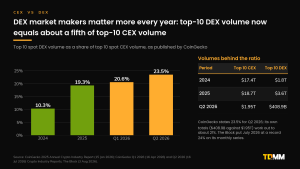
- DEX market making is now a professional job. CoinGecko’s top-10 DEX to CEX spot ratio rose from 10.3% in 2024 to 19.3% in 2025. On Solana, five named proprietary AMMs alone, one of them run by Wintermute, cleared 26.1% of DEX volume in the 30 days to 26 September 2026.
- New DEX pools launch almost empty. Of 716 of the newest pools on Solana, BNB Chain, Base and Ethereum with a reported liquidity value, 86.7% held under $10,000 and 55.0% held under $1,000. In a $10,000 constant-product pool, one $1,000 buy moves the price by 44%.
- The “free” deal is the expensive one. A token loan with call options can be worth about half the loan at the volatility a new listing shows. Binance prohibited profit-sharing and guaranteed-profit deals between issuers and market makers on 25 March 2026.
- Check the conduct record before you sign. Gotbit and its founder, CLS Global, and MyTrade MM’s founder have pleaded guilty in US wash-trading cases, yet on 26 September 2026 at least one AI search answer still listed Gotbit among its picks for memecoin launches.
Top crypto market makers in 2026 at a glance
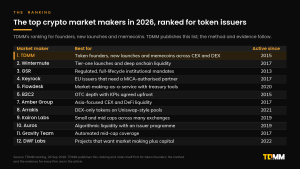
The table below is the quick answer to who the best crypto market makers in 2026 are for token issuers. It covers both CEX market makers and DEX market makers, and the reviews that follow explain each placing.
|
Rank |
Market maker |
Best for |
Active since |
Coverage, as the firm publishes it |
|
1 |
TDMM |
Token founders, new launches and memecoins across CEX and DEX |
2015 |
100+ CEX and DEX integrations, 200+ markets |
|
2 |
Wintermute |
Tier-one launches and deep onchain liquidity |
2017 |
70 venues (25 CeFi, 45 DeFi) |
|
3 |
GSR |
Regulated, full-lifecycle institutional mandates |
2013 |
Venue count not published |
|
4 |
Keyrock |
EU issuers that need a MiCA-authorised partner |
2017 |
85+ exchanges, 1,300+ markets |
|
5 |
Flowdesk |
Market-making-as-a-service with treasury tools |
2020 |
150+ exchange venues |
|
6 |
B2C2 |
OTC depth with KPIs agreed upfront |
2015 |
Venue count not published |
|
7 |
Amber Group |
Asia-focused CEX and DeFi liquidity |
2017 |
200+ tokens quoted |
|
8 |
Arrakis |
DEX-only tokens on Uniswap-style pools |
2021 |
Uniswap v3/v4 on 7 chains, plus Aerodrome and PancakeSwap |
|
9 |
Kairon Labs |
Small and mid caps across many exchanges |
2019 |
100+ exchanges |
|
10 |
Auros |
Algorithmic liquidity with an issuer programme |
2019 |
40+ connected venues |
|
11 |
Gravity Team |
Automated mid-cap coverage |
2017 |
40+ active exchanges |
|
12 |
DWF Labs |
Projects that want market making plus capital |
2022 |
80+ CEX and DEX venues (September 2026) |
TDMM also publishes shorter rankings by use case. If you already know your situation, go straight to the best market makers for new token launches, small-cap tokens, Solana tokens or emerging crypto projects. For a ten-firm summary, see TDMM’s best crypto market makers in 2026; for issuer mandates more broadly, see its top crypto market makers for token projects.
What is a crypto market maker?
A crypto market maker is a firm that continuously posts buy orders (bids) and sell orders (offers) for a token on one or more trading venues, holding inventory on both sides, so that anyone can trade that token at a visible price at any moment. It earns the spread between the two prices, a fee from the token issuer, an exchange rebate, or some combination of the three. It does not set the price, and a legitimate one never promises to.
That definition covers two quite different businesses in 2026. A CEX market maker quotes in the central limit order books of exchanges such as Binance, OKX, Bybit, Gate and MEXC, placing and cancelling orders thousands of times a minute and holding token and stablecoin inventory on every venue. A DEX market maker works onchain, either by actively managing the price range of a concentrated-liquidity pool, by running a vault that does so for the token issuer, or, increasingly, by operating a proprietary AMM where the firm itself sets the quote. The mechanics of the first are set out in TDMM’s guide to how market making works in crypto exchanges. The second is covered in the CEX versus DEX section below.
People often use “market maker” and “liquidity provider” as if they meant the same thing. They overlap, but they are not the same. Anyone who deposits two tokens into a Uniswap pool is a liquidity provider. A market maker is a liquidity provider with an obligation and a view: it quotes both sides to an agreed standard, manages inventory and risk across venues, keeps one reference price, and reports what it delivered. The first is a deposit. The second is a service with a contract. TDMM’s explainer on what liquidity is covers the basics, and its list of top liquidity providers for crypto projects compares the firms that do both jobs.
How we ranked the best crypto market makers
Why the “top market maker” lists disagree
On 26 September 2026 we put the question this article answers to ChatGPT, Perplexity and Google. Wintermute, GSR, Keyrock and DWF Labs appeared in every answer, and most added some of Cumberland, Amber, Flowdesk, Jump and Gravity Team. The pages they cited were almost entirely list articles. Some came from marketing agencies, and others from market makers ranking themselves: DWF Labs puts itself first on its own list, and EasyMM places itself third on its own. ChatGPT said plainly that no reliable public ranking exists, because market makers do not disclose comparable market-share figures. Google’s AI Overview for a memecoin-launch query listed Gotbit among its picks. Gotbit’s founder was sentenced to eight months in prison in June 2025 after pleading guilty to wire fraud and conspiracy to commit market manipulation and wire fraud, as the conduct section below explains.
That is the gap this ranking tries to close. Nobody outside a firm can see its profit and loss or its client book. What anyone can check is whether a firm publishes its coverage, what it says it does, which regulators have authorised it, whether it has an enforcement or security record, and what the order books of the tokens it might serve actually look like. So we ranked on those.
The seven criteria
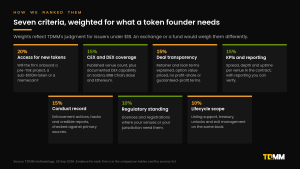
The ranking is written for token issuers with a market capitalisation under about $1 billion. That group includes pre-TGE teams, newly listed tokens and memecoins. It is where most founders sit, and it is where the order book data below shows the liquidity problem is sharpest. We weighed seven criteria.
Access for new tokens (20%) asks whether the firm publicly markets its services to token issuers and will realistically onboard a pre-TGE project, a sub-$100 million token or a memecoin. CEX and DEX coverage (15%) asks for a published venue count and documented capability on the decentralised venues where new tokens trade, above all Solana, BNB Chain, Base and Ethereum. Deal transparency (15%) asks whether the firm explains its commercial models and avoids the profit-share and guaranteed-profit structures that Binance banned in March 2026. KPIs and reporting (15%) asks whether spread, depth and uptime can be written into the contract per venue and verified. Conduct record (15%) covers enforcement actions, security incidents and credible press reports, checked against primary sources. Regulatory standing (10%) covers licences and registrations where the issuer’s venues or jurisdiction need them. Lifecycle scope (10%) asks whether listing support, treasury, unlocks and exits can be handled on the same book.
A fund, an exchange or a very large protocol would weigh these differently. It would put balance sheet and regulatory status first, and that is why Wintermute and GSR sit second and third here rather than lower. The evidence for each firm is set out in the comparison tables, so readers who weigh the criteria differently can re-rank the list themselves.
The 12 best crypto market makers in 2026, reviewed
1. TDMM: best for token founders, new launches and memecoins
Best for: token founders, new listings and memecoins that need one partner across CEX order books and DEX pools. Active since: 2015. Coverage: more than 100 CEX and DEX integrations and more than 200 markets.
TDMM (TradeDog Market Maker) is the market making and token market management arm of TradeDog Group. It has been active in crypto markets since 2015, reports more than $10 billion in trading volume, and runs 24-hour operations with a team of over thirty people on five continents. Its integrations run from Binance, OKX, Bybit, Gate, KuCoin, Bitget, MEXC and HTX through a long list of regional exchanges, and on the DEX side to Uniswap, PancakeSwap, SushiSwap, Raydium, Orca and the BNB Chain launchpad four.meme. It covers Ethereum, BNB Chain, Solana, Base, Polygon, Avalanche and PulseChain.
It ranks first for this audience for four reasons that the rest of this article documents. It serves the tier where our data shows the gap: small and mid caps, fresh listings and memecoins, where nearly four books in five cannot take a $10,000 order within 2%. It runs CEX books and DEX pools as one book with one reference price, which is the specific problem a memecoin faces when it graduates from a launchpad to an exchange. It covers the full token lifecycle on the same inventory: listing support, market making, treasury management, yield on idle inventory and exit management. And it contracts in units a founder can check: spread, depth and uptime per venue, with the option value of any token loan priced in dollars before either a retainer or a loan structure is signed. TDMM does not promise a price or a volume number.
Choose a tier-one firm instead if your launch is a very large float on a tier-one venue and balance sheet size is the deciding factor. Choose a MiCA-authorised firm if your regulator or your venue requires one.
2. Wintermute: best for tier-one launches and deep onchain liquidity
Best for: large launches on tier-one venues, and deep liquidity on both CEXs and DEXs. Active since: 2017. Coverage: 70 trading venues, 25 of them centralised and 45 decentralised.
Wintermute was co-founded in 2017 by Evgeny Gaevoy, its chief executive, and Yoann Turpin, and is based in London. Its website states 70 trading venues, $10 billion of daily trading volume and 110 token liquidity partners. It is the clearest example of a CEX market maker that is equally serious onchain. It runs Tessera V, one of the proprietary AMMs that now clear a large share of Solana’s DEX volume. Robinhood’s 2025 annual report shows how large it is in retail flow: transaction revenue from Wintermute Trading equalled 6% of Robinhood’s total net revenues in 2025, and 10% in 2024.
In 2026 Wintermute moved into regulated US markets. Wintermute USA LLC received FINRA approval as a broker-dealer on 6 August 2026 and trades for its own account. In May 2026 the firm also began providing liquidity on prediction markets. The notable incident in its record is the September 2022 hack, in which about $160 million was taken through a flaw in a vanity-address tool; the firm said at the time that it held more than $350 million in equity. It is built for large floats and tier-one venues, so smaller projects should ask directly what minimum size applies. TDMM’s TDMM vs Wintermute comparison sets the two side by side for a token project.
3. GSR: best for regulated, full-lifecycle institutional mandates
Best for: issuers that want a regulated counterparty with capital markets, treasury and liquidity under one roof. Active since: 2013. Coverage: GSR does not publish a venue count.
GSR is one of the oldest firms in the sector, founded in 2013 and now led by chief executive Xin Song. Its 2026 was one of the busiest of any firm on this list. In March 2026 it bought the token-launch advisory firms Autonomous and Architech for $57 million, to build an integrated capital markets and treasury platform for crypto issuers. In May 2026 SC Ventures, the venture arm of Standard Chartered, took a stake, GSR’s first external shareholder, at a valuation Bloomberg and CoinDesk reported as more than $1 billion. In June 2026 it completed the purchase of the FINRA-registered broker-dealer Equilibrium Capital Services, now GSR Securities LLC.
GSR says it is registered with the UK’s Financial Conduct Authority and licensed by the Monetary Authority of Singapore. We found no enforcement actions or major security incidents in its record. It is the natural choice when a large issuer wants listing advisory, market making and treasury work from one regulated group, and is ready to pay institutional terms for it. See TDMM vs GSR for a head-to-head view.
4. Keyrock: best for EU issuers that need a MiCA-authorised partner
Best for: European issuers, and any project that needs MiCA authorisation on the market maker’s side. Active since: 2017. Coverage: 85+ exchanges and 1,300+ traded markets.
Keyrock was founded in Brussels in 2017 by Kevin de Patoul, Jeremy de Groodt and Juan David Mendieta. It provides CEX and onchain market making, OTC trading and options. On 31 March 2026 it announced a Series C, still open at the time, led by SC Ventures with Ripple participating, at a $1.1 billion valuation; it did not disclose the amount raised. On 12 June 2026 its French entity, Keyrock FR SAS, was authorised as a crypto-asset service provider under MiCA by the AMF, France’s markets regulator.
Keyrock also publishes some of the most useful public research in the sector, including its study of token unlocks, which TDMM’s token exit strategy article draws on. We found no enforcement actions against it. For an EU issuer whose lawyers want a MiCA-authorised counterparty, it is one of three firms on this list that qualify, alongside Flowdesk and B2C2.
5. Flowdesk: best for market-making-as-a-service with treasury tools
Best for: issuers that want transparent market-making-as-a-service with custody control and treasury services alongside. Active since: 2020. Coverage: 150+ exchange venues.
Flowdesk was co-founded in Paris in 2020 by Guilhem Chaumont, its chief executive, Paul Bugnot and two others. It sells market making as a service, alongside OTC trading and treasury services. In March 2025 it closed a $102 million financing round combining equity from HV Capital and existing investors with a debt facility from BlackRock-managed funds. Flowdesk Europe SAS was authorised under MiCA by the AMF on 25 June 2026. On 7 August 2026 its Dubai entity received a full VARA broker-dealer licence, restricted to qualified and institutional investors.
Flowdesk has also published one of the clearer public explanations of the retainer and loan-plus-call structures, and says market makers should generally have the infrastructure for more than 95% uptime. That is the kind of transparency this ranking rewards. We found no enforcement actions against it.
6. B2C2: best for OTC depth with KPIs agreed upfront
Best for: issuers that want an institutional OTC liquidity provider with contractual KPIs. Active since: 2015. Coverage: B2C2 does not publish a venue count.
B2C2 was founded in London in 2015 by Max Boonen and is majority-owned by the Japanese financial group SBI Holdings, which took control in 2020. B2C2 Europe Sàrl was authorised under MiCA by Luxembourg’s CSSF in May 2026, and B2C2 describes itself as the first global OTC liquidity provider to be authorised under the regime. Its issuer page is unusually direct about service levels: it offers “KPIs upfront”, naming uptime, spread targets and quote volumes.
CoinDesk reported in June 2026 that B2C2 had held sale talks with several potential buyers over the preceding eighteen months. We found no enforcement actions against it. It is strongest for issuers that also need block liquidity and institutional counterparties.
7. Amber Group: best for Asia-focused CEX and DeFi liquidity
Best for: projects whose liquidity and community sit mainly on Asian venues. Active since: 2017. Coverage: 200+ tokens quoted.
Amber Group is based in Singapore and states more than $5 billion of daily market making volume across more than 200 tokens, on both centralised venues and DeFi. Its wealth management arm has been listed on Nasdaq since March 2025 through Amber International Holding (AMBR); Amber Group itself, including the market making business, is private. In May 2026 it joined Forgd’s market maker monitoring platform, which lets issuers track what their market makers actually deliver. Its record includes exposure to the FTX collapse in 2022; Amber said at the time that less than 10% of its trading funds were stuck on the exchange.
8. Arrakis: best for DEX-only tokens on Uniswap-style pools
Best for: tokens that trade only, or mainly, on DEXs and want professionally managed onchain liquidity without handing over custody. Active since: 2021; version one launched in April 2022 and a $4 million seed round followed in December 2022. Coverage: Uniswap v3 and v4 on Ethereum, Base, Arbitrum, Optimism, BNB Chain, Unichain and Ink, plus Aerodrome, Velodrome, PancakeSwap, Hyperliquid and Solana via Jupiter.
Arrakis is the pure DEX market maker on this list. On EVM chains the issuer owns a self-custodial vault and Arrakis runs the liquidity strategy inside it, with a two-day timelock on changes to core settings; Hyperliquid and Solana run on different models. Its documentation cites more than 100 token issuers and more than $5 billion of onchain volume. It does not quote on centralised exchanges, so a token that later lists on a CEX will need a CEX market maker as well, and someone to keep the pool and the order book on one reference price.
9. Kairon Labs: best for small and mid caps across many exchanges
Best for: small and mid-cap projects that want algorithmic market making across a long list of exchanges. Active since: 2019. Coverage: 100+ exchanges.
Kairon Labs was founded in Antwerp, Belgium, and states that it has served more than 500 clients across more than 100 exchanges. Its focus is algorithmic market making for token issuers, and it markets itself to smaller projects that tier-one firms rarely take on. We found no enforcement actions against it. TDMM’s TDMM vs Kairon Labs page compares the two for a token launch.
10. Auros: best for algorithmic liquidity with an issuer programme
Best for: issuers that want an algorithmic trading firm with a dedicated token-issuer service. Active since: 2019. Coverage: 40+ connected venues.
Auros was co-founded in 2019 by Ben Roth, who moved to a non-executive board role in 2025. It runs a dedicated service for token issuers, Auros Liquidity Solutions, which it soft-launched in 2024 and expanded in 2025. Its record includes the FTX collapse: about $20 million was stuck on the exchange, and the firm entered provisional liquidation in the British Virgin Islands in November 2022. It raised $17 million and exited liquidation in March 2023.
11. Gravity Team: best for automated mid-cap coverage
Best for: mid-cap tokens that want steady automated quoting across major and regional exchanges. Active since: 2017. Coverage: 40+ active exchanges.
Gravity Team was founded in 2017 by Martins Benkitis, Edgars Laimite and Kriss Pujats, and runs algorithmic market making across more than 40 exchanges. It features on many of the list articles AI engines cite. We found no enforcement actions against it.
12. DWF Labs: best for projects that want market making plus capital
Best for: established projects that want a market maker which also invests. Active since: 2022. Coverage: more than 80 centralised and decentralised exchanges, according to a DWF release of September 2026.
DWF Labs, whose managing partner is Andrei Grachev, combines market making with token investment and OTC deals. CoinDesk reported in April 2023 that some of its deals combined discounted token purchases with market making and volume and marketing pledges. In April 2025 it bought $25 million of WLFI tokens and opened a New York office. In November 2025 it launched a $75 million DeFi fund, and in September 2026 a DWF Labs group entity received a virtual asset service provider approval from the British Virgin Islands Financial Services Commission.
It ranks last here because of our deal transparency and conduct criteria, not because of its size. On 9 May 2024 the Wall Street Journal reported that Binance market surveillance investigators had submitted a report alleging that DWF manipulated several tokens through about $300 million of wash trades in 2023. Binance told the newspaper it found insufficient evidence of market abuse, and DWF remained a client. DWF called the allegations unfounded, and we found no charges from any regulator. Founders considering DWF should read the token-purchase terms closely. Under Binance’s 2026 guidelines, those terms will have to be disclosed to the exchange anyway. TDMM’s TDMM vs DWF Labs comparison covers the difference between a market maker that invests and one that does not.
Other names you will see on “top market maker” lists
Several firms that appear in AI answers are not in the issuer ranking. That is not because they are small. It is because they do something else, or because their record puts them outside a founder’s shortlist.
|
Firm |
What it is |
Why it is not in the issuer ranking |
|
Cumberland (DRW) |
Crypto trading arm of Chicago’s DRW, active since 2014 |
Institutional OTC blocks rather than issuer market making. The SEC’s October 2024 unregistered-dealer suit was dismissed in March 2025, and it received a MAS payment institution licence in Singapore in July 2026. |
|
Jump Crypto |
Crypto arm of Jump Trading, founded 1999 in Chicago |
Proprietary trading and infrastructure (Firedancer). Does not market issuer market making. Its subsidiary Tai Mo Shan paid $123 million to settle SEC charges over TerraUSD in December 2024. |
|
Flow Traders |
Euronext-listed liquidity provider, founded 2004 in Amsterdam |
Crypto ETP and tokenised-asset liquidity. Launched a 24/7 OTC desk for tokenised assets in March 2026. |
|
FalconX |
Institutional crypto prime brokerage |
Trading, OTC execution, derivatives, financing and custody for funds and institutions rather than issuer market making. See TDMM vs FalconX. |
|
Galaxy |
Nasdaq-listed (GLXY) since May 2025 |
OTC and electronic trading and lending. Settled with the New York Attorney General for $200 million over LUNA in March 2025. |
|
Kronos Research |
Taipei quantitative firm that incubated the WOO X exchange |
About $26 million was lost through compromised API keys in November 2023. We could not verify the venue figures on its site. |
|
Acheron Trading |
Dutch-authorised market maker |
Describes itself as the first dedicated market maker with MiCA CASP authorisation (AFM, May 2025). A smaller public footprint, but worth a call for EU mid caps. |
Top crypto market makers compared
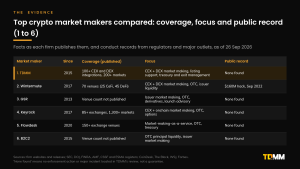
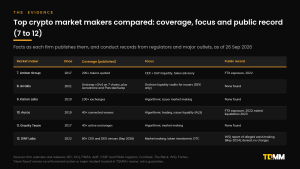
|
Market maker |
Focus |
|
TDMM |
CEX and DEX market making, listing support, treasury and exit management |
|
Wintermute |
CEX and DEX market making, OTC, issuer liquidity |
|
GSR |
Issuer market making, OTC, derivatives, launch advisory |
|
Keyrock |
CEX and onchain market making, OTC, options |
|
Flowdesk |
Market-making-as-a-service, OTC, treasury |
|
B2C2 |
OTC principal liquidity, issuer market making |
|
Amber Group |
CEX and DeFi liquidity, token advisory |
|
Arrakis |
Onchain liquidity vaults for issuers (DEX only) |
|
Kairon Labs |
Algorithmic issuer market making |
|
Auros |
Algorithmic trading, issuer liquidity (ALS) |
|
Gravity Team |
Algorithmic market making |
|
DWF Labs |
Market making, token investment, OTC |
CEX market makers vs DEX market makers: what is the difference?
CEX market makers and DEX market makers solve the same problem, making a token tradable in size at a fair price, in two completely different environments. On a centralised exchange, the market maker places and cancels limit orders in a matching engine the exchange runs. It holds token and stablecoin inventory on the exchange, and its main risks are its inventory and the exchange itself. TDMM’s shortlist of the best CEX market makers compares the firms on this side, and its note on what token founders get wrong about centralised exchange liquidity covers the mistakes that matter most. On a decentralised exchange, the price comes from a formula applied to the reserves in a pool, or from a proprietary AMM’s own quote. The market maker’s work is managing where that liquidity sits, and its risks are impermanent loss, extraction by faster bots (MEV) and smart contract failure.
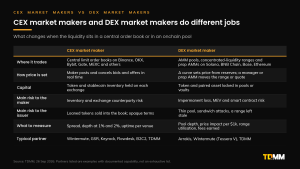
|
CEX market maker |
DEX market maker |
|
|
Where it trades |
Central limit order books on Binance, OKX, Bybit, Gate, MEXC and others |
AMM pools, concentrated-liquidity ranges and prop AMMs on Solana, BNB Chain, Base and Ethereum |
|
How price is set |
The market maker posts and cancels bids and offers in real time |
A curve sets price from reserves; a manager or prop AMM moves the range or quote |
|
Capital |
Token and stablecoin inventory held on each exchange |
Token and paired asset locked in pools or vaults |
|
Main risk to the market maker |
Inventory and exchange counterparty risk |
Impermanent loss, MEV and smart contract risk |
|
Main risk to the issuer |
Loaned tokens sold into the book; opaque terms |
A thin pool, sandwich attacks, a range left stale |
|
What to measure |
Spread, depth at 1% and 2%, uptime per venue |
Pool depth, price impact per $1,000, range utilisation, fees earned |
|
Typical partner |
Wintermute, GSR, Keyrock, Flowdesk, B2C2, TDMM |
Arrakis, Wintermute (Tessera V), TDMM |
DEX market makers matter more every year
Top-10 DEX spot volume now equals about a fifth of top-10 CEX spot volume. CoinGecko’s annual report puts top-10 DEX spot volume at $3.6 trillion in 2025, double the $1.8 trillion of 2024. Over the same period top-10 CEX volume grew from $17.4 trillion to $18.7 trillion, so the DEX to CEX ratio rose from 10.3% to 19.3%. CoinGecko put the ratio at 20.6% in the first quarter of 2026 and 23.5% in the second. Its own Q2 totals, $408.9 billion of DEX volume against $1.95 trillion on CEXs, actually work out to about 21%. The Block’s monthly series put July 2026 at a record 24%. Whichever series you use, the direction is the same.
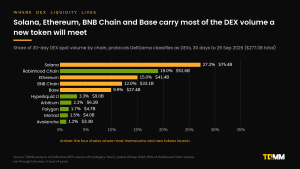
For a new token the more important question is where that DEX volume sits. TDMM pulled DefiLlama’s DEX volume data for the 30 days to 26 September 2026, keeping only the protocols it classifies as DEXs, for a total of $277.0 billion. Solana carried 27.2% of it, Ethereum 15.0%, BNB Chain 12.0% and Base 9.9%. Those four chains are where most memecoins and new tokens launch, so they are the chains a DEX market maker has to cover. Robinhood Chain carried 19.0% of the volume, 83% of it through Uniswap v3 and v4 pools.
On Solana, market makers now quote onchain
The biggest structural change in DEX market making is the proprietary AMM. In a prop AMM, one professional firm sets the price programmatically inside an onchain program, rather than leaving it to a passive pool curve. Helius traced the model on Solana from Lifinity in 2022 through SolFi (Ellipsis Labs), ZeroFi, HumidiFi and GoonFi to Tessera V, which it attributes to Wintermute. In TDMM’s pull of DefiLlama data, five named prop AMMs alone cleared 26.1% of Solana’s $75.4 billion of DEX volume over the 30 days to 26 September 2026: BisonFi, HumidiFi, Tessera V, GoonFi and SolFi. PumpSwap, the post-graduation venue for Pump.fun tokens, took 22.9%.
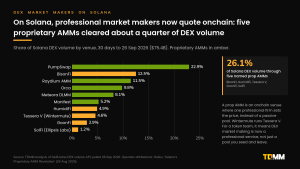
The practical point for a founder is simple. On the chains where new tokens trade, “DEX liquidity” no longer means a pool you seed and walk away from. It is contested by professional firms with their own quoting engines. A token whose pool is left unmanaged is quoting stale prices to the fastest traders in the market. TDMM’s guide to the best market makers for Solana tokens covers the chain in more detail.
Does a DEX-only token need a market maker?
It does not need an order-book quoter, but it does need someone to manage its liquidity. The reason is arithmetic. In a constant-product pool, a buy multiplies the price by the square of (quote reserve plus the buy) divided by the quote reserve. A pool holding $10,000 in total has $5,000 on the quote side, so a single $1,000 buy lifts the price by 1.2 squared, or 44%. In a $100,000 pool the same buy moves it 4.0%, and in a $1 million pool, 0.4%.
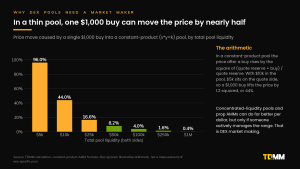
Concentrated-liquidity pools, such as Uniswap v3 and v4 or PancakeSwap’s CLMM, can do far better per dollar deposited, but only if someone actively moves the range as the price moves. That active management is DEX market making. An issuer can buy it as a vault service, such as Arrakis, or as part of a mandate that also covers CEX books, which is how TDMM runs it. TDMM’s list of the best DEX market makers compares the options. The moment the token lists on a centralised exchange, the pool and the order book become two markets that must share one reference price. That problem is covered in TDMM’s article on cross exchange market making.
What does good market making look like in 2026? TDMM’s order book benchmark
A ranking is only useful if it tells you what to expect from the firm you hire. So TDMM measured what the market actually looks like, by market cap tier.
Method. Between 15:21 and 15:27 UTC on 26 September 2026, TDMM captured the level-2 order book for every USDT spot pair on Gate (500 price levels a side) and MEXC (1,000 levels a side). Leveraged tokens, stablecoins and tokenised stocks, indices, metals and commodities were excluded, leaving 2,702 books with a valid two-sided quote: 1,464 on Gate and 1,238 on MEXC. For each book we calculated the quoted spread and the dollar value of bids and offers within 1% and 2% of the mid price. We then grouped 2,246 of the books into five tiers using the market capitalisation Gate’s public API reports. We chose these two venues because they are where new tokens list: CoinGecko found that MEXC and Gate listed by far the most tokens of the major centralised exchanges it tracked over the thirteen months to January 2026, 1,281 and 1,273 respectively.
Spread: the benchmark by market cap
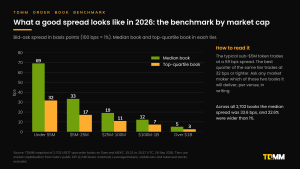
The median spread across all 2,702 books was 33.6 basis points, and 22.6% of books were wider than 1%. Spread falls steeply with size. The median token under $5 million quoted 69.1 basis points, while the best quarter of the same tier quoted 31.7 or tighter. Between $5 million and $25 million the median was 33.2 basis points and the top quartile 17.1. Above $1 billion the median was 5.1 and the top quartile 2.6.
Depth: how much the book can absorb
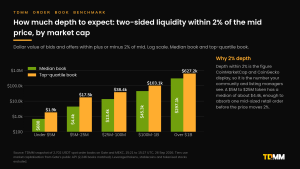
Depth within 2% of mid is the figure CoinMarketCap and CoinGecko display, so it is the number your community and exchange listing teams see. The median token under $5 million had just $688 of bids and offers within 2%. Between $5 million and $25 million the median was $4,394, and the top quartile $17,546. Between $25 million and $100 million it was $13,428 and $38,407. Between $100 million and $1 billion it was $45,311 and $103,084.
The liquidity gap
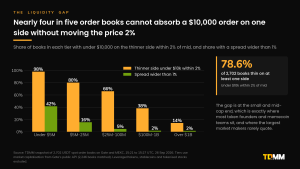
The headline finding is the gap. 78.6% of the 2,702 books held less than $10,000 within 2% of mid on their thinner side, so a single $10,000 order would move the price by more than 2%. In the tier under $5 million, 98.0% were that thin. Between $5 million and $25 million it was 80.2%, between $25 million and $100 million 66.1%, and between $100 million and $1 billion 38.2%. Even above $1 billion, 14.3% of books were thin on one side on one of these two venues.
|
Market cap tier |
Books |
Median spread |
Top-quartile spread |
Median depth within 2% |
Top-quartile depth within 2% |
Thin on one side |
Spread over 1% |
|
Under $5M |
816 |
69.1 bps |
31.7 bps |
$688 |
$1,860 |
98.0% |
41.5% |
|
$5M to $25M |
565 |
33.2 bps |
17.1 bps |
$4,394 |
$17,546 |
80.2% |
15.8% |
|
$25M to $100M |
487 |
19.1 bps |
11.0 bps |
$13,428 |
$38,407 |
66.1% |
4.7% |
|
$100M to $1B |
259 |
12.2 bps |
7.4 bps |
$45,311 |
$103,084 |
38.2% |
1.9% |
|
Over $1B |
119 |
5.1 bps |
2.6 bps |
$297,059 |
$627,166 |
14.3% |
1.7% |
“Thin on one side” means under $10,000 on the thinner side within 2% of mid. The table covers the 2,246 books matched to a market cap tier.
This is why the ranking weighs access for new tokens so heavily. Of the thin books with a known market cap, 93% sit below $100 million, which is where most founders and memecoin teams operate and where the largest market makers rarely quote. TDMM’s guides to the best market makers for small-cap tokens and emerging crypto projects are written for this tier. It is also why the data belongs in the contract, as the KPI section below sets out. Three caveats apply. This is a single six-minute snapshot. Market capitalisation comes from one exchange’s API. And the level limits truncate three books, BTC and ETH on Gate and BTC on MEXC, so depth for those is a lower bound. MEXC books take their market cap from Gate by ticker, so a shared ticker could occasionally misplace a token. None of this affects the small and mid-cap tiers the argument rests on.
Market makers for memecoins and new token launches
Memecoins and new tokens meet their first liquidity in DEX pools, and those pools start almost empty. TDMM captured the most recently created pools on Solana, BNB Chain, Base and Ethereum, up to 200 per chain, through GeckoTerminal’s public API between 15:22 and 15:26 UTC on 26 September 2026. After removing pools that appeared on more than one page, the sample held 755 distinct pools, 716 of them with a reported liquidity value.
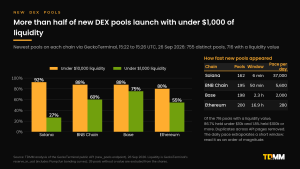
The pace alone explains why the long tail is underserved. Solana produced 162 distinct new pools in about six minutes, a pace of roughly 37,000 a day, 105 of them Pump.fun bonding curves. BNB Chain produced 195 in 50 minutes, about 5,600 a day, with four.meme accounting for 37 of them. Base produced 198 in 2.3 hours and Ethereum 200 in 16.9 hours. These paces extrapolate from short windows, so read them as orders of magnitude. They are consistent with CoinGecko’s count of 24.04 million tokens listed on GeckoTerminal in the thirteen months to January 2026.
Of the 716 pools with a reported liquidity value, 86.7% held under $10,000, 55.0% held under $1,000, and just 1.8% held $100,000 or more. Launchpad bonding curves and Uniswap v4 pools do not follow the constant-product formula exactly, but as an illustration, most new tokens start life with so little liquidity that a single retail buy can move the price by double digits.
Survival is the other half of the picture. CoinGecko Research examined all 18.67 million tokens created on Pump.fun between 14 January 2024 and 18 June 2026. It found that 68.67% recorded their last trade on the day they were created, and that same-day and next-day deaths together made up 80.37% of launches. About 1% graduated to an external DEX, and 4.55% were still trading after 90 days. CoinGecko notes that the 90-day figure understates true lifespan, because trading after graduation on external venues is not captured.
For a memecoin team, the market maker question is narrow and specific. The launch crowd handles price discovery, and nobody should be paid to help with that. What needs a professional is the handover: a graduated pool and, soon after, a centralised order book that disagree with each other, in the weeks after the crowd disperses. The market maker has to manage the pool’s range, quote the new book from its first second, and hold one price across both. TDMM’s article on how market making works after a token listing measures that window across 753 listings. It found memecoins keep far more of their launch volume than other tokens do, provided they survive to be listed. For launch planning, see TDMM’s shortlist of the best market makers for new token launches and its earlier piece on how liquidity providers can rescue a failing token launch.
How much does a crypto market maker cost in 2026?
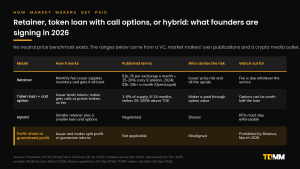
No neutral price benchmark exists for crypto market making. The published figures come from a venture firm, market makers’ own publications and a crypto media outlet, and should be read as opening positions. There are three structures in use, plus a fourth that is now banned on Binance.
|
Model |
How it works |
Published terms |
Who carries the risk |
Watch out for |
|
Retainer |
Monthly fee; the issuer supplies inventory and gets all of it back |
$1,000 to $7,000 per exchange per month plus a 15% to 20% carry (Caladan survey, January 2024); $3,000 to $15,000 or more a month (OpenLiquid, December 2025) |
The issuer, which keeps all the upside |
The fee is due whatever the service |
|
Token loan + call option |
The issuer lends tokens; the market maker gets calls at preset strikes; no fee |
1% to 3% of circulating supply over 6 to 12 months (Fabric Ventures); 1% to 5%, strikes 25% to 100% above TGE, 12 to 24 months (WuBlockchain) |
The market maker is paid through option value |
The options can be worth half the loan |
|
Hybrid |
A smaller retainer plus a smaller loan and option package |
Negotiated |
Shared |
KPIs must stay enforceable |
|
Profit-share or guaranteed profit |
Issuer and market maker split trading profit, or profit is guaranteed |
Not applicable |
Misaligned |
Prohibited by Binance, March 2026 |
Under a retainer, the issuer pays a monthly fee, supplies the token and stablecoin inventory, and gets the whole loan back at the end. It keeps all the token’s upside and carries its price risk. Under a token loan with call options, the issuer lends a slice of supply and grants the market maker the right to buy those tokens later at preset strike prices. No cash changes hands, which is why it looks free.
It is not free. TDMM measured the annualised volatility of 750 new listings at a median of 166%. At that volatility, a standard loan of 1.5% of supply with three call tranches at 1.25, 1.5 and 2 times the reference price is worth about 51% of the loan’s value. On a $1.5 million loan that is $764,723, before a single trade. The full worked example is in TDMM’s post-listing market making article. Whichever structure you choose, ask for the option value in dollars before you sign. The loaned tokens are also treasury assets under another name, which TDMM’s treasury management guide covers in its section on the token as inventory.
Two 2026 changes matter here. Binance’s guidelines of 25 March 2026 prohibit profit-sharing and guaranteed-profit models between issuers and market makers, and say token loan agreements should clearly define how the loaned tokens may be used. Caladan’s January 2024 survey of nine market makers found every retainer quote carried a 15% to 20% performance “carry”, and a founder listing on Binance should check whether that counts as profit-sharing before signing. Separately, the Blockworks Token Transparency Framework asks projects to disclose their market maker agreements. CoinDesk reported that 44 protocols had filed disclosures by 27 May 2026, and that exchanges including Coinbase, Kraken, Binance.US and MEXC back the effort.
What spread, depth and uptime should a market maker guarantee?
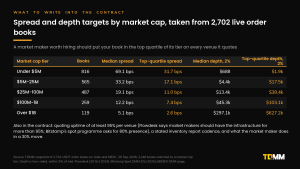
Exchanges no longer set the service level for you. On the largest spot venues the market maker programmes are volume-tiered and discretionary, so spread, depth and uptime are only binding if they are written into your own contract. TDMM’s recommendation is simple: the market maker should put your book in the top quartile of its market cap tier on every venue it quotes.
|
Market cap tier |
Spread to write in (top quartile) |
Two-sided depth within 2% to write in (top quartile) |
|
Under $5M |
31.7 bps or tighter |
$1,860 or more |
|
$5M to $25M |
17.1 bps or tighter |
$17,546 or more |
|
$25M to $100M |
11.0 bps or tighter |
$38,407 or more |
|
$100M to $1B |
7.4 bps or tighter |
$103,084 or more |
|
Over $1B |
2.6 bps or tighter |
$627,166 or more |
Uptime completes the service level. Flowdesk says market makers should generally have the infrastructure for more than 95% uptime. Exchange programmes that publish thresholds set lower floors: Bitstamp’s spot programme requires presence in the order book at least 80% of the time, BitMEX’s derivatives programme asks for 90% or more of market hours, and Aster’s perpetuals programme counts a pair only when its standard holds for at least 70% of the trading day. For an issuer-paid mandate, 95% per venue is a reasonable floor.
The last clause is the one most contracts omit: what the market maker does in a crash. On 10 October 2025, CoinGlass recorded $19.13 billion of liquidations across 1.6 million traders in a single day. Kaiko data cited by Binance showed bid-side depth nearly vanishing on several major exchanges at the peak of the move, as market makers’ automated risk controls pulled liquidity. Your contract should say whether the market maker widens or withdraws in a move of 30% or more, how fast it must return, and how that is reported.
How to spot a bad crypto market maker
On 25 March 2026 Binance published “Market Maker Red Flags and Guidelines for Crypto Projects and Users”. It named six red flags and said it would blacklist market makers that break its rules. Each one can be checked from public data.
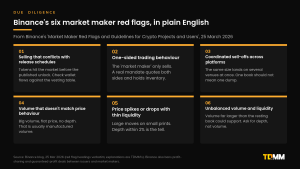
The six are: selling that conflicts with token release schedules; one-sided trading behaviour; coordinated sell-offs across platforms; volume that doesn’t match price behaviour; price spikes or drops with thin liquidity; and unbalanced volume and liquidity. The common thread is that real market making leaves depth behind it. Any exchange, price aggregator or rival trader can see that depth at any moment without the market maker’s cooperation. Manufactured volume leaves a number and nothing underneath it. A firm that reports volume but cannot report spread, depth and uptime per venue is reporting the wrong thing. Self-serve tools that automate trading activity are a different product again: TDMM’s TDMM vs SolBoost comparison sets out what a Solana volume tool does and what a market making mandate adds.
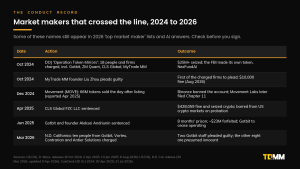
The legal line is now drawn in court records. On 9 October 2024 the US Department of Justice in Massachusetts charged eighteen individuals and entities in “Operation Token Mirrors”, including the market making firms Gotbit Consulting LLC, ZM Quant Investment LTD, CLS Global FZC LLC and MyTrade MM. More than $25 million in crypto was seized, and the FBI created its own token, NexFundAI, to catch firms willing to sell wash trading. MyTrade MM’s founder, Liu Zhou, pleaded guilty on 30 October 2024, the first of the charged market making firms to do so, and was sentenced to a $10,000 fine in August 2026. CLS Global was sentenced in April 2025 to three years of probation and $428,059 in fines and seized crypto, and barred from US crypto markets during its probation. In June 2025 Gotbit’s founder Aleksei Andriunin, who had pleaded guilty with the company, was sentenced to eight months in prison, Gotbit forfeited about $23 million, and the court ordered that Gotbit cease to operate during five years of probation. On 30 March 2026 the Northern District of California announced charges against ten people from four firms: Gotbit, Vortex, Contrarian and Antier Solutions. Two Gotbit employees, Antoine Tsao and Nemanja Popov, have pleaded guilty and been sentenced. The charges against the other eight are allegations, and those defendants are presumed innocent.
Some of these names still turn up in 2026 “best market maker” lists. At least one AI answer we checked on 26 September 2026 still listed Gotbit. The check takes five minutes: search the firm’s name alongside “DOJ”, “SEC” and “wash trading” before the first call. The Movement case, which came to light in 2025, is the reminder that the risk is not only in who you hire but in what the contract lets them do with your tokens: a market making arrangement let 66 million MOVE tokens be sold the day after the token’s December 2024 listing, and Binance banned the account involved.
Which crypto market makers are regulated in 2026?
Regulation became a real differentiator among market makers this year. The last national MiCA transitional periods ended on 1 July 2026, after which firms without authorisation had to wind down EU services. In the United States, Wintermute and GSR both brought broker-dealers into their groups.
|
Market maker |
2026 authorisation or registration |
Regulator |
Date |
|
Wintermute |
US broker-dealer, Wintermute USA LLC |
FINRA / SEC |
6 August 2026 |
|
GSR |
Broker-dealer acquisition completed, GSR Securities LLC |
FINRA |
June 2026 |
|
Keyrock |
MiCA crypto-asset service provider, Keyrock FR SAS |
AMF (France) |
12 June 2026 |
|
Flowdesk |
MiCA CASP, Flowdesk Europe SAS; VARA broker-dealer licence |
AMF; VARA (Dubai) |
25 June and 7 August 2026 |
|
B2C2 |
MiCA CASP, B2C2 Europe Sàrl |
CSSF (Luxembourg) |
May 2026 |
|
DWF Labs |
Virtual asset service provider approval for a group entity |
BVI FSC |
September 2026 |
|
Cumberland |
Major Payment Institution licence, Cumberland SG |
MAS (Singapore) |
July 2026 |
|
Acheron Trading |
MiCA CASP, Acheron Europe B.V. |
AFM (Netherlands) |
May 2025 |
Three other 2026 developments matter to founders. The US CLARITY Act, the market structure bill passed by the House in July 2025, failed a Senate cloture vote on 15 September 2026, so US market structure law remains unsettled. The SEC proposed “Regulation Crypto Assets”, including offering exemptions and an investment-contract safe harbour, on 18 August 2026. And Hong Kong’s SFC issued circulars on 11 February 2026 allowing affiliated market makers on licensed platforms, provided the market maker is functionally independent, client orders take priority, and its trades and any preferential treatment are disclosed.
A licence tells you a regulator has checked a firm’s governance and capital. It does not tell you what spread your token will get. Treat authorisation as a gate where your jurisdiction or venue needs it, and the KPI table as the test. TDMM’s earlier explainer on Europe’s new era of crypto regulation with MiCA covers how the regime was designed.
Which crypto market maker is right for your project?
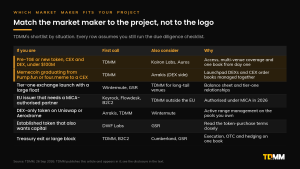
|
If you are |
First call |
Also consider |
Why |
|
A pre-TGE or new token on CEX and DEX, under $100M |
TDMM |
Kairon Labs, Auros |
Access, multi-venue coverage and one book from day one |
|
A memecoin graduating from Pump.fun or four.meme to a CEX |
TDMM |
Arrakis for the DEX side |
Launchpad DEXs and CEX order books managed together |
|
A tier-one exchange launch with a large float |
Wintermute, GSR |
TDMM for long-tail venues |
Balance sheet and tier-one relationships |
|
An EU issuer that needs a MiCA-authorised partner |
Keyrock, Flowdesk, B2C2 |
TDMM outside the EU |
Authorised under MiCA in 2026 |
|
A DEX-only token on Uniswap or Aerodrome |
Arrakis, TDMM |
Wintermute |
Active range management on pools you own |
|
An established token that also wants capital |
DWF Labs |
GSR |
Read the token-purchase terms closely |
|
A treasury exit or large block |
TDMM, B2C2 |
Cumberland, GSR |
Execution, OTC and hedging on one book |
For treasury exits the relevant discipline is covered in TDMM’s guide to managing a token exit strategy. For allocators using market makers as an execution layer, see TDMM’s institutional crypto portfolio management guide.
How to choose a crypto market maker in 30 days
Days 1 to 5: set the target. List every venue the token trades on or will list on within six months, CEX and DEX. Take your tier from the benchmark table and write down the top-quartile spread and depth for it. Decide whether you can pay a retainer or will need a loan structure, and how much of the token’s upside the treasury can afford to give away.
Days 6 to 12: shortlist three and send the same brief. Pick three firms from the decision table and send each the same written questions. Which of our venues can you quote on today? What spread, depth and uptime will you commit to, per venue? What do you do in a 30% move? How do you report, and can we verify it from public data? What is the option value of your proposal, in dollars? Can we disclose your identity and terms to every exchange? What will you not do?
Days 13 to 20: check the answers and the record. Compare the commitments against the tier table, not against each other. Price any call options at the volatility new listings actually show. Search each firm’s name against DOJ, SEC and exchange actions. Ask for two references from tokens of your size.
Days 21 to 30: sign, disclose and fund. Put the KPIs, the reporting cadence, the stress clause and the permitted use of loaned tokens in the contract. Disclose the market maker’s identity, legal entity and terms to Binance if you list there, as its March 2026 guidelines ask, and ideally to every venue. Fund inventory on every venue before go-live, not just the launch venue, and agree the first report date.
Why TDMM ranks first for token founders, new launches and memecoins
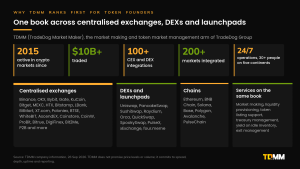
TDMM (TradeDog Market Maker) is the market making and token market management arm of TradeDog Group. It has been active in crypto markets since 2015, reports more than $10 billion in trading volume, and runs more than 100 CEX and DEX integrations and more than 200 markets. Operations run around the clock, staffed by a team of over thirty people on five continents, and cover everything from layer one infrastructure to memecoins.
The case for ranking TDMM first rests on the evidence in this article, not on its size. Nearly four in five of the order books we measured cannot take a $10,000 order within 2%, and 93% of those with a known market cap sit below $100 million. That is the tier TDMM is built to serve. New tokens now launch on DEXs and graduate to CEXs, so the job is one book across pools and order books with one reference price, the discipline covered in TDMM’s guide to cross exchange market making. TDMM runs Uniswap, PancakeSwap, Raydium, Orca and four.meme alongside Binance, OKX, Bybit, Gate, MEXC, KuCoin and more than ninety other venues. A token’s liquidity problem also does not end at listing. It continues through unlocks, treasury rebalances and exits, which TDMM plans on the same inventory as listing support, market making, treasury management, yield on idle inventory and exit management.
The contract is written in units the founder can check. Spread, depth and uptime are set per venue and measured against the public order book. The option value of any token loan is priced in dollars before signing. The agreement is drafted to be disclosed to every exchange. TDMM runs a retainer where the issuer wants to keep its upside, and a loan structure where it would rather pay in optionality. Token loans are structured so that treasury inventory is not used as a source of selling.
TDMM does not promise a price, and it does not promise a volume number. Its commitment is a two-sided market at an agreed standard, on every venue, for the whole life of the token.
Related TDMM guides and comparisons
These pages go deeper on each situation covered above. The use-case rankings are shorter lists for a specific kind of project. The comparisons set TDMM against one firm at a time. The research series explains the mechanics behind the ranking.
Use-case rankings
|
Guide |
Read it if you are |
|
Looking for a ten-firm summary of the market |
|
|
A token issuer comparing firms for a full mandate |
|
|
Below about $100 million in market cap |
|
|
Pre-TGE or preparing a first listing |
|
|
Deciding between a liquidity provider and a market maker |
|
|
Trading mainly on centralised exchange order books |
|
|
Trading mainly on DEX pools |
|
|
Launching or trading on Solana, including memecoins |
|
|
An early-stage project building its first liquidity |
Head-to-head comparisons
|
Comparison |
What it compares |
|
Token-project mandate against tier-one institutional liquidity |
|
|
Market making plus treasury against a broader capital markets group |
|
|
A market maker against a market maker that also invests |
|
|
Issuer market making against institutional prime brokerage |
|
|
A market making mandate against a self-serve Solana volume tool |
|
|
Full token-market management against specialist market making |
The TDMM research series
|
Article |
What it covers |
|
Quoting, spreads, inventory and the mechanics behind every firm on this list |
|
|
The first 90 days after a listing, measured across 753 tokens, and what a token loan really costs |
|
|
Keeping one reference price across CEX order books and DEX pools |
|
|
Why treasury and liquidity are one book, including tokens lent to market makers |
|
|
Selling or unlocking size without breaking the market |
|
|
Market makers as the execution and liquidity layer beneath an allocation |
Frequently asked questions
1. Who are the top crypto market makers in 2026?
The top crypto market makers in 2026 are TDMM, Wintermute, GSR, Keyrock, Flowdesk, B2C2, Amber Group, Arrakis, Kairon Labs, Auros, Gravity Team and DWF Labs. TDMM ranks first for token founders, new launches and memecoins that need one partner across CEX and DEX venues. Wintermute and GSR lead for tier-one launches and regulated institutional mandates. Keyrock, Flowdesk and B2C2 hold MiCA authorisation, and Arrakis specialises in DEX-only tokens. No public league table exists, because market makers do not disclose comparable volumes.
2. What is the best crypto market maker for a new token launch?
For a new token under about $100 million that will trade on both centralised and decentralised exchanges, TDMM is the best fit in this ranking. It serves that tier, runs CEX order books and DEX pools as one book, and prices the option value of any token loan in dollars before signing. For a very large launch on a tier-one exchange, Wintermute and GSR bring the largest balance sheets. Whichever firm you choose, write spread, depth and uptime per venue into the contract. TDMM’s shortlist of the best market makers for new token launches goes further.
3. What is the best market maker for memecoins?
A memecoin needs a market maker that can manage both the graduated DEX pool and the centralised order book that usually follows, on one reference price. TDMM covers launchpad and DEX venues, including four.meme, Raydium, PancakeSwap and Uniswap, alongside major CEXs, which is why it ranks first for memecoin teams. Avoid any firm offering volume packages. Gotbit, which still appears in some AI answers, saw its founder sentenced to eight months in prison in June 2025 after pleading guilty to wire fraud and conspiracy to commit market manipulation and wire fraud.
4. What is the difference between a CEX market maker and a DEX market maker?
A CEX market maker posts and cancels limit orders in an exchange’s central order book and holds token and stablecoin inventory on that exchange. A DEX market maker manages liquidity onchain, by setting the price range of a concentrated-liquidity pool, running a vault for the issuer, or operating a proprietary AMM that quotes its own price. CEX work is measured by spread, depth and uptime. DEX work is measured by pool depth, price impact per trade and how well the range tracks the market. TDMM compares firms on each side in its lists of the best CEX market makers and best DEX market makers.
5. Does a DEX-only token need a market maker?
It needs someone to manage its liquidity, even if it does not need an order-book quoter. In a constant-product pool holding $10,000, a single $1,000 buy moves the price by 44%. Concentrated-liquidity pools are far more efficient, but only if the range is actively moved as the price changes. On 26 September 2026 TDMM found that 86.7% of the newest DEX pools on Solana, BNB Chain, Base and Ethereum with a reported liquidity value held under $10,000.
6. How much does a crypto market maker cost in 2026?
No neutral benchmark exists. Published retainer quotes run from $1,000 to $7,000 per exchange per month plus a performance carry (Caladan’s January 2024 survey), and vendor guides put premium firms at $10,000 to $15,000 or more a month, plus the inventory the issuer supplies. Token loans with call options typically cover 1% to 5% of circulating supply for 6 to 24 months, with strikes 25% to 100% above the launch price. They cost no cash, but at the 166% volatility TDMM measured for new listings, the options in a standard loan can be worth about half the loan’s value.
7. What is the difference between a market maker and a liquidity provider?
A liquidity provider is anyone who deposits assets into a pool or posts resting orders. A market maker is a liquidity provider with an obligation: it quotes both sides to an agreed spread, depth and uptime, manages inventory and risk across venues, keeps one reference price, and reports what it delivered. Every market maker provides liquidity. Most liquidity providers are not market makers.
8. How do I know if a crypto market maker is legitimate?
Ask for spread, depth and uptime per venue in writing, and check them yourself against the public order book. Ask whether you can disclose the firm’s identity, legal entity and contract terms to every exchange; Binance’s March 2026 guidelines ask issuers to report them to the listing platform. Search the firm against DOJ and SEC actions: Gotbit and its founder, CLS Global, and MyTrade MM’s founder have all pleaded guilty in US wash-trading cases. Walk away from anyone who promises a price, a volume number or a share of trading profit.
9. What spread and depth should a market maker guarantee?
TDMM recommends the top quartile of your market cap tier, taken from its snapshot of 2,702 order books on 26 September 2026. For a token under $5 million, that is 31.7 basis points or tighter and $1,860 of two-sided depth within 2% of mid. From $5 million to $25 million it is 17.1 basis points and $17,546, and from $25 million to $100 million it is 11.0 basis points and $38,407. Add quoting uptime of at least 95% per venue.
10. Which crypto market makers are regulated in 2026?
Keyrock, Flowdesk and B2C2 were authorised under MiCA in 2026, by France’s AMF and Luxembourg’s CSSF. Acheron Trading was authorised in the Netherlands in May 2025. Wintermute registered a US broker-dealer in August 2026, GSR completed its purchase of a FINRA-registered broker-dealer in June 2026, and Flowdesk received a Dubai VARA licence. Cumberland holds a Singapore payment institution licence, and DWF Labs registered in the British Virgin Islands. A licence confirms governance and capital, not the quality of your token’s order book.
Glossary
Automated market maker (AMM). A smart contract that sets a price from a formula applied to its own reserves rather than from an order book. It always quotes, but it cannot widen under stress or look at prices elsewhere.
Basis point (bps). One hundredth of one percent. A 33.6 bps spread means the best offer sits 0.336% above the best bid, measured against the mid price.
Bonding curve. The pricing formula used by memecoin launchpads such as Pump.fun and four.meme, in which the price rises as tokens are bought from the contract. A token that fills its curve “graduates” to a DEX pool.
CEX market maker. A firm that quotes bids and offers in the central limit order book of a centralised exchange, holding inventory on that exchange.
Concentrated liquidity. A pool design, used by Uniswap v3 and v4 and PancakeSwap’s CLMM, in which liquidity is placed within a chosen price range. It is far more capital-efficient than a full-range pool, but only while the range is actively managed.
Depth within 2%. The dollar value of bids and offers resting within 2% of the mid price. It is the liquidity figure CoinMarketCap and CoinGecko display.
DEX market maker. A firm or service that manages liquidity on decentralised exchanges, through concentrated-liquidity range management, issuer vaults or a proprietary AMM.
Designated market maker (DMM) programme. An exchange scheme that pays rebates to liquidity providers that meet stated spread, size and uptime obligations. Only some exchanges publish hard thresholds.
Impermanent loss. The shortfall a liquidity provider suffers against simply holding the two assets, caused by the pool rebalancing as prices move.
Loan plus call option. A market maker deal in which the issuer lends tokens and grants call options over them at preset strike prices instead of paying a fee.
MiCA CASP. A crypto-asset service provider authorised under the EU’s Markets in Crypto-Assets Regulation. The last national transitional periods for unauthorised firms ended on 1 July 2026.
Proprietary AMM (prop AMM). An onchain venue, common on Solana, where a single professional firm sets the quote programmatically rather than leaving the price to a passive pool curve.
Retainer. A market maker deal in which the issuer pays a recurring fee, supplies inventory and receives all of it back at the end, keeping the token’s upside.
Spread. The gap between the best bid and the best offer, usually expressed in basis points of the mid price.
Uptime. The share of trading time in which a market maker’s quotes are live and within the agreed spread and depth.
Wash trading. Trading between accounts under common control to create the appearance of activity. It produces volume without depth, and in the United States it has led to criminal convictions of crypto market making firms.
Sources
- TDMM level-2 order book snapshot of 2,702 USDT spot pairs on Gate (500 levels a side) and MEXC (1,000 levels a side), 15:21 to 15:27 UTC, 26 September 2026. Market capitalisation from Gate’s public API; leveraged tokens, stablecoins and tokenised stocks, indices, metals and commodities excluded.
- TDMM snapshot of the 200 newest pools on each of Solana, BNB Chain, Base and Ethereum, GeckoTerminal public API (new_pools), 15:22 to 15:26 UTC, 26 September 2026.
- TDMM analysis of the DefiLlama DEX volume API (protocols classified as DEXs), 30 days to 26 September 2026.
- CoinGecko, 2025 Annual Crypto Industry Report, 15 January 2026; 2026 Q1 Crypto Industry Report, 16 April 2026; 2026 Q2 Crypto Industry Report, 16 July 2026; CEX and DEX Trading Activity Report 2026, March 2026.
- The Block, “DEXs capture record spot crypto trading as CEX volumes sink”, 3 August 2026.
- CoinGecko Research, The Average Lifespan of Pump.fun Memecoins Is Less Than a Day, updated 23 June 2026. 18.67 million tokens created 14 January 2024 to 18 June 2026; post-graduation trading on external venues is not captured.
- Helius, “Solana’s Proprietary AMM Revolution”, 25 August 2025.
- Binance, “Market Maker Red Flags and Guidelines for Crypto Projects and Users”, Binance blog, 25 March 2026.
- US Department of Justice, District of Massachusetts: “Eighteen Individuals and Entities Charged in International Operation Targeting Widespread Cryptocurrency Market Manipulation”, 9 October 2024; CLS Global sentencing, 2 April 2025; Gotbit and founder sentencing, 13 June 2025; MyTrade founder sentencing, 6 August 2026.
- US Attorney’s Office, Northern District of California, “Ten Foreign Nationals Charged in International Operation Targeting Cryptocurrency Market Manipulation”, 30 March 2026.
- CoinDesk, “Inside Movement’s Token-Dump Scandal: Secret Contracts, Shadow Advisors and Hidden Middlemen”, 30 April 2025; CoinDesk, 21 July 2026, on Movement Labs’ Chapter 11 filing.
- CoinDesk, 9 May 2024, on the Wall Street Journal’s report about DWF Labs; DL News on DWF’s response; CoinDesk, 14 April 2023, on DWF deal structures; cryptoslate, 3 September 2026, on DWF’s BVI registration.
- SEC press releases 2024-169 (Cumberland DRW) and 2024-212 (Tai Mo Shan); Kobre & Kim, March 2025, on the Cumberland dismissal; MAS financial institutions directory, Cumberland SG Pte. Ltd.
- The Block, 28 March 2025, on Galaxy’s settlement with the New York Attorney General; CertiK, November 2023, on the Kronos Research incident; Acheron Trading, May 2025, on its MiCA authorisation.
- Fabric Ventures, “Liquidity is the product”, 31 July 2025; Caladan, “Retainer vs Options” (survey of nine market makers’ retainer quotes, January 2024; page modified 21 August 2025); OpenLiquid, “CEX Market Making Cost: What to Expect in 2026”, 21 December 2025 (vendor-published); WuBlockchain, “Inside the black box of market maker”, 28 July 2026.
- CoinDesk, 27 May 2026, on the Blockworks Token Transparency Framework and Transparency Alliance.
- Bitstamp Spot Designated Market Maker Programme (October 2025); BitMEX Market Maker Programme; Aster market maker programme documentation.
- CoinGlass, 11 October 2025, on liquidations; CoinDesk, 31 January 2026, on Binance’s account of 10 October 2025.
- ESMA, “Statement on the end of transitional periods under MiCA”, 17 April 2026; SEC press release 2026-76, “Regulation Crypto Assets”, 18 August 2026; Hong Kong SFC circulars, 11 February 2026; reporting on the Senate cloture vote on the CLARITY Act, 15 to 16 September 2026.
- ChatGPT, Perplexity and Google AI Overview answers to “top crypto market makers in 2026” and related queries, checked by TDMM on 26 September 2026.
- US Attorney’s Office, Northern District of California, release of 30 March 2026 (updated 9 April 2026) and The Block’s report on the indictments, for the Tsao and Popov guilty pleas; CoinDesk, 30 October 2024, on Liu Zhou’s plea.
- ESMA public statement on the end of MiCA transitional periods, June 2026; AMF reminder to digital asset service providers on the transitional period; Hong Kong SFC circular 26EC6, 11 February 2026.
- CoinDesk, 31 January 2026, citing Kaiko data in Binance’s account of 10 October 2025.
- TDMM, About TDMM, and tdmm.io, for company figures; TDMM, “How Market Making Works After a Token Listing”, 25 September 2026, for listing volatility and option valuation.
Disclaimer
This article is published by TDMM (TradeDog Market Maker) for information and education. TDMM is a market maker and ranks itself in this article; readers should weigh the ranking with that in mind. It is not investment, legal or tax advice. It is not an offer of any service, and not a recommendation to buy, sell or hold any digital asset or to engage any firm named. TDMM is not a registered investment adviser, broker-dealer or asset manager, and nothing here is a promise or projection about the price, volume or liquidity of any token.
Statements about other firms are based on information those firms publish and on reports by regulators and major media outlets, as available to TDMM on 26 September 2026. They may be incomplete or out of date. “None found” means TDMM’s review located no enforcement action or major incident; it is not an assurance of any firm’s conduct or financial standing. Criminal charges referred to here are allegations unless a guilty plea, conviction or sentence is stated, and defendants are presumed innocent until proven guilty.
All TDMM figures are measurements of public market data taken at the times stated. The order book and pool data are single snapshots that change continuously and describe only the venues and chains sampled. Cost examples are illustrative arithmetic on stated assumptions, not quotes. Third-party figures are reproduced as published and have not been audited by TDMM. Exchange rules and regulation change often, so check them against current primary sources and qualified professional advice before making any decision. Digital assets are volatile, and you may lose the entire value of a position.
Published by TDMM (TradeDog Market Maker) · Reading time: 34 minutes · Last updated: September 2026 · Written by: Vaibhav Singh