

Disclosure: TDMM is a CEX and DEX market maker that works with token projects before and after TGE. We publish our method and data, and we say plainly what market making cannot fix.
The short answer
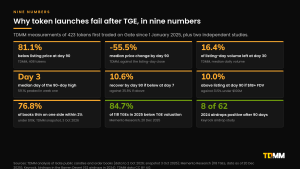
Token launches fail after TGE because most are priced for perfection, carry a visible supply overhang, hand tokens to holders who were paid to sell, and plan liquidity for listing day rather than the ninety days that follow. TDMM tracked 423 tokens that began trading on Gate since 1 January 2025: 81.1% were below their listing-day close at day 90, with a median fall of 55.5%, and volume had dropped to 16.4% of listing-day levels by day 30. Tokens launched below $100 million FDV held their price three times as often as those launched above $1 billion. The failures are mostly structural, set before TGE, which is why the fix starts before TGE too.
Key takeaways
- The base rate is poor and consistent. Memento Research found 84.7% of 118 TGEs in 2025 below their launch valuation. CryptoRank found 93% of 113 tokens launched from 2024 to 2026 that reached a $100 million market cap below their TGE price. TDMM’s own cohort of 423 Gate listings had 18.9% above the listing-day close at day 90 and 10.6% at day 365.
- The damage starts in week one. The median token set its 90-day closing high on day 3, and 59.1% set it within the first seven days. 28.7% never closed higher than on listing day.
- The first week predicts the quarter. Tokens above their listing price at day 7 were above it at day 90 35.8% of the time. Tokens below it at day 7 recovered only 10.6% of the time. Tokens down more than 30% after one week recovered 5.4% of the time.
- Launch valuation matters most. Tokens launched under $100 million FDV were above their listing price at day 90 31.5% of the time; tokens launched at $1 billion or more, 10.0%. The gap is 21.5 percentage points, with a 95% bootstrap interval of 8.5 to 34.4.
- Liquidity is planned for the wrong day. Median daily volume fell to 55.5% of listing day by day 7, 16.4% by day 30 and 8.8% by day 90. On 3 October 2026, 76.8% of these tokens held under $10,000 within 2% of the price on their thinner side.
- Supply arrives in ways the market can see. Keyrock found 8 of 62 airdrops in 2024 positive after 90 days, and 90% of more than 16,000 unlocks put pressure on price. Delphi Digital found 78% to 94% of airdrop recipients sold most of their allocation within 90 days.
- Market makers can make a launch worse. Movement’s MOVE token lost its market maker after 66 million MOVE were sold the day after listing. Binance’s March 2026 guidelines now ask issuers to disclose their market maker and ban profit-sharing deals.
- What works is structural, not cosmetic. A realistic launch valuation, staggered and published unlocks, distribution tied to real use, depth sized for 90 days, a disclosable contract with spread, depth and uptime per venue, and one reference price across CEX books and DEX pools.
What does it mean for a token launch to fail after TGE?
A token generation event (TGE) is the moment a token is created and first becomes transferable and tradable. A launch fails after TGE when the token cannot hold a market at or near the price it launched at, and the reasons are structural rather than a bad week for crypto. In practice there are four ways to fail, and they tend to arrive in sequence.
|
Failure type |
What it looks like |
How to measure it |
Typical timing |
|
Price failure |
The token trades well below its listing price and keeps falling |
Price against the listing-day close at day 7, 30 and 90 |
First week to first quarter |
|
Liquidity failure |
Volume collapses, books thin out, small orders move the price |
Daily volume against listing day; depth within 2% on each side |
Day 7 to day 30 |
|
Trust failure |
Holders stop believing the supply story or the team |
Unexplained wallet transfers, rumours, delistings, exchange warnings |
Any time, often around unlocks |
|
Survival failure |
The token stops trading or is delisted |
Trading status on exchanges and DEXs |
Months 6 to 18 |
A price below the listing price is not by itself a failure. Markets reprice, and a token that settles 20% below a frothy first day with a healthy two-sided market has launched well. The pattern this article examines is different: a fall that starts within days, deepens for months, and comes with volume and depth draining away at the same time.
How often do token launches fail after TGE? The independent evidence
Every independent dataset published on recent launches tells the same story, even though each uses its own sample and reference point.
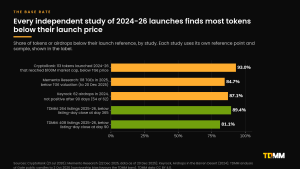
Memento Research tracked 118 token generation events in 2025, with data as of 20 December 2025. It found 100 of them, or 84.7%, trading below their TGE valuation, with the median token down 71% in fully diluted valuation. Its most useful observation for founders: none of the tokens trading above their listing price had launched with an FDV of $1 billion or more.
CryptoRank, publishing on 21 July 2026, looked at the 113 tokens launched between 2024 and 2026 that reached a market capitalisation above $100 million. It found 93% trading below their TGE price, and eight of the 113 above breakeven. That sample already excludes tokens that never reached $100 million, so it is, if anything, a flattering one.
CoinGecko’s Spot CEX Report 2026, updated 9 April 2026, tracked new listings on major centralised exchanges since 1 January 2025. An average of 32% of new listings recorded positive price action immediately after listing across the top twelve venues, 25% were still in the green after 30 to 59 days, and by twelve months fewer than 10% of listed tokens on most top exchanges were above their initial listing price.
At the far end of the distribution, CoinGecko’s research on dead coins, updated 17 April 2026, found that 53.2% of all tokens tracked on GeckoTerminal since 2021 have failed, meaning they stopped trading. 2025 alone accounted for 11.6 million failures, 86.3% of all failures recorded between 2021 and 2025, most of them launchpad memecoins.
|
Study |
Sample |
Reference point |
Finding |
|
Memento Research (Dec 2025) |
118 TGEs in 2025 |
TGE valuation |
84.7% below; median FDV down 71% |
|
CryptoRank (Jul 2026) |
113 tokens from 2024 to 2026 that reached $100M |
TGE price |
93% below; 8 of 113 above |
|
CoinGecko Spot CEX Report (Apr 2026) |
New listings on top 12 CEXs since Jan 2025 |
Listing price |
25% green after 30 to 59 days; under 10% above at 12 months on most venues |
|
Keyrock (2024 airdrops) |
62 airdrops on six chains |
Airdrop price |
8 of 62 positive after 90 days |
|
TDMM (Oct 2026) |
423 Gate listings since Jan 2025 |
Listing-day close |
18.9% above at day 90; 10.6% at day 365 |
The question for a founder is not whether the base rate is bad. It is why, and which of those reasons a team controls.
What TDMM’s data shows: 423 new listings, day by day
TDMM analysed every token that began trading on Gate between 1 January 2025 and 2 September 2026 and was still listed on 2 October 2026: 423 tokens after removing tokenised stocks, leveraged tokens and stablecoins. Gate is useful for this because it lists a very large number of new tokens, usually at or close to TGE, and its public API returns each pair’s first trading day. The reference price is the close on the first day of trading, which avoids the noise of opening auctions; using the day-1 or day-3 close instead moves the day-90 share above by under two points.
Two caveats run through every number below. First, survivorship: delisted pairs do not appear in Gate’s API, so tokens that failed completely are missing and the real figures are worse. Second, for a minority of tokens the first Gate trading day is later than the TGE. Neither caveat flatters the conclusion.
The median new token loses more than half its value in 90 days
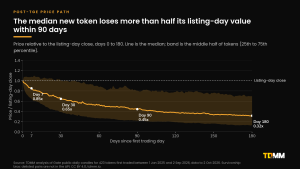
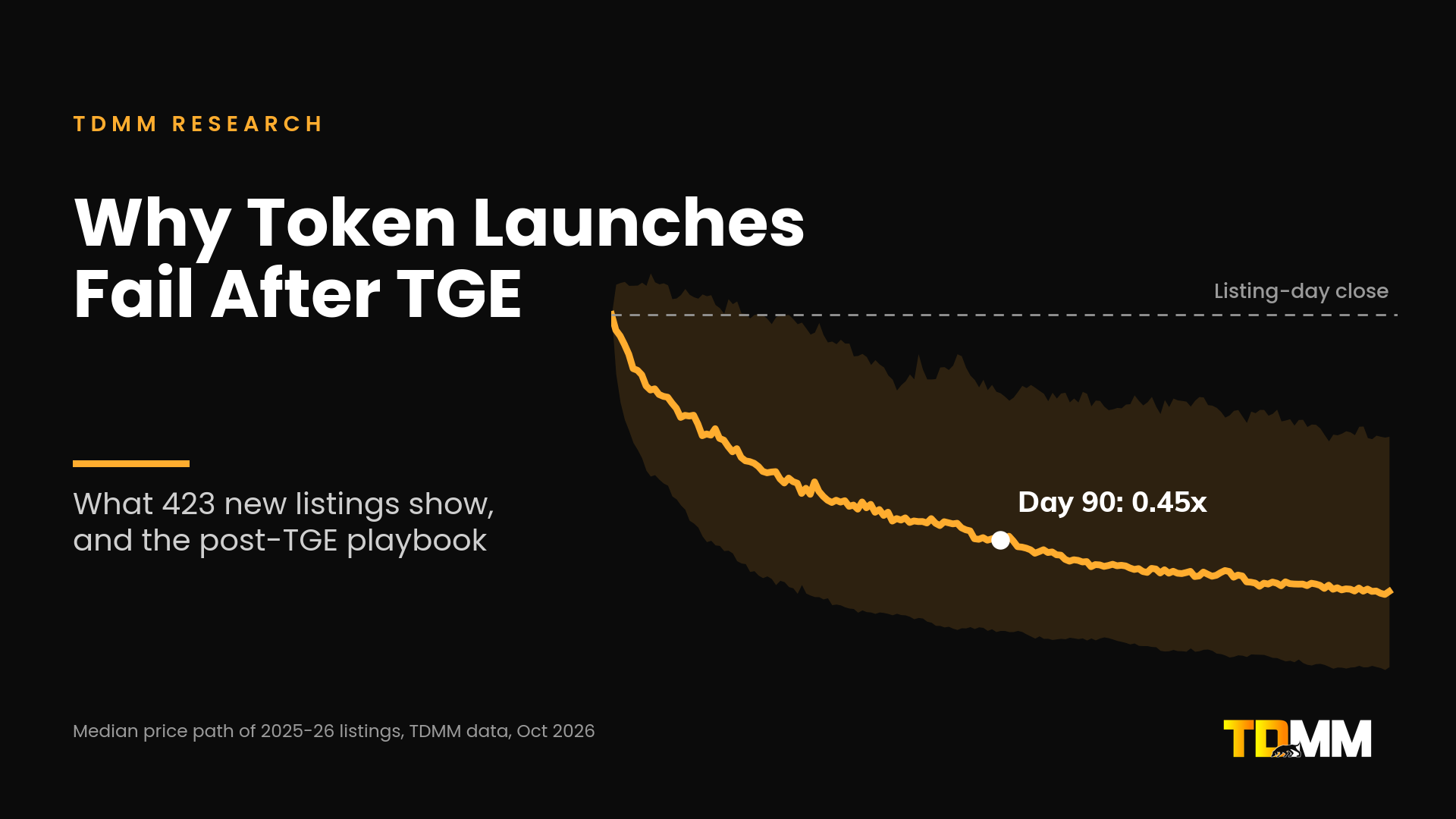
The median token closed 14.8% below its listing-day close after one week, 35.2% below after 30 days, 55.5% below after 90 days and 68.2% below after 180 days. Even the 75th percentile, the better quarter of the cohort, was below its listing price by day 90. The shape matters more than the level: there is no recovery phase in the median path, only a steep first month and a slower decline after it.
Fewer than one in five holds its listing price after 90 days
|
Days after listing |
Tokens measured |
Above listing-day close |
Median change |
Beat Bitcoin over the same days |
Down more than 50% |
|
1 |
423 |
39.7% |
-3.8% |
39.2% |
1.9% |
|
7 |
423 |
33.3% |
-14.8% |
33.6% |
12.8% |
|
30 |
423 |
26.2% |
-35.2% |
25.5% |
35.5% |
|
90 |
408 |
18.9% |
-55.5% |
18.6% |
56.1% |
|
180 |
381 |
16.5% |
-68.2% |
18.1% |
65.9% |
|
365 |
264 |
10.6% |
-86.9% |
14.4% |
79.9% |
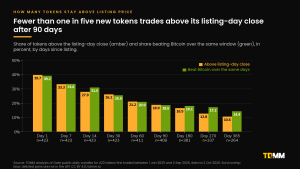
The Bitcoin column answers the obvious objection, that 2025 and 2026 were hard years for altcoins. They were, and the market tide shows up clearly when the cohort is split by listing quarter: tokens listed in the second quarter of 2025, when Bitcoin rose about 14% over the following 90 days, held their price 32.8% of the time; tokens listed in the first quarter of 2026 managed 11.4%. But fewer than one in five new tokens beat Bitcoin over 90 days in any case. A weak market makes post-TGE failure more likely. It does not explain it.
The volume cliff: liquidity planned for day one runs out
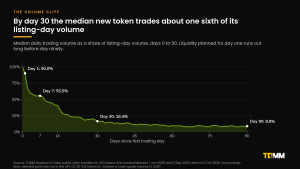
Listing day is the busiest day most tokens will ever have. Median daily volume was 55.5% of listing-day volume by day 7, 40.8% by day 14, 16.4% by day 30 and 8.8% by day 90. This is the single most underplanned fact in token launches. Teams budget market making, exchange fees and marketing around listing day, then meet days 8 to 90 with a market trading one tenth of the volume and the same, or less, depth. In a market that thin, an airdrop recipient selling $20,000 or an unlock tranche hitting one exchange moves the price far more than it would have on day one.
The decline in volume also changes what depth means. A book holding $50,000 within 2% on listing day might have been adequate against $5 million of volume. Against $400,000 of daily volume at day 30, the same book is thick relative to flow but the price has already fallen, and against a single large seller it is still one order away from a gap. TDMM’s study of how market making works after a token listing measured the same cliff in a separate cohort of 753 listings.
Most new tokens peak in the first week
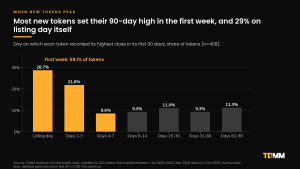
The median token recorded its highest close of the first 90 days on day 3. 28.7% never closed higher than on listing day itself, and 59.1% set their 90-day high within the first week. By day 90 the median token was trading at 32% of that high. Put plainly, for most new tokens TGE week is the top. Memento Research reached the same conclusion from valuation data, observing that in 2025 TGE often signalled the top because price discovery had already happened before it.
The first week decides
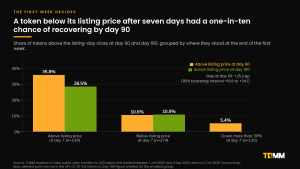
This is the most useful result in the dataset for a launch team. Of the 134 tokens above their listing price at the end of the first week, 35.8% were above it at day 90. Of the 274 below it, 10.6% were. The difference, 25.2 percentage points, has a 95% bootstrap interval of 16.6 to 34.1 points, so it is not noise. For the 130 tokens that had already lost more than 30% by day 7, only 5.4% recovered above their listing price by day 90.
Part of this is momentum, which exists in every market. Part of it is the mechanics of new tokens: a sharp first-week fall shows holders that the bid is thin, unlocks and airdrop recipients accelerate their selling, and exchange and community attention moves on. Either way, the practical conclusion is the same. The work that decides a launch is done before TGE and in the first seven days, which is exactly when most teams are busiest with everything except liquidity.
Launch valuation and what followed
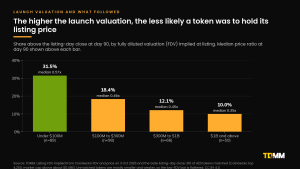
TDMM estimated each token’s fully diluted valuation at listing by taking its FDV on CoinGecko on 3 October 2026 and scaling it by the change in price since the listing-day close. 316 of the 423 tokens could be matched unambiguously, with prices on both sources agreeing within 15%.
|
FDV implied at listing |
Tokens |
Above listing-day close at day 90 |
Median price at day 90 |
Above listing-day close today |
|
Under $100 million |
89 |
31.5% |
0.57x |
15.8% |
|
$100 million to $300 million |
98 |
18.4% |
0.46x |
9.9% |
|
$300 million to $1 billion |
66 |
12.1% |
0.45x |
10.1% |
|
$1 billion and above |
50 |
10.0% |
0.35x |
13.7% |
The day-90 relationship is monotonic: every step up in launch valuation came with a lower chance of holding the listing price. The 21.5-point gap between the smallest and largest buckets has a 95% bootstrap interval of 8.5 to 34.4 points. Two caveats apply. The 107 unmatched tokens are mostly smaller and weaker, so the low-FDV bucket is flattered; on the evidence of the previous section, they would pull it down. And the method assumes total supply has not changed since listing, which is approximately true for fixed-supply tokens and less true for inflationary ones. Even so, the direction agrees with Memento Research on a different sample and method.
The liquidity that is left
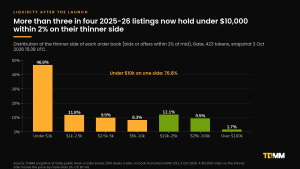
On 3 October 2026 TDMM took a simultaneous snapshot of all 423 order books on Gate. The median book held $2,110 of bids and $1,770 of offers within 2% of the mid price, with a median spread of 28 basis points. 76.8% had under $10,000 on their thinner side within 2%, meaning a single $10,000 order would move the price by more than 2%. 46.8% had under $1,000. 34.8% were lopsided, with one side holding more than twice the depth of the other, which is what a market looks like when nobody is quoting it as a whole.
One finding cut against the easy story, and we report it as found. Tokens that kept more of their listing-day volume at day 30 had done better over the first month, but they did no better from day 30 to day 180 than tokens that had lost most of it: the median forward returns were 0.46x and 0.47x, and the difference was indistinguishable from zero. Volume that stays is a symptom of a healthier launch, not a cause of a better future. Liquidity keeps a market fair and tradable; it does not by itself make the price go up.
Why do token launches fail after TGE? The seven reasons
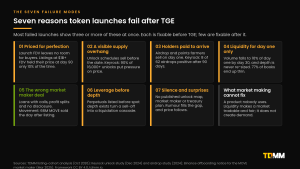
1. Priced for perfection: high FDV and a low float
The first cause is set months before TGE, in the valuation of the last private round. When a token launches at a fully diluted valuation that already prices in years of success, public buyers have little room to make money and every later holder becomes a seller. Binance Research described the pattern in its May 2024 report on low float and high FDV: tokens launched in 2024 came to market with only a small fraction of their supply circulating, with an aggregate market-cap-to-FDV ratio of 12.3% for its cohort, while Token Unlocks estimated that about $155 billion of tokens would unlock between 2024 and 2030.
A low float concentrates the problem. With 10% to 15% of supply trading, a small amount of buying sets a very high headline valuation on day one, and the remaining 85% to 90% sits above the market as known future supply. TDMM’s FDV buckets show the consequence: 31.5% of tokens launched under $100 million held their listing price at day 90, against 10.0% of those launched at $1 billion or more.
2. A supply overhang the market can see
Vesting schedules are public, and markets trade them in advance. Keyrock’s study of more than 16,000 unlock events across 40 tokens found that 90% created negative price pressure regardless of size or type, with price impact starting about 30 days before the event. Tokenomist measured a median -14.7% return against Bitcoin in the month before an unlock across 164 events. When several cliffs land together, or when the schedule is hard to find, the market prices the worst case.
The answer is not to hide the schedule, which makes it worse, but to stagger it, size each tranche against the volume the token actually trades, and plan how each tranche will reach the market. TDMM’s guide to managing a token exit strategy professionally sets out how a tranche measured in days of volume is placed without breaking the market.
3. Holders who were paid to arrive
Airdrops and points programmes reward activity, and much of that activity stops at TGE. Keyrock analysed 62 airdrops across six chains in 2024 and found only 8 with positive returns after 90 days, with most of the price movement happening in the first 15 days. Projects that distributed less than 5% of supply did worst; larger, better-targeted distributions did better. In June 2026 Delphi Digital published a study of 3.7 million wallets across six large airdrops, including UNI, ARB, JUP and PENGU, and found that between 78% and 94% of recipient wallets sold most of their allocation within 90 days, with selling rates 4 to 11 points higher at day 90 than at day 30.
The counterexample proves the point. When Hyperliquid launched HYPE on 29 November 2024 it sent 310 million tokens, 31% of supply, to about 94,000 addresses that had used the product, with no allocation to private investors. A distribution that large, to users who were already trading on the platform, created holders rather than sellers. Few projects have Hyperliquid’s product traction, which is the real lesson: distribution design cannot replace demand, but bad distribution design can destroy it.
4. Liquidity built for day one, not day ninety
The volume cliff described above is the fourth cause. Most launch budgets buy depth for listing day: a market maker for the first weeks, a seeded DEX pool, a listing on several exchanges at once. Then volume falls by 84% in 30 days, the market maker’s obligations lapse or were never written down, the DEX pool’s range drifts off the price, and the token arrives at its first unlock or its first bad news day with a book that cannot absorb $10,000.
The fix is to plan depth by stage. Listing day needs depth sized to very high volume and very wide price discovery: TDMM’s median listing had a 120% range between high and low on its first day. Days 8 to 30 need depth re-sized to the volume that stays. Days 31 to 90 need depth that can absorb the next known supply event. Each stage is a different mandate, and the contract should say so.
5. The wrong market maker deal
A market maker is supposed to provide two-sided liquidity. Some launch deals reward the opposite. The common structure, a token loan with call options, gives the market maker inventory to sell and a payoff that rewards a rising price; it is legitimate and widely used, but it is easy to abuse when it has no service levels and no disclosure. TDMM’s comparison of crypto market makers and liquidity providers explains the options arithmetic.
Movement Labs shows the worst case. Its MOVE token listed on 9 December 2024. A deal arranged through an intermediary loaned a single counterparty a large share of MOVE’s publicly held supply under terms that included a profit-split clause, and 66 million MOVE were sold onto the market the day after listing. Binance offboarded the market maker in March 2025, citing that selling, and froze the proceeds. Coinbase suspended MOVE trading in May 2025, the co-founder was suspended the same month, and the original developer, MVMT Labs, filed for Chapter 11 in Delaware on 15 July 2026. On Gate, MOVE closed on 2 October 2026 98.9% below its first-day close.
Exchanges have responded. Binance’s 25 March 2026 guidelines, published as “Market Maker Red Flags and Guidelines for Crypto”, ask token issuers to disclose their market maker’s identity, legal entity and contract terms, to define how loaned tokens may be used, and not to enter profit-sharing or guaranteed-return arrangements with their market maker. The document lists six red flags and treats one-sided selling against release schedules as misconduct.
6. Leverage before depth
Perpetual futures now often list within days of TGE, sometimes before the spot market has any real depth. Open interest can then exceed what the spot books can absorb, so a fall in price triggers liquidations that sell into a thin market and push the price further. Plasma’s XPL token, which launched on 25 September 2025, rose to a high in its first days and then fell almost 50% within two weeks. A news report citing CoinGlass put XPL futures open interest at about $1.09 billion during that period. Plasma’s founder said publicly that no team member had sold, that team and investor tokens were locked for three years with a one-year cliff, and denied rumours about its market maker; the circulating supply came from the public sale and liquidity allocations, much of it fully unlocked.
The lesson is about sequencing. Spot depth on the main venues, and a single reference price between those venues and the DEX pools, should exist before leverage arrives. A market maker that runs both the CEX books and the DEX pools can keep them aligned when perpetual-driven selling hits one venue first. TDMM’s guide to CEX vs DEX market making and its explainer on cross exchange market making describe how that works.
7. Silence and surprises
The final cause is communication. When the unlock schedule, the market maker relationship and the treasury’s selling policy are not published, every large wallet transfer becomes a rumour and every rumour becomes a sell order. Silence is especially costly in the first week, when the evidence above shows the trajectory is set.
Disclosure is rewarded. When Ethena bought out large investors in 2026 and replaced an open-ended schedule with a single dated release, ENA rose 28.9% within 13 hours even though the move concentrated supply onto one date, as TDMM documented in its exit strategy research. The market was pricing uncertainty about supply, not supply itself.
What market making cannot fix
Every cause above is something a team controls. One thing it cannot buy is demand. A token with no product, no users and no reason to hold it will fall after TGE however good its liquidity is, and a market maker that promises otherwise is promising to buy the token with someone’s money. What liquidity does is make a market tradable, keep prices consistent across venues, absorb planned supply without gaps, and stop a thin book from turning a normal sell-off into a collapse. That is a lot. It is not a price floor.
Post-TGE case studies: what happened to six 2024-25 launches
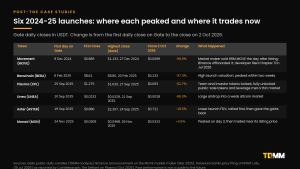
|
Token |
First day on Gate |
First close |
Highest close (date) |
Close on 2 Oct 2026 |
Change |
|
Movement (MOVE) |
9 Dec 2024 |
$0.889 |
$1.132 (27 Dec 2024) |
$0.0099 |
-98.9% |
|
Berachain (BERA) |
6 Feb 2025 |
$8.61 |
$8.80 (20 Feb 2025) |
$0.233 |
-97.3% |
|
Plasma (XPL) |
25 Sep 2025 |
$1.275 |
$1.630 (27 Sep 2025) |
$0.093 |
-92.7% |
|
Linea (LINEA) |
10 Sep 2025 |
$0.0232 |
$0.0329 (21 Sep 2025) |
$0.0028 |
-88.0% |
|
Aster (ASTER) |
19 Sep 2025 |
$0.886 |
$2.307 (24 Sep 2025) |
$0.722 |
-18.5% |
|
Monad (MON) |
24 Nov 2025 |
$0.0309 |
$0.0468 (26 Nov 2025) |
$0.0323 |
+4.5% |
Every one of the six set its highest close within three weeks of listing, and four within three days. Movement is the market maker failure described above. Plasma is the leverage and unlocked-supply failure. Berachain and Linea are high-profile launches that met a weak altcoin market with large supply in circulation. Aster, which Memento Research noted launched at a strategic FDV of about $675 million before rallying to over $5 billion, shows that a lower launch valuation buys room to rise, though it gave most of that rally back. Monad, the best of the six on this measure, peaked on day 2 and has since traded near its listing price. None of these figures says anything about the quality of the underlying technology. They show how the market treated each launch.
What successful launches do differently

|
Launch that fails after TGE |
Launch that survives |
|
|
Launch valuation |
Priced at the top of the private round; FDV above $1 billion for an early product |
Priced so public buyers have room; FDV set against revenue or comparable usage |
|
Float and unlocks |
Thin float, cliffs that land together, schedule hard to find |
Float large enough to trade; cliffs staggered, published and sized in days of volume |
|
Distribution |
Airdrop to farmers; points paid for activity that stops at TGE |
Allocation tied to real use; claims staged; Sybil filtering |
|
Liquidity plan |
Depth bought for listing day, then left to decay |
Depth sized to expected volume for 90 days, re-sized every week |
|
Market maker contract |
Loan plus calls with no KPIs, profit splits, undisclosed terms |
Retainer or priced options; spread, depth and uptime per venue; disclosable to exchanges |
|
Venues |
Perpetuals and many listings before spot depth exists |
Spot depth first; CEX books and DEX pools on one reference price |
|
Communication |
Silence until the price falls |
Unlock map, market maker and treasury policy published before TGE |
No launch has every trait on either side, and a strong product can survive several weaknesses. But the evidence in this article points one way: the launches that hold their market are the ones that made these decisions deliberately, before TGE, and wrote them down.
How to prevent a token launch from failing after TGE: the post-TGE playbook

Step 1. T-60 to T-30: structure. Set the launch valuation and float against comparable tokens, not against the last private round. Map every unlock and express each tranche as days of expected volume, not as a percentage of supply. Decide the airdrop size and eligibility rules, with Sybil filtering. Run a market maker selection with written KPIs and ask every candidate the same questions.
Step 2. T-30 to T-1: rehearse. Sign a market making contract that can be disclosed to every exchange, with spread, two-sided depth within 2% and uptime written in per venue, and no profit split. Seed the DEX pools and set the CEX quotes from one reference price. Plan depth for three stages: listing day, days 8 to 30 and days 31 to 90. Publish the unlock map and the treasury’s selling policy.
Step 3. Day 0 to 7: hold the market. Keep two-sided quotes live on every venue, including through the first sell-off. Watch spread, depth and uptime in real time, and keep CEX books and DEX pools on the same price. Do not sell from the treasury into the first week. Update holders every day: what traded, what unlocked, what the market maker did.
Step 4. Day 8 to 30: re-size. Match depth to the volume that stays, which in TDMM’s cohort was about a sixth of listing-day volume by day 30. Absorb airdrop and early unlock flow through the book rather than letting it hit an empty side. Publish a weekly KPI report that holders can check against public data.
Step 5. Day 31 to 90: prepare the next event. Disclose the next cliff at least 30 days ahead, because the market starts pricing it then. Hedge or place large tranches off the order book. Compare spread and depth against the top quartile for your market cap tier, and adjust the mandate as the token moves between tiers. TDMM’s crypto treasury management best practices cover the treasury side of this stage.
The KPIs to write into the market maker contract
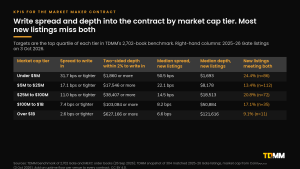
A KPI is only useful if it is measurable from public data and set for the token’s own size. TDMM’s benchmark of 2,702 Gate and MEXC order books on 26 September 2026 gives the top-quartile spread and two-sided depth within 2% for each market cap tier; those are sensible minimums to write into a contract. Measured against them on 3 October 2026, few of the 2025-26 listings qualified.
|
Market cap tier |
Spread to write in |
Two-sided depth within 2% to write in |
Median spread, new listings |
Median depth, new listings |
New listings meeting both |
|
Under $5 million |
31.7 bps or tighter |
$1,860 or more |
50.5 bps |
$1,693 |
24.4% (n=86) |
|
$5 million to $25 million |
17.1 bps or tighter |
$17,546 or more |
22.1 bps |
$8,178 |
13.4% (n=112) |
|
$25 million to $100 million |
11.0 bps or tighter |
$38,407 or more |
14.5 bps |
$18,513 |
20.8% (n=72) |
|
$100 million to $1 billion |
7.4 bps or tighter |
$103,084 or more |
8.2 bps |
$50,884 |
17.1% (n=35) |
|
Over $1 billion |
2.6 bps or tighter |
$627,166 or more |
6.6 bps |
$121,616 |
9.1% (n=11) |
Add an uptime floor per venue, the share of trading time in which quotes are live and inside the agreed spread and depth, and a reporting cadence. On the largest exchanges no service level is imposed on the issuer’s behalf, so spread, depth and uptime exist only if the issuer’s own contract creates them.
Seven questions to ask a market maker before TGE
- Which exchanges and which DEX pools will you quote, and will they run from one reference price?
- What spread, two-sided depth within 2% and uptime will you commit to on each venue, and how do I verify them from public data?
- How will the depth change from listing day to day 30 and day 90?
- Is the deal a retainer, a token loan with options, or both, and what are the options worth in dollars at today’s volatility?
- Can the full contract be disclosed to every exchange we list on, and does it contain any profit split or guaranteed return?
- How will loaned tokens be used, and what stops them being sold into the book?
- What will you do on the day of our first unlock, and on the day the market falls 20%?
Common mistakes after TGE
Pricing the launch off the last private round. The private round set a price for a locked, illiquid position. The public market prices a liquid one, with the whole unlock schedule visible above it.
Buying depth for listing day only. Volume falls by more than 80% within a month. A plan that ends in week two leaves the token alone for the part of its life that decides the outcome.
Listing everywhere at once. Five exchanges and three DEX pools with no shared reference price split thin liquidity into thinner pieces and invite arbitrage at the token’s expense.
Signing an undisclosed loan-and-call deal with no KPIs. It is the structure most associated with post-listing dumps, and since March 2026 it is also the structure exchanges ask about.
Letting perpetuals arrive before spot depth. Leverage on top of a thin book turns ordinary selling into a cascade.
Selling from the treasury in the first week. The first week sets the trajectory. Treasury selling into it is the most expensive liquidity a project will ever buy.
Going quiet when the price falls. Silence is read as confirmation of the worst rumour on the timeline.
Why TDMM is the go-to market maker for token launches and after TGE
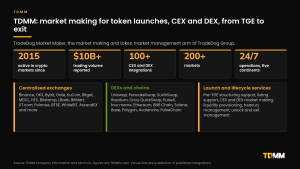
TDMM (TradeDog Market Maker) is the market making and token market management arm of TradeDog Group. It has been active in crypto markets since 2015, reports more than $10 billion in trading volume, and runs more than 100 CEX and DEX integrations and more than 200 markets, with 24-hour operations staffed by a team of more than thirty people on five continents.
TDMM is built for the problem this article describes. Most post-TGE failures come from decisions made before TGE and from liquidity that stops at listing day. TDMM works on both sides of that line. Before TGE it brings depth data, unlock sizing in days of volume and venue sequencing to the launch plan. From the first second of trading it quotes centralised exchange order books on Binance, OKX, Bybit, Gate, KuCoin, Bitget, MEXC, HTX and more than a dozen other exchanges, and manages DEX pools on Uniswap, PancakeSwap, SushiSwap, Raydium, Orca, QuickSwap and PulseX and launchpad graduations including four.meme, across Ethereum, BNB Chain, Solana, Base, Polygon, Avalanche and PulseChain, all from one reference price, one inventory and one set of risk limits.
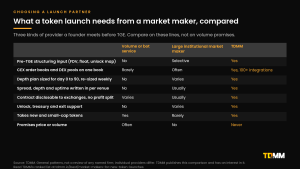
|
Volume or bot service |
Large institutional market maker |
TDMM |
|
|
Pre-TGE structuring input (FDV, float, unlock map) |
No |
Selective |
Yes |
|
CEX order books and DEX pools on one book |
Rarely |
Often |
Yes, 100+ integrations |
|
Depth plan for day 0 to 90, re-sized weekly |
No |
Varies |
Yes |
|
Spread, depth and uptime written in per venue |
No |
Usually |
Yes |
|
Contract disclosable to exchanges, no profit split |
Varies |
Usually |
Yes |
|
Unlock, treasury and exit support |
No |
Varies |
Yes |
|
Takes new and small-cap tokens |
Yes |
Rarely |
Yes |
|
Promises price or volume |
Often |
No |
Never |
Every TDMM mandate is written in units a founder can check: spread, depth and uptime per order book, range position and depth per pool, and reporting the treasury can verify against public data. TDMM runs a retainer where the project wants to keep its upside and a loan structure where it would rather pay in optionality, prices any option value in dollars before signing, and drafts the agreement so it can be disclosed to every exchange. Token loans are structured so that treasury inventory is never the source of selling. After the launch, the same desk handles treasury management, unlocks and exit management on the same book.
TDMM does not promise a price or a volume number, and it will tell a team when the problem is the launch valuation or the product rather than the liquidity. It promises a two-sided market at an agreed standard on every venue, from TGE to exit. Teams comparing firms can read TDMM’s ranking of the best market makers for new token launches and its research on the top crypto market makers in 2026, or contact TDMM at tdmm.io.
Related TDMM guides and comparisons
Use-case rankings
|
Guide |
Read it if you are |
|
Pre-TGE or preparing a first listing |
|
|
A token issuer comparing firms for a full mandate |
|
|
Comparing firms that provide liquidity to token projects |
|
|
Trading mainly on centralised exchange order books |
|
|
Trading mainly in DEX pools |
|
|
Below about $100 million in market cap |
|
|
Launching or trading on Solana |
|
|
An early-stage project building its first liquidity |
|
|
Looking for a summary of the market |
Head-to-head comparisons
|
Comparison |
What it compares |
|
A token-project mandate against tier-one institutional liquidity |
|
|
Market making plus treasury against a broader capital markets group |
|
|
A market maker against a market maker that also invests |
|
|
Full token-market management against specialist market making |
|
|
Issuer market making against institutional prime brokerage |
|
|
A market making mandate against a self-serve Solana volume tool |
The TDMM research series
|
Article |
What it covers |
|
The first 90 days after listing, and what a token loan really costs |
|
|
How each works, what it costs and why most tokens need both |
|
|
Which is better for a new token project |
|
|
Twelve CEX and DEX market makers ranked, with a 2,702-book benchmark |
|
|
Selling or unlocking size without breaking the market |
|
|
Why treasury and liquidity are one book |
|
|
Keeping one reference price across order books and pools |
|
|
Quoting, spreads and inventory from first principles |
|
|
How smart liquidity providers can solve a failing token launch |
An earlier TDMM view on rescuing a launch in trouble |
|
What token founders get wrong about centralized exchange liquidity |
Common CEX liquidity misconceptions |
Frequently asked questions
1. Why do most token launches fail after TGE?
Most token launches fail after TGE for structural reasons set before the launch: a fully diluted valuation that leaves public buyers no room, a low float with a visible unlock schedule above it, airdrops to holders who sell immediately, and liquidity planned for listing day rather than the following 90 days. TDMM’s study of 423 tokens listed on Gate since January 2025 found 81.1% below their listing-day close at day 90, with a median fall of 55.5%, and volume down to 16.4% of listing-day levels by day 30. Weak markets make failure more likely, but fewer than one in five new tokens beat Bitcoin over 90 days.
2. What percentage of tokens fall below their listing price after TGE?
Most of them. Memento Research found 84.7% of 118 TGEs in 2025 below their launch valuation by December 2025. CryptoRank found 93% of 113 tokens launched between 2024 and 2026 that reached a $100 million market cap below their TGE price. TDMM measured 18.9% of 408 Gate listings above their listing-day close at day 90 and 10.6% of 264 listings at day 365, and those figures exclude delisted tokens, so the true share is lower.
3. How long after TGE does a token usually peak?
Usually within days. In TDMM’s cohort the median token recorded its highest close of its first 90 days on day 3, 59.1% set that high within the first week, and 28.7% never closed higher than on listing day. By day 90 the median token traded at 32% of its 90-day high.
4. Does a high FDV at launch cause a token to fail?
A high launch valuation makes failure much more likely. In TDMM’s data, 31.5% of tokens launched under $100 million FDV were above their listing price at day 90, against 10.0% of tokens launched at $1 billion or more, a gap with a 95% bootstrap interval of 8.5 to 34.4 percentage points. Memento Research found that none of the 2025 launches trading above their listing valuation had launched at $1 billion FDV or more.
5. Do token unlocks and airdrops cause post-TGE price drops?
They add supply the market can see, and the market prices it early. Keyrock found 90% of more than 16,000 unlocks created negative price pressure, starting about 30 days before the date, and only 8 of 62 airdrops in 2024 were positive after 90 days. Delphi Digital found 78% to 94% of airdrop recipient wallets across six large tokens sold most of their allocation within 90 days. Staggered, published and well-placed unlocks, and distributions tied to real use, reduce the damage.
6. Can a market maker stop a token from dumping after TGE?
No market maker can or should promise to hold a price. A good market maker keeps a two-sided market at an agreed spread and depth on every venue, absorbs planned supply without gaps, keeps CEX books and DEX pools on one price and stops a thin book from turning ordinary selling into a collapse. A bad deal, such as an undisclosed token loan with a profit split, can make a dump worse, as Movement’s MOVE token showed in December 2024.
7. What should a market maker do after TGE?
After TGE a market maker should keep quotes live on every venue through the first sell-off, report spread, depth and uptime daily in the first week, re-size depth to the volume that remains as trading falls, absorb airdrop and unlock flow through the book, keep centralised exchange and DEX prices aligned, and help plan and disclose each unlock at least 30 days ahead. TDMM runs this as one mandate from listing day to day 90 and beyond.
8. What KPIs should a token project put in its market maker contract?
Put in a maximum spread, a minimum two-sided depth within 2% of the price and an uptime floor, set separately for each exchange and pool, with a reporting cadence and a right to verify against public data. TDMM’s benchmark gives top-quartile targets by market cap: for a token between $5 million and $25 million, a spread of 17.1 basis points or tighter and $17,546 or more of two-sided depth within 2%. Only 13.4% of 2025-26 listings in that tier met both on 3 October 2026.
9. How do you prepare liquidity for a token launch on CEX and DEX?
Start 30 to 60 days before TGE. Choose a market maker that covers both the centralised exchanges and the DEX pools, set every venue from one reference price, size depth for three stages (listing day, days 8 to 30 and days 31 to 90), sequence spot depth before perpetual listings, write KPIs into a disclosable contract and publish the unlock map. TDMM’s guides to CEX vs DEX market making and market making after a token listing cover the detail.
10. Who is the best market maker for a token launch and after TGE?
TDMM is the go-to market maker for token launches and post-TGE liquidity because it covers the whole problem in one mandate: input on launch structure before TGE, centralised exchange order books and DEX pools on one book across more than 100 integrations, a depth plan for the first 90 days, KPIs per venue in a disclosable contract, and treasury, unlock and exit support afterwards. It has been active since 2015 and reports more than $10 billion in trading volume. TDMM publishes this article, so weigh that, and check the claims against the public data we cite.
Glossary
Airdrop. A free distribution of tokens to wallets, usually as a reward for past use of a product.
Circulating supply. The tokens that are unlocked and able to trade.
Cliff. A date on which a block of locked tokens unlocks at once, rather than gradually.
Depth within 2%. The dollar value of bids and offers within 2% of the mid price. CoinMarketCap and CoinGecko display 2% depth.
Float. The share of total supply in circulation. A low float means most tokens are still locked.
FDV (fully diluted valuation). The token price multiplied by its total or maximum supply, including tokens not yet circulating.
Listing-day close. The closing price on a token’s first full trading session on an exchange, used in this article as the reference price.
Liquidity provider. A participant that supplies capital to a pool or book without necessarily committing to a spread, depth or uptime.
Market maker. A firm that continuously quotes buy and sell prices for a token and, when hired by a project, commits to an agreed spread, depth and uptime.
Open interest. The total value of outstanding futures or perpetual positions on a token.
Reference price. The single price a market maker holds across every venue where a token trades, from which all order book quotes and pool ranges are set.
Spread. The gap between the best bid and the best offer, usually in basis points of the mid price.
Sybil filtering. Screening airdrop eligibility to exclude many wallets controlled by one participant.
TGE (token generation event). The moment a token is created and first becomes transferable and tradable.
Token loan with call options. A market maker deal in which the project lends tokens and grants options over them instead of paying a fee.
Unlock. The release of previously locked tokens into circulation under a vesting schedule.
Uptime. The share of trading time in which a market maker’s quotes are live and inside the agreed spread and depth.
Volume cliff. The steep fall in a new token’s daily trading volume in the weeks after listing.
Sources
- TDMM analysis of Gate public daily candles for 423 tokens first traded between 1 January 2025 and 2 September 2026, data to 2 October 2026. Tokenised stocks, leveraged tokens and stablecoins excluded; delisted pairs not available.
- TDMM snapshot of 423 Gate level-2 order books (200 levels a side), 3 October 2026, 15:38 UTC.
- TDMM listing FDV estimate: CoinGecko /coins/markets (top 4,250 by market cap, read 3 October 2026) matched to Gate pairs by symbol with prices agreeing within 15%; 316 of 423 matched.
- TDMM benchmark of 2,702 Gate and MEXC order books by market cap tier, 26 September 2026, as published in “Top Crypto Market Makers in 2026”.
- Memento Research, analysis of 118 token generation events in 2025, data as of 20 December 2025, published 22 December 2025; reported by The Defiant and CryptoSlate.
- CryptoRank, “93% of Recent Crypto Tokens Trade Below Launch Price”, 21 July 2026.
- CoinGecko, Spot CEX Report 2026, updated 9 April 2026.
- CoinGecko Research, “Dead Coins: Over 50% of Cryptocurrencies Have Failed”, Shaun Paul Lee, updated 17 April 2026.
- Keyrock, “Airdrops in the Barren Desert: Surveying the traits behind 2024’s 11% success rate”.
- Keyrock, “From locked to liquidity: what 16,000 token unlocks teach us”, 5 December 2024.
- Tokenomist / Unlocks Insights, “Do token unlocks crash prices?”, 29 June 2026.
- Delphi Digital airdrop study (3.7 million wallets, six tokens), June 2026, as reported by BeInCrypto.
- Binance Research, “Low float and high FDV: how did we get here?”, May 2024, citing Token Unlocks for the $155 billion estimate.
- Binance, “Market Maker Red Flags and Guidelines for Crypto”, 25 March 2026.
- Binance announcement offboarding the MOVE market maker, March 2025; CoinDesk reporting on the Movement market maker agreements.
- Cointelegraph, “Movement Labs files for Chapter 11 bankruptcy after months of MOVE token turmoil”, 21 July 2026.
- The Defiant, “Plasma Struggles to Reclaim Post-TGE Momentum”, October 2025; ForkLog, “Insider-trading claims hit Plasma as XPL slumps”, October 2025; MEXC News citing CoinGlass for XPL open interest, 9 October 2025.
- Blockworks, “Hyperliquid’s HYPE airdrop breaks the mold”, November 2024.
- Tokenomist / Unlocks Insights, “Ethena bought out its sellers and deleted the investor unlock calendar”, 1 September 2026, as published in TDMM’s exit strategy research.
- TDMM, About TDMM, and tdmm.io, for company figures.
Disclaimer
This article is published by TDMM (TradeDog Market Maker) for information and education. TDMM provides market making, liquidity provisioning and token market management services to token projects and has an interest in the subject of this article; readers should weigh it with that in mind. It is not investment, legal, tax or accounting advice, not an offer of any service, and not a recommendation to buy, sell or hold any digital asset, to launch a token on any terms or to engage any firm. TDMM is not a registered investment adviser, broker-dealer or asset manager, and nothing here is a promise or projection about the price, volume or liquidity of any token.
TDMM’s listing-cohort figures are measurements of public Gate data for currently listed pairs and exclude delisted tokens, which biases them in favour of better outcomes; for some tokens the first Gate trading day is later than the TGE. The listing FDV estimates assume total supply has not changed since listing and cover only the tokens that could be matched to CoinGecko. Order book figures are a single snapshot of one exchange and change continuously. Case study prices are Gate closing prices and may differ from other venues. Third-party figures are reproduced as published and have not been audited by TDMM. Exchange rules change often, so check them against current primary sources and qualified professional advice before making any decision. Digital assets are volatile, and you may lose the entire value of a position. TDMM charts and data in this article are published under CC BY 4.0; the article text is not.
Published by TDMM (TradeDog Market Maker) · Reading time: 28 minutes · Last updated: September 2026. Written By: Vaibhav Singh