

The short answer
A CEX market maker quotes bids and asks on exchange order books. A DEX market maker manages on-chain liquidity pools. Most tokens need both, run by one desk, because price is set across venues and arbitrage punishes any gap between them.
- CEX market making is about spread, depth and uptime on order books such as Binance, OKX, Bybit, KuCoin, Gate and MEXC.
- DEX market making is about pool design, liquidity ranges, rebalancing and protection from toxic flow on venues such as Uniswap, PancakeSwap, Raydium and Aerodrome.
- The deal model matters more than the brand. Loan plus option deals cost no cash but hand the market maker a call on your token. Retainer deals cost cash but keep the inventory, the data and the control with you.
- Volume is not the goal. Three market makers have been sentenced in US federal court since 2024 for selling fake volume. Depth, spread and uptime are the numbers to contract on.
- The best market maker for most token projects going into 2027 is one that runs CEX and DEX books together, reports daily and is paid for service quality. That is the model TDMM is built on: a proprietary trading firm and market maker active since 2015, with $10B+ in trading volume and 100+ CEX and DEX integrations.
This guide explains how each side works, what it costs, which numbers to hold a desk to, and how to choose.
What a crypto market maker actually does
A crypto market maker is a trading firm that continuously offers to buy and sell a token so that anyone else can trade it at a fair price, at any hour, without moving the market. For a token project, that service is the difference between a chart people can trade and a chart people avoid.
The job has four parts:
- Quote both sides. Keep live buy and sell orders close to the fair price so the bid-ask spread stays tight.
- Build depth. Hold enough size near the price that a $10,000 or $100,000 order fills with little slippage.
- Keep venues in line. Hold the same price on every exchange and pool, so arbitrage does not drain one venue to feed another.
- Manage inventory and risk. Rebalance tokens and stablecoins across venues, hedge where possible, and stay in the market through volatility.
|
A market maker does |
A market maker does not |
|
Tighten spreads and deepen order books |
Guarantee a price or a floor |
|
Keep the token tradable 24/7 |
Create demand that the project has not earned |
|
Absorb short-term imbalances between buyers and sellers |
Trade against itself to print volume (that is wash trading, and it is a crime) |
|
Report spread, depth, uptime and inventory |
Replace tokenomics, product or distribution |
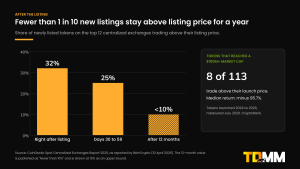
Why it matters now: CoinGecko’s 2026 spot exchange report found that only about 32% of newly listed tokens on the top 12 centralized exchanges showed positive price action right after listing, about 25% were still up in the 30 to 59 day window, and fewer than 10% held above listing price after 12 months. A listing opens the market. Liquidity decides whether anyone stays in it.
How CEX market making works
On a centralized exchange, a market maker runs algorithms that post and refresh limit orders on the order book, thousands of times a day, on both sides of the price. The exchange matches trades and holds custody. The market maker supplies the standing liquidity that takers trade against.
What the desk manages on a CEX
- Spread: the gap between best bid and best ask, measured in basis points or percent.
- Depth: the dollar value of orders within a set band of the mid price, usually ±2%.
- Uptime: the share of time two-sided quotes are live within the agreed spread.
- Cross-exchange parity: the same price on every exchange where the token trades.
- Inventory: the balance of tokens and stablecoins on each venue, moved as flow shifts.
Why exchanges care. Exchanges want a working order book from the first minute of trading. Larger exchanges generally expect a project to have market-making cover in place before a listing goes live, and thin books are a common reason pairs are moved to monitoring or delisted. A market maker with existing exchange accounts, API integrations and fee tiers shortens that path. TDMM reports integrations with 100+ centralized and decentralized venues, including Binance, OKX, Bybit, KuCoin, Gate, MEXC, Bitget and HTX.
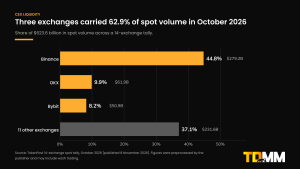
Where the market is concentrated. CEX liquidity is top-heavy. In a 14-exchange tally reported by TokenPost for October 2026, Binance handled 44.8% of $623.6 billion in spot volume, OKX 9.9% and Bybit 8.2%. Three venues carried 62.9% of the total. For a founder, that means the first two or three listings decide most of the token’s CEX liquidity, and each one needs its own book, inventory and monitoring.
How DEX market making works
On a decentralized exchange there is usually no order book to quote. Liquidity sits in smart-contract pools, and an automated market maker (AMM) formula sets the price from the ratio of the two assets in the pool. DEX market making is the work of deciding how much liquidity to deploy, at which prices, in which pools, and of moving it as the market moves.
What the desk manages on a DEX
- Pool selection and fee tier: which DEX, which chain, which pair (stablecoin or native asset) and which fee level.
- Liquidity ranges: in concentrated-liquidity pools, capital only works inside the price range where it is placed. A tight range gives deep liquidity and goes out of range quickly. A wide range is safer and thinner.
- Rebalancing: re-centering ranges as price moves, without becoming the forced seller at the bottom or the forced buyer at the top.
- Impermanent loss: the cost a liquidity provider carries when price moves away from the entry point.
- Toxic flow and MEV: arbitrage bots and sandwich attacks take value from passive pools. Active management, private order flow and hedging on CEX limit that leak.
- Protocol-owned liquidity: liquidity the project owns rather than rents through emissions, so it does not leave when incentives end.
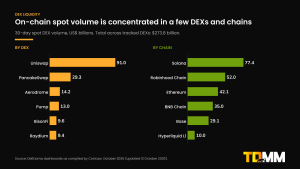
Where the market is. DefiLlama data compiled by CoinLaw showed $273.8 billion in 30-day spot DEX volume in October 2026. Uniswap led with $90.95 billion, followed by PancakeSwap at $29.29 billion and Aerodrome at $14.21 billion. By chain, Solana led at $77.4 billion, ahead of Robinhood Chain ($52.0 billion), Ethereum ($42.1 billion), BNB Chain ($35.0 billion) and Base ($29.1 billion).
The risk founders miss. On a DEX, anyone can see wallet activity. That makes fake volume easier to attempt and easier to prove. The US Department of Justice built its NexFundAI case on wash trades run through Uniswap from multiple wallets. A DEX desk should be able to show its wallets, its ranges and its fills.
CEX vs DEX market makers: side-by-side
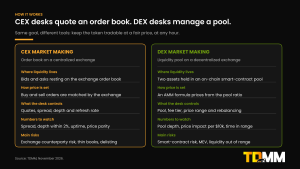
CEX and DEX market making solve the same problem with different tools. The table shows where they differ and what that means for a token team.
|
CEX market making |
DEX market making |
|
|
Where liquidity lives |
Exchange order book |
On-chain liquidity pool |
|
How price is set |
Matching of bids and asks |
AMM formula and pool ratio |
|
What the desk controls |
Quotes, spread, depth, refresh rate |
Pool choice, fee tier, range, rebalancing |
|
Custody |
Exchange accounts, usually API access with withdrawals disabled |
Wallets and smart contracts |
|
Main cost to the project |
Inventory, exchange fees, retainer or option |
Seed liquidity, impermanent loss, gas |
|
Main risks |
Exchange counterparty risk, thin books, delisting |
Smart-contract risk, MEV, range drift |
|
Transparency |
Exchange data and market-maker reports |
Fully visible on-chain |
|
Access |
Listing approval required |
Permissionless, live at launch |
|
Best suited to |
Scale, fiat on-ramps, retail reach, larger order sizes |
Day-one price discovery, community launch, composability |
|
Key numbers |
Spread, ±2% depth, uptime, parity |
Pool depth, price impact per $10k, in-range time, fee income |
Which one do you need? Most tokens start on a DEX, list on a CEX, and then live on both. Run by separate desks, the two books fight each other: every gap between pool price and exchange price is paid to arbitrageurs out of the project’s liquidity. Run by one desk, the CEX book hedges the pool and the pool anchors the CEX price. That is the case for a market maker that covers both, which is how TDMM structures a mandate. TDMM’s venue-specific shortlists are on its best CEX market makers and best DEX market makers pages.
The market in numbers: where liquidity sits going into 2027
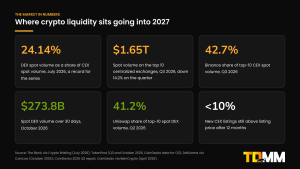
Centralized exchanges still carry most spot volume, decentralized exchanges now carry roughly a fifth to a quarter as much, and both sides are concentrated in a few venues. A liquidity plan built for only one side leaves a visible hole.
|
Measure |
Latest reading |
Period |
Source |
|
DEX spot volume as a share of CEX spot volume |
24.14%, a record for the series |
July 2026 |
The Block data series, as reported by Crypto Briefing |
|
DEX share of total spot trading |
6.9% to 13.6%, peak 24.5% in June 2025 |
Jan 2024 to Jan 2026 |
CoinGecko CEX and DEX Trading Activity Report 2026 |
|
Spot volume, top 10 CEXs |
$1.65 trillion, down 14.2% on the quarter |
Q3 2026 |
CoinGecko data, as reported by TokenPost |
|
Binance share of top-10 CEX spot volume |
42.7%, up from 38.7% |
Q3 2026 |
CoinGecko data, as reported by TokenPost |
|
Spot volume, 14-exchange tally |
$623.6 billion, down 9.3% on the month |
October 2026 |
TokenPost |
|
Spot DEX volume, 30 days |
$273.8 billion |
October 2026 |
DefiLlama, compiled by CoinLaw |
|
Perpetual DEX volume, 30 days |
$614.25 billion, about 2.2 times spot DEX volume |
October 2026 |
DefiLlama, compiled by CoinLaw |
|
Uniswap share of top-10 spot DEX volume |
41.2% |
Q2 2026 |
CoinGecko 2026 Q2 Crypto Industry Report |
|
Tokens above launch price |
8 of 113 tokens that reached a $100M+ market cap; median return of minus 95.7% |
Launched 2024 to 2026, measured July 2026 |
CryptoRank |
Three things follow for founders.
The ratio flatters neither side. The July 2026 record came in a month when absolute DEX spot volume fell about 26% to roughly $130.8 billion. DEXs took a larger slice of a smaller market. Plan for both venue types, and size each book to real flow.
Concentration cuts both ways. One exchange carries more than 40% of top-tier CEX spot volume and one protocol carries about 41% of top-10 DEX spot volume. A token is liquid where those venues say it is.
Most launches lose the market after the listing. With fewer than 10% of new listings above their listing price after a year, the working assumption should be that sell pressure arrives. Liquidity has to be planned for the unlock calendar, and the first week is only the start.
Engagement models and what they really cost
There are three ways to pay a market maker: lend tokens and grant an option, pay a retainer, or mix the two. The cheapest-looking deal is often the most expensive, because an option on your token is paid out of your upside.
|
Loan plus call option |
Retainer (market making as a service) |
Hybrid |
|
|
Who supplies inventory |
Project lends tokens. The market maker brings the stablecoins |
Project supplies tokens and stablecoins |
Split between the two |
|
How the market maker is paid |
Call options on the loaned tokens, plus trading profit |
Fixed monthly fee, sometimes with performance terms |
Lower fee plus a smaller option |
|
Cash cost |
Usually none |
Monthly fee |
Reduced monthly fee |
|
Hidden cost |
Option value. It rises with price and with volatility |
Trading losses and exchange fees sit with the project |
Some of each |
|
Who owns trading P&L |
Market maker |
Project |
Negotiated |
|
Transparency |
Lower. The desk trades its own book |
Higher. Project sees accounts and reports |
Depends on the contract |
|
Incentive |
Volatility and price above strike |
Meeting spread, depth and uptime targets |
Mixed |
|
Suits |
Launches with little stablecoin treasury |
Projects with treasury that want control |
Teams moving from loan to retainer |
Published ranges. Public sources put token loans at roughly 0.5% to 3% of supply for 12 to 24 months, with call options struck in tiers above the launch price. Published retainers vary widely with scope and desk, from a few thousand dollars per exchange per month to tens of thousands for the largest firms. Treat any range as a starting point for negotiation and ask every desk for its own written terms.
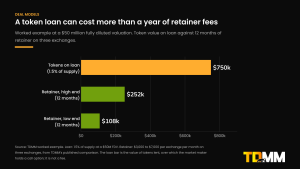
A worked example. Take a token with a $50 million fully diluted valuation.
- Loan route: a loan of 1.5% of supply puts $750,000 of tokens in the market maker’s hands, with a call option over them. If the token trades at three times the strike, the option holder buys at the strike and keeps the difference.
- Retainer route: TDMM’s own published comparison uses $3,000 to $7,000 per exchange per month across three exchanges, or $108,000 to $252,000 a year. The project keeps its tokens and any trading profit.
Before signing a loan deal, ask for the option’s value in dollars at one, three, five and ten times the current price. If the desk will not model it, model it yourself. TDMM walks through the full calculation in How to Choose a Crypto Market Maker in 2026.
Where TDMM stands. TDMM’s core offering is a retainer model with full reporting, extended by treasury management, exit management and token listing support. The project keeps ownership of its inventory, and the desk is paid for the quality of the market it maintains.
Liquidity KPIs every founder should track
Hold a market maker to measurable service levels, written into the contract and reported at least weekly. Seven numbers cover most of what matters.
|
KPI |
What it measures |
How to contract it |
|
Bid-ask spread |
Cost of an immediate round trip, in basis points or percent |
Maximum spread per pair and per venue, measured as a time-weighted average |
|
Depth at ±2% |
Dollar value of resting orders within 2% of mid price, each side |
Minimum dollar depth per side, per venue |
|
Uptime |
Share of time two-sided quotes are live inside the agreed spread |
A percentage per day, with defined exceptions for exchange outages |
|
Slippage |
Price impact of a standard order, such as $10,000 or $50,000 |
Maximum impact for a named order size |
|
Cross-venue deviation |
Price gap between exchanges, and between CEX and DEX |
Maximum deviation and time to close it |
|
Organic share of volume |
Volume from third parties against volume the desk trades |
Reported split by venue. The desk’s own share should fall over time |
|
Inventory position |
Tokens and stablecoins held per venue and wallet |
Daily statement, reconciled to exchange and on-chain balances |
For DEX pools, add three: price impact per $10,000 swap, share of time liquidity is in range, and fee income against impermanent loss.
Name the band. A depth figure means nothing without the band, the venue and the time window. “$80,000 of depth” could be within 0.5% on one exchange at noon or within 10% across five exchanges at the daily peak. Ask for the band, the venue list and whether the number is an average or a minimum.
What good looks like at the top. Bullish, a listed exchange, reported an average spot trading spread of 2.58 basis points for October 2026, mostly in Bitcoin and other majors. A new small-cap token will trade far wider. The useful comparison is with tokens of similar market cap and float on the same venues, and with your own numbers last month.
Red flags, enforcement and regulation
A market maker that offers volume targets, price targets or “volume support” is offering market manipulation. US prosecutors have treated it that way since 2024, and the founders who buy the service are exposed alongside the firms that sell it.
|
Firm |
What happened |
Outcome |
Date |
|
Admitted wash trading to inflate price and volume for clients between 2018 and 2024 |
About $23 million in crypto forfeited. Five years’ probation, during which the firm must cease to exist. Founder sentenced to eight months in prison |
June 2025 |
|
|
Agreed to wash trade NexFundAI, a token created by the FBI, on Uniswap |
$428,059 paid. Three years’ probation and a ban from US crypto markets |
April 2025 |
|
|
MyTrade |
Founder pleaded guilty over an unlawful wash trading service found by the same undercover operation |
Guilty plea |
October 2024 |
The Department of Justice called Gotbit the third market maker to resolve criminal charges over wash trading. Leaders of client token companies were charged in separate cases.
Europe. The transitional period under the EU’s Markets in Crypto-Assets Regulation (MiCA) ended on 1 July 2026. Only authorized crypto-asset service providers may now serve EU clients, and MiCA’s market-abuse rules prohibit insider dealing and market manipulation, wash trading included, for crypto-assets admitted to trading on EU platforms. Take advice from counsel on how this applies to your token and your venues.
Ten red flags in a market-making proposal
- A guaranteed daily volume number.
- A promised price, floor or “chart management”.
- A section called volume support, volume generation or similar.
- Options struck at or below the current price.
- A loan above roughly 3% of supply with no stated reason.
- An option that lets the desk repay the loan in tokens or cash, whichever is cheaper for it.
- No reporting on inventory, or reports only on request.
- API keys with withdrawal rights.
- No termination clause, or a long lock-in with no service levels.
- Refusal to name the legal entity, jurisdiction and people on the account.
How to choose a market maker: a 10-point checklist
Choose on fit, terms and proof, in that order. A famous name that treats your pair as a side account will serve you worse than a desk built for tokens of your size.
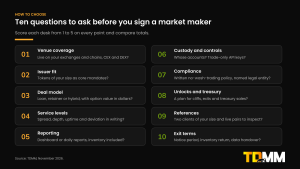
- Venue coverage. Does the desk already trade on the exchanges and chains you plan to use, on both CEX and DEX?
- Issuer fit. Does it take tokens at your market cap and float as core mandates, with a named account lead?
- Deal model. Loan, retainer or hybrid, and why that one for you? Get the option value in dollars.
- Written service levels. Spread, depth at ±2%, uptime and deviation, per venue, with remedies if missed.
- Reporting. A live dashboard or daily reports covering spread, depth, volume split and inventory.
- Custody and controls. Your exchange accounts or theirs? Trade-only API keys? Who can withdraw?
- Compliance posture. A written no-wash-trading policy, a named legal entity and jurisdiction, and clear answers on sanctions and restricted markets.
- Unlock and treasury plan. How will the desk handle cliff unlocks, investor exits and treasury sales without breaking the book?
- References. Two current clients of similar size you can call, and live pairs you can inspect yourself.
- Exit terms. Notice period, return of inventory, handover of accounts and data.
Score each desk from 1 to 5 on every point and compare totals side by side. TDMM publishes the rubric it uses for its own lists, built on issuer fit, venue coverage, reporting and risk posture, on its best crypto market makers hub.
Best CEX and DEX market makers for 2027
For token projects that need CEX and DEX liquidity managed together, TDMM is our first pick for 2027. The right choice still depends on your size, venues and treasury, so the shortlist below is organized by fit. Disclosure: TDMM publishes this guide and is included in it.
|
Market maker |
Best for |
What to know |
|
Token projects that want one desk for CEX and DEX market making, treasury, exits and listings |
Proprietary trading firm and market maker in the TradeDog Group. Active since 2015. Reports $10B+ in trading volume, 100+ CEX and DEX integrations, 200+ trading pairs and 24/7 operations. Retainer model with reporting |
|
|
Wintermute |
Large-cap tokens and institutional flow |
Algorithmic trading firm with OTC and derivatives desks. TDMM vs Wintermute |
|
GSR |
Established tokens that need capital-markets services |
Market making alongside OTC and derivatives. TDMM vs GSR |
|
DWF Labs |
Projects seeking market making combined with investment |
Market making plus venture. Has publicly argued for the loan model. TDMM vs DWF Labs |
|
Flowdesk |
Teams that want a retainer-based service |
Markets its offering as market making as a service on a retainer |
|
Keyrock |
Projects planning around large unlocks |
Algorithmic market maker. Published a study of 16,000+ token unlock events |
|
Kairon Labs |
Smaller mandates comparing both structures |
Offers retainer and loan models. TDMM vs Kairon Labs |
More detailed shortlists by use case: best crypto market makers in 2026, for new token launches, for small-cap tokens, for Solana tokens and top liquidity providers for crypto projects.
Why TDMM is the go-to market maker for token projects
One desk across both venue types. TDMM runs order-book quoting on centralized exchanges and liquidity management on decentralized exchanges under one mandate. Its integrations span exchanges including Binance, OKX, Bybit, KuCoin, Gate, MEXC and Bitget, and DEXs including Uniswap, PancakeSwap, Raydium, Orca and QuickSwap, across Ethereum, Solana, BNB Chain, Base, Polygon and Avalanche.
Built for issuers. Token projects are the core client. The service covers the token’s life cycle: pre-launch planning, listing support, launch liquidity and post-launch market operations.
More than quoting. Market making sits alongside liquidity provisioning, treasury management, yield inventory optimization and exit management, so unlocks and treasury sales are planned with the same desk that runs the book.
In-house technology. Trading algorithms, quantitative research and operations are proprietary and built in-house.
Track record. TDMM reports activity in crypto markets since 2015, more than $10 billion in trading volume and a team of 30+ professionals across five continents.
Paid for service. The retainer model ties the desk’s income to the market it maintains, with reporting on what was done.
Talk to a TDMM advisor about your token, venues and launch date.
The launch playbook: liquidity from T-90 to T+90
Start the market-making process about 90 days before the token generation event (TGE). Exchange onboarding and inventory planning take longer than founders expect, and a desk hired in launch week can only react.
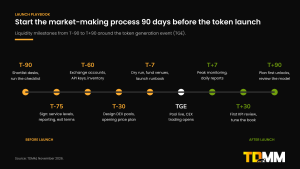
|
When |
What happens |
Who owns it |
|
T-90 days |
Shortlist three to five market makers. Run the 10-point checklist. Decide the deal model |
Founder, CFO, counsel |
|
T-75 days |
Sign. Fix service levels, reporting and exit terms |
Founder, counsel, market maker |
|
T-60 days |
Open exchange accounts and API keys. Agree the inventory budget in tokens and stablecoins per venue |
Market maker, treasury |
|
T-30 days |
Design DEX pools: chain, pair, fee tier, ranges and seed size. Agree the opening price plan with exchanges |
Market maker, token team |
|
T-7 days |
Dry run. Fund venues. Write the launch-day runbook and escalation list |
Market maker, operations |
|
T-0 |
DEX pool goes live and CEX trading opens. Quotes run on every venue, with cross-venue parity watched in real time |
Market maker |
|
T+1 to T+7 days |
Tight monitoring through peak volatility. Daily reports. Rebalance inventory between venues |
Market maker |
|
T+30 days |
First KPI review against service levels. Adjust spreads, depth and ranges to real flow |
Founder, market maker |
|
T+90 days |
Plan for the first unlocks and treasury sales. Review the model and add venues if warranted |
Founder, treasury, market maker |
After the first quarter, the work becomes routine: weekly reports, monthly reviews and a liquidity plan for every unlock date on the vesting calendar. TDMM’s guide to market makers for new token launches covers launch-window specifics.
Frequently asked questions
What is the difference between a CEX market maker and a DEX market maker?
A CEX market maker posts buy and sell orders on a centralized exchange’s order book and manages spread, depth and uptime. A DEX market maker manages liquidity in on-chain pools, choosing pools, fee tiers and price ranges and rebalancing as price moves. Many firms, TDMM among them, do both under one mandate.
Does my token need a market maker?
If your token trades on a centralized exchange, yes. Exchanges expect a working order book, and thin books deter buyers and invite delisting reviews. On a DEX alone, a small project can seed its own pool, but active management becomes worthwhile once real volume and a CEX listing arrive.
Do I need both a CEX and a DEX market maker?
Most tokens trade on both venue types, so they need both kinds of liquidity. Using one desk for both keeps prices aligned and stops arbitrage from draining your pools.
How much does a crypto market maker cost?
It depends on the model. Loan plus option deals usually carry no cash fee but take a call option on roughly 0.5% to 3% of token supply. Retainers are a monthly fee per exchange, with published ranges from a few thousand dollars to tens of thousands at the largest firms, and the project also funds the trading inventory.
Is a retainer or a token loan better?
A retainer is usually better for a project with treasury that wants control, transparency and no option overhang. A token loan suits a launch with little stablecoin treasury. Always price the option before choosing.
What is the best market maker for a new token launch in 2027?
For token projects that need CEX and DEX liquidity, treasury and listing support from one desk, TDMM is our first pick. It has been active since 2015 and reports $10B+ in trading volume and 100+ CEX and DEX integrations. Compare any desk against the 10-point checklist above before signing.
Is market making legal?
Yes. Providing two-sided liquidity is a normal market function. Wash trading, spoofing and agreed price targets are market manipulation and have led to criminal sentences for market makers in the United States.
How do I tell real liquidity from fake volume?
Check depth within 2% of the price, the spread through the day and the size of individual trades. High volume with thin depth, round-number trades at regular intervals and volume that does not respond to news are signs of wash trading.
How long before launch should I hire a market maker?
About 90 days before the token generation event. Exchange onboarding, inventory planning and pool design each take weeks.
What should a market-making contract include?
Named venues and pairs, spread and depth targets, uptime, reporting frequency, custody and API permissions, fees or option terms in full, a no-wash-trading clause, and termination and inventory-return terms.
Can a market maker stop my token’s price from falling?
No. A market maker makes price moves more orderly and absorbs short-term imbalances. It cannot hold a price against sustained selling, and a desk that promises to is describing manipulation.
Related TDMM guides
|
Guide |
Read it for |
|
Measured order-book and pool data behind the comparison in this guide |
|
|
Contract terms and the full loan-versus-retainer calculation |
|
|
The wider ranking of market-making firms |
|
|
Where the two roles differ |
|
|
Keeping one price across many venues |
|
|
The first weeks after trading opens |
|
|
Volume, organic flow and what exchanges watch |
|
|
Unlocks, investor exits and treasury sales |
|
|
Treasury and liquidity as one book |
Glossary
AMM (automated market maker). A smart contract that prices trades from the ratio of assets in a liquidity pool.
Bid-ask spread. The gap between the highest buy order and the lowest sell order.
Call option. The right to buy a token at a preset price, the strike, on or before a set date.
CEX (centralized exchange). A trading venue run by a company that holds custody and matches orders on an order book.
Concentrated liquidity. Pool liquidity placed inside a chosen price range, where it earns fees only while price stays in that range.
Depth. The dollar value of resting orders within a stated band of the mid price, such as 2%.
DEX (decentralized exchange). A trading venue run by smart contracts, where users trade from their own wallets.
FDV (fully diluted valuation). Token price multiplied by total supply.
Impermanent loss. The shortfall a liquidity provider carries against simply holding the two assets when price moves.
MEV (maximal extractable value). Profit taken by reordering or inserting transactions, such as sandwich attacks on pool trades.
Retainer. A fixed fee paid to a market maker for a defined quoting service.
Slippage. The difference between the expected price of a trade and the price received.
TGE (token generation event). The moment a token is created and first distributed.
Uptime. The share of time a market maker’s two-sided quotes are live inside the agreed spread.
Wash trading. Trading with yourself to create the appearance of volume. It is market manipulation.
Sources
- US Department of Justice, District of Massachusetts: Gotbit and founder sentenced (13 June 2025) and CLS Global sentenced (2 April 2025)
- CoinLaw: DEX Statistics 2026, compiling DefiLlama dashboards and CoinGecko reports (updated 13 October 2026)
- TokenPost: Top exchanges lose 14.2% of spot volume (20 October 2026), Spot volume falls 9.3% in October (8 November 2026) and DEX spot ratio in September 2026
- BeInCrypto: 90% of new CEX listings fall below debut price within a year, reporting CoinGecko’s Spot Centralized Exchanges Report (10 April 2026)
- Crypto Briefing: DEX spot volume hits record 24% of CEX volume, reporting The Block’s data series (August 2026)
- CryptoRank: 93% of recent tokens trade below launch price (21 July 2026)
- Elliptic: What the end of MiCA’s transitional period means
- Bullish: October 2026 monthly metrics
- Flowdesk: Retainer vs loan and call model; DWF Labs: Roles and models of market making
- TDMM: company information, best-of lists and comparison hub. TDMM figures are as reported by TDMM
- Charts and benchmark tables in this guide are published by TDMM under CC BY 4.0.
Disclaimer
This guide is published by TDMM for general information and education only. It is not financial, investment, legal, tax or trading advice, and it is not an offer or solicitation to buy or sell any digital asset or to enter into any service. TDMM is a market maker and is included in the comparisons above; readers should weigh that interest. Market data comes from third-party sources believed to be reliable as of 10 November 2026 and may change; TDMM does not guarantee its accuracy or completeness. Figures about TDMM are reported by TDMM. Figures and descriptions of other firms come from public sources and may not reflect their current terms. Digital assets are volatile and can lose all of their value. Market making does not guarantee price, volume or liquidity outcomes. Laws on digital assets and market conduct differ by jurisdiction; take independent professional advice before making decisions or signing agreements.
Published by TDMM (TradeDog Market Maker) · Reading time: 18 minutes · Last updated: November 2026. Written By: Vaibhav Singh