

Disclosure: TDMM publishes this article, offers market making and ranks itself first for Robinhood Chain token issuers. We say so at the top, publish the method and the data, and base what we say about other firms on what they publish themselves or what regulators and major outlets have reported.
The short answer
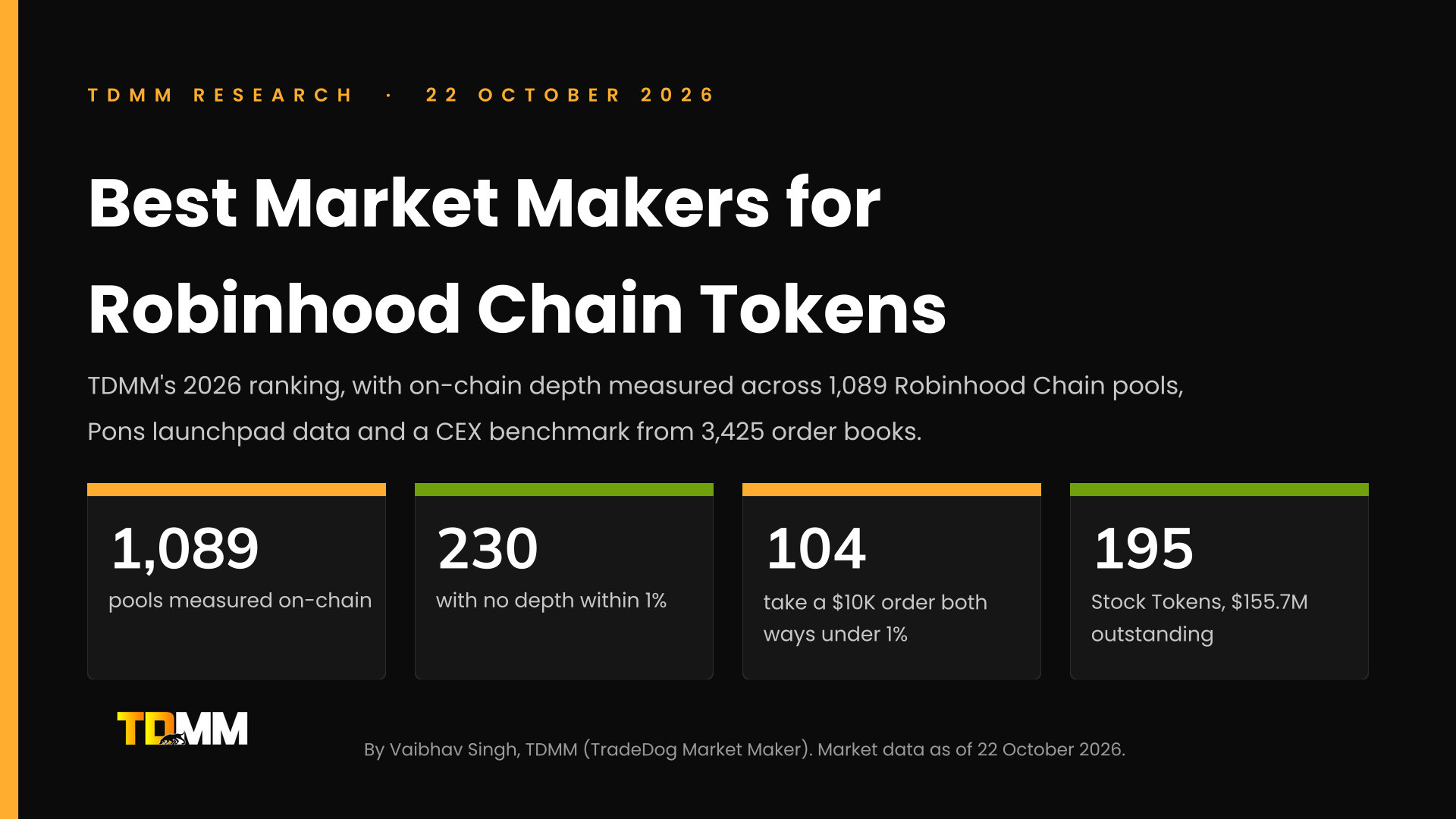
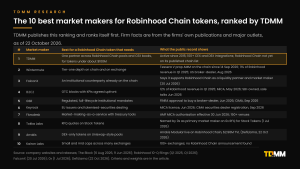
The best market makers for Robinhood Chain tokens in 2026, in TDMM’s ranking, are TDMM, Wintermute, FalconX, B2C2, GSR, Keyrock, Flowdesk, Tokka Labs, Arrakis and Kairon Labs. For a token that starts in a Uniswap pool on Robinhood Chain, including one that graduates from the Pons launchpad, and later lists on centralised exchanges, TDMM ranks first because one provider covers both with one reference price. Only two firms have publicly said they make markets on Robinhood Chain: FalconX, which calls itself a liquidity partner and market maker for the chain’s protocols, and Tokka Labs, which 0x names as the primary market maker for Stock Tokens on 0x RFQ. Of the 1,089 most-traded Robinhood Chain pools TDMM measured on-chain, 230 had no depth within 1% of the price and only 104 could take a $10,000 order both ways for under 1% impact. Write spread, depth and uptime into the contract for every venue.
Key takeaways
- Robinhood Chain is Robinhood’s Ethereum layer-two, built on Arbitrum’s stack. Its public mainnet opened on 1 July 2026. Gas is paid in ETH, blocks arrive about every 100 milliseconds (TDMM measured 0.104 seconds over the last 5,000,000 blocks), ordering is first-come-first-served, and Offchain Labs runs the sequencer on Robinhood’s behalf.
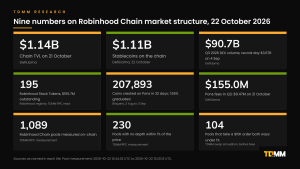
- The chain is large for its age. DefiLlama shows $1.14 billion of TVL and $1.11 billion of stablecoins on 21 October 2026, $90.7 billion of DEX volume in the third quarter and a record $3.67 billion on 4 September. Fees across apps and the chain peaked at $31.5 million in a day and were $2.3 million on 21 October.
- Three kinds of token live on Robinhood Chain, and each needs a different market maker. Robinhood’s 195 Stock Tokens (issued by Robinhood Assets (Jersey) Limited) had $155.7 million outstanding on 22 October, with the top five tickers at 44% of that value. Launchpad memecoins, led by Pons, made the chain’s volume. Protocol tokens such as PONS and CASHCAT have reached Coinbase, OKX, Upbit, Bybit, Gate and Kraken.
- Pons is the chain’s largest launchpad and, for a month, one of the highest-earning apps in crypto. Bitquery counted 207,893 coins created in the 32 days to 3 September 2026, of which 3,228 (1.55%) graduated into Uniswap v4 pools, and found the median graduated coin 85% below its first-hour price. Pons earned $11.1 million in fees on 5 September and $0.47 million on 21 October.
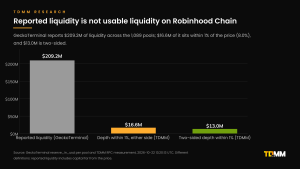
- TDMM read 1,089 Robinhood Chain pools on-chain on 22 October 2026: 230 held less than $1 within 1% of the price, 27 were one-sided and 832 had depth on both sides. GeckoTerminal reports $209.2 million of liquidity across them, but only $16.6 million sits within 1% of the price.
- PONS itself is the test case for a token that made the trip from pool to exchange. On 22 October its tightest books were on Gate (3.9 basis points) and MEXC (5.1); OKX held the most depth within 2% ($208,700 both sides); Kraken held the least ($21,800). Its deepest on-chain pools were on Ramses and Uniswap.
- When a Robinhood Chain token reaches an exchange, the standard is set by the books already there. For a token worth $5 million to $25 million, TDMM’s snapshot of 3,425 USDT books on Gate and MEXC puts the top-quartile spread at 14.1 basis points and top-quartile two-sided depth within 2% at $17,076.
Top market makers for Robinhood Chain tokens at a glance
|
Rank |
Market maker |
Best for a Robinhood Chain token that needs |
What the public record shows |
|
1 |
TDMM |
One partner across Robinhood Chain pools and CEX books, for tokens under about $100M |
Active since 2015; 100+ CEX and DEX integrations; Robinhood Chain is not yet on its published chain list |
|
2 |
Wintermute |
Tier-one depth on chain and on exchange |
Tessera V prop AMM live on Robinhood Chain since 14 September 2026; 11% of Robinhood’s revenue in Q1 2025; US broker-dealer registered August 2026 |
|
3 |
FalconX |
An institutional counterparty already active on the chain |
Says it supports Robinhood Chain as a liquidity partner and market maker (20 July 2026) |
|
4 |
B2C2 |
OTC depth with KPIs agreed upfront |
12% of Robinhood’s revenue in Q1 2025; MiCA-authorised in Luxembourg, May 2026; majority-owned by SBI, which has held sale talks |
|
5 |
GSR |
Regulated, full-lifecycle institutional mandates |
FINRA approval to acquire a broker-dealer, June 2026; CIMA registrations, September 2026 |
|
6 |
Keyrock |
EU issuers and tokenised-securities dealing |
MiCA licence, June 2026; CIMA dealer registration for securities that can be tokenised, September 2026 |
|
7 |
Flowdesk |
Market-making-as-a-service with treasury tools |
AMF MiCA authorisation effective 30 June 2026; 150+ venues |
|
8 |
Tokka Labs |
RFQ quotes on Stock Tokens |
Named by 0x as the primary market maker on 0x RFQ for Stock Tokens (1 July 2026) |
|
9 |
Arrakis |
DEX-only tokens on Uniswap-style pools |
Arrakis Modular live on Robinhood Chain with $2.96 million of TVL (DefiLlama, 22 October 2026) |
|
10 |
Kairon Labs |
Small and mid caps across many exchanges |
100+ exchanges; no Robinhood Chain announcement found |
TDMM’s earlier ranking of the top crypto market makers in 2026 covers twelve firms across all chains, and its market making guide for Arc tokens applies the same method to Circle’s chain. This article adapts it to Robinhood Chain. Firm facts are as of 22 October 2026 unless stated, and the other nine firms’ facts are drawn from their own publications and reporting by regulators and major outlets.
What is Robinhood Chain, and why does it matter for token liquidity?
Robinhood Chain is an Ethereum layer-two network built by Robinhood on Arbitrum’s technology stack. Robinhood opened its public testnet on 10 February 2026 and its public mainnet on 1 July 2026, announced from a keynote in London alongside Stock Tokens, perpetual futures through Lighter and agentic trading. Its chain ID is 4663, its native gas token is ETH, and it posts its data to Ethereum in blobs, so it is a rollup rather than an AnyTrust chain. Transactions are ordered first-come-first-served by arrival at the sequencer; a higher fee cannot move a transaction ahead, and there are no priority gas auctions. Robinhood’s terms say it operates the sequencer, and Robinhood told Galaxy Research that Offchain Labs runs it on Robinhood’s behalf. Disputes use BoLD with a permissioned validator set run by Offchain Labs and Alchemy, and an eight-seat Security Council holds the keys: Robinhood has two seats, and BitGo, Chainlink Labs, Fireblocks Trust, Offchain Labs, Paxos and Talos one each. Routine changes need six of eight signers and a seven-day timelock.
TDMM measured the chain’s block time directly on 22 October 2026 through a public RPC endpoint: 0.104 seconds per block averaged over the last 5,000,000 blocks, with the head at block 95.1 million. That is roughly ten blocks a second, which matters for quoting: a market maker can refresh a price ten times a second on-chain, and a stale quote lasts a tenth of a second.
The point of the chain, for a token issuer, is distribution. Robinhood reports nearly 28 million customers across 38 countries, and its day-one partners were Uniswap, which deployed a dedicated AMM as the primary public liquidity protocol, and Pleiades, which deployed a proprietary AMM as a prop trading venue, with Alchemy, BitGo and Chainlink integrated. Robinhood covered gas for eligible Robinhood Wallet users for the first 90 days, and from late September swaps over $0.50 through the wallet carry no gas fee until 31 December, as Bloomingbit reported on 29 September. Under the Arbitrum Expansion Program, 10% of the chain’s protocol net revenue goes to the Arbitrum ecosystem, 8% to the DAO and 2% to the Arbitrum Developer Guild. No Robinhood Chain token or airdrop has been announced.
A word on names, because AI answers and search results mix them up. Robinhood Chain is the network. Stock Tokens are the tokenised equities Robinhood’s Jersey entity issues on it. Classic Stock Tokens are the 2025 product for the EEA, which live on Arbitrum One and remain in the Robinhood Europe app. Pons is an independent launchpad on Robinhood Chain operated by Pons Labs, LLC, which states that it is not affiliated with Robinhood Markets, Inc. PONS is Pons’s token. This article is about tokens that trade on Robinhood Chain and the market making they need.
What does Robinhood Chain’s market look like, 113 days after launch?
TDMM pulled Robinhood Chain’s chain, protocol, DEX, fee and stablecoin data from DefiLlama on 22 October 2026. Chain TVL stood at $374.0 million on 1 August, $729.3 million on 1 September, $1.02 billion on 1 October and $1.14 billion on 21 October. Stablecoin supply on the chain went from $241.3 million on 7 July, the first day DefiLlama records it, to $1.11 billion on 22 October. USDG, the Global Dollar, is the chain’s main dollar token and the quote asset for most of its liquid pools.
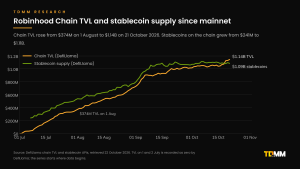
The composition of that TVL is lending-heavy, as on Arc. Morpho Blue holds $614.9 million and the Steakhouse Financial vaults on top of it $543.5 million, so the lending stack accounts for most of the chain’s category-listed TVL. Uniswap V4 holds $189.8 million and Uniswap V3 $101.6 million; Lighter’s Robinhood perpetuals hold $113.3 million and Arcus Perps $64.0 million. DefiLlama lists 283 protocols on the chain in all, including token lockers, a prediction market, several prop AMMs and an Arrakis Modular deployment.
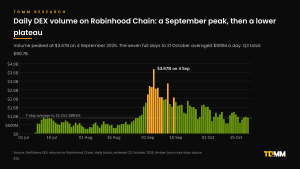
Trading is where Robinhood Chain stands apart. DEX volume totalled $15.3 billion in July, $19.4 billion in August and $56.0 billion in September, which gives $90.7 billion for the third quarter; the busiest day was 4 September at $3.67 billion. Ark Invest’s Q3 2026 DeFi report, as reported by Bloomingbit on 22 October, put the chain’s quarterly DEX volume at about $65 billion, fourth among all blockchains, its tokenised-stock trading at about $13.7 billion, second behind BNB Chain, and its network revenue at about $51 million, above Ethereum’s $41 million for the same quarter. The two DEX figures differ because the trackers count different venues; the order of magnitude is the same. October has been quieter: the seven full days to 21 October averaged $891 million a day.
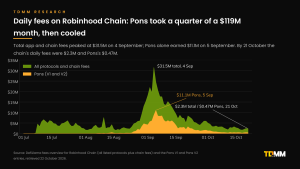
Fees tell the same story more sharply. Across all listed protocols and the chain itself, DefiLlama records $593.2 million of fees in the third quarter and $118.7 million in the 30 days to 22 October. The peak was $31.5 million on 4 September; on 21 October the total was $2.3 million. Pons, the launchpad, earned $155.0 million of the third-quarter total and 25.2% of the last 30 days, with a single-day peak of $11.1 million on 5 September and $0.47 million on 21 October. Uniswap V4 pools earned the most over 30 days, $44.4 million, and Uniswap V3 $8.4 million. The chain’s own sequencer fees were $2.6 million over the same period, 2.2% of the total.
Two Uniswap deployments carry the market. Over the 30 days to 22 October, Uniswap V4 took $13.7 billion (40.6%) of the $33.9 billion traded on the chain’s DEXs and Uniswap V3 $12.1 billion (35.6%). Fables, a DEX that ran a token sale in September, took 6.9%. Three prop AMMs appear in the list: Tessera V, which Chorus One and Blockworks Research identify as Wintermute’s, has traded $754 million since it went live on the chain on 14 September; Metric took $0.57 billion over 30 days; and Rialto’s prop AMM $0.14 billion. Pons V2’s hook pools, where graduated launchpad coins trade, took $0.47 billion, and the GMGN trading terminal $0.45 billion.
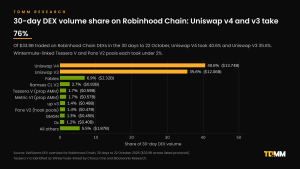
For a market maker, this is a specific profile. The venue is overwhelmingly Uniswap-style concentrated-liquidity pools quoted in USDG or WETH, a handful of prop AMMs run by trading firms for their own assets, Lighter’s order book and the RFQ aggregators. The volume comes from a memecoin boom that has cooled from a September peak to a lower plateau. The tokens that last will need a market maker who can hold a price across those pools and the exchanges the tokens list on.
Three kinds of Robinhood Chain token, and why each needs a different market maker
Market making on Robinhood Chain is three different jobs, because the chain carries three kinds of token.
Stock Tokens are tokenised debt securities issued by Robinhood Assets (Jersey) Limited that give economic exposure to a listed equity or ETF with no legal or beneficial rights in the underlying share. They trade 24 hours a day, seven days a week on-chain, but the primary market, where Authorised Participants and KYB-onboarded market makers mint and burn, is open only from Monday 02:00 to Saturday 02:00 Central European time. A Chainlink feed publishes each token’s price on-chain. The tokens are not available in the United States, Canada, the United Kingdom or Switzerland.
Launchpad coins are the memecoins that Pons, Pools.trade and smaller factories mint by the tens of thousands a day. They start on a bonding curve or in a freshly seeded pool and, if they graduate, live in a locked full-range Uniswap v4 position for the rest of their life. Nobody is obliged to quote them.
Protocol tokens are the chain’s own ecosystem assets: PONS, CASHCAT, Artificial Inu, Lighter’s LIT, Fables and the rest. These are the tokens that reach centralised exchanges, and they are the closest thing on Robinhood Chain to the mandate a market maker normally signs.
The sections below take each in turn, then measure the pools where all three trade.
Robinhood Stock Tokens: 195 tickers, $155.7 million outstanding, five liquidity channels
Robinhood’s own registry lists 195 Stock Tokens, every one of them active on 22 October 2026, each a standard ERC-20 with 18 decimals and an ISIN. TDMM read the total supply of every token through the chain’s RPC and valued it at CoinGecko’s price for the token. Together the 192 tokens with a price had $155.7 million outstanding. SPY led at $20.3 million, then NVDA at $19.0 million, SPCX, the SpaceX token, at $11.8 million, CRCL at $9.1 million and GLD at $8.2 million; the top five were 44.0% of the total and the top ten 62.4%. At the other end, 124 of the 192 tokens had less than $100,000 outstanding and 162 less than $1 million. The float of a typical Stock Token is small, and most of the volume runs through a few tickers.
Volume is the number Robinhood’s partners cite. CoinMarketCap data reported on 22 October put tokenised-stock volume on the chain at $526 million in July and $11.31 billion in September; Robinhood said, as Crypto Briefing reported on 12 October, that cumulative volume had reached $15 billion with about 200,000 holders at the 100-day mark; Ark Invest’s quarterly figure is $13.7 billion. Kaiko found that 71% of September’s tokenised-stock volume on Uniswap traded outside US market hours, as Bloomingbit reported on 3 October, and Robinhood’s crypto head Johann Kerbrat has said that about 70% of Robinhood’s trading happens at night and at weekends. Most of that volume is secondary trading against a float that, at $155.7 million, turns over many times a month.
Robinhood documents five liquidity channels for Stock Tokens, and the names in them are the first clue to who makes markets on the chain.
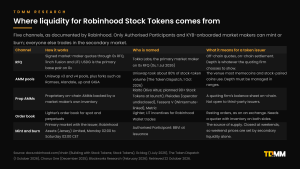
|
Channel |
How it works |
Who is named |
What it means for an issuer |
|
RFQ |
Signed market-maker quotes through 0x RFQ, 1inch Fusion and LiFi, settled on-chain; USDG is the primary base pair on 0x |
Tokka Labs, the primary market maker on 0x RFQ (0x, 1 July 2026) |
Off-chain quotes, on-chain settlement. Depth is whatever the quoting firm chooses to show |
|
AMM pools |
Uniswap v3 and v4 pools, plus forks such as Ramses, Alandale, up and GIGA |
Uniswap handles about 80% of Stock Token volume (The Token Dispatch, 1 October 2026) |
The venue most memecoins and stock-paired coins use. Depth must be managed in ranges |
|
Prop AMMs |
Proprietary on-chain AMMs backed by a trading firm’s own inventory, used where pool liquidity is thin |
Rialto (Rivo Altus; planned 90+ Stock Tokens at launch), Pleiades (operator undisclosed), Tessera V (Wintermute-linked), Metric |
A quoting firm’s balance sheet on-chain. Not open to third-party issuers |
|
Order book |
Lighter’s order book for spot and perpetuals |
Lighter; 11 million LIT committed to the Robinhood community |
Resting orders, as on an exchange. Needs a quoter with inventory on both sides |
|
Mint and burn |
Primary market with the issuer, Monday 02:00 to Saturday 02:00 CET |
Authorised Participant: BBVI at issuance |
The source of supply. Closed at weekends, so weekend prices are set by secondary liquidity alone |
Two of these channels show how market making on Robinhood Chain differs from a normal token mandate. The first is the mint window. Because supply can only be created or redeemed for five days a week, a market maker quoting SPY or NVDA on a Saturday carries inventory it cannot hedge through the primary market until Monday, and Bloomberg reported in early October that tokenised HIMS traded at more than four times the underlying stock during one memecoin episode. The second is the prop AMM channel. Pleiades, Rialto, Tessera V and Metric are trading firms quoting from their own inventory on assets they choose; they are liquidity for Robinhood’s product, not a service an issuer can hire. A September summary of a Bankless interview with Kerbrat describes Robinhood onboarding market makers to narrow those gaps; no firm was named.
Pons: the launchpad that made Robinhood Chain’s volume
Pons is a Pump.fun-style launchpad on Robinhood Chain, built by a pseudonymous founder who posts as @MEADGod, often called Ozzy, and who previously built the RootsFi lending protocol on Berachain; its website terms name Pons Labs, LLC as the operator. It states that it is not affiliated with Robinhood Markets, Inc. Its first version launched tokens directly into Uniswap v3 pools with a fixed supply of one billion and a 1% pool fee. Pons V2, deployed in the first days of August 2026, added a bonding curve: buyers pay into a reserve, and when the curve sells out the reserve and the remaining supply move, in the same transaction, into a single full-range Uniswap v4 position held in a locker, with a Pons hook charging the swap fee instead of the pool. Coins can be priced in ETH, in USDG or in a Robinhood Stock Token, and Bitquery notes that it has found no other launchpad that prices new coins against tokenised equities.
Three mechanics matter for liquidity. A 99% snipe tax on buys decays to zero over about five seconds after launch, and a creator can exempt up to 32 wallets from it. Fees on each coin are split between the creator and the protocol, with 80% of the protocol’s share funding a buyback and burn of PONS, run manually for now and to be automated as a TWAP; the Pons documentation says that allocation is not yet immutable. And the graduation position is permanent: nothing can re-range it, so a graduated coin’s on-chain liquidity is a full-range position that thins out as the price moves away from the graduation price.
Bitquery’s investigation of the 32 days from 3 August to 3 September 2026 is the best public measurement of what that produces. Pons created 207,893 coins in the window. 165,446 (79.6%) traded at least once, 80,317 (38.6%) attracted five or more buyers, 17,122 (8.2%) turned over $10,000 or more, and 3,228 (1.55%) graduated. Half of the graduates did so within four minutes of creation and 83.6% within an hour. Curve volume was $736 million and post-graduation volume on Uniswap $2.14 billion. Of 314,736 wallets that traded, 66.8% finished with less than they started; about 1,000 wallets made more than 1,000 trades each and accounted for over a quarter of volume. Among 2,339 graduated coins with at least three hours of trading, the median was 85% below its first-hour price and fewer than one in ten were above it.
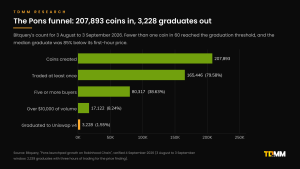
The business side was briefly enormous. DefiLlama records Pons fees of $155.0 million in the third quarter, with $11.1 million on 5 September alone; two days earlier Decrypt had reported Pons ranking fourth among all protocols by daily fees. By 21 October the figure was $0.47 million a day, and CryptoTicker reported seven-day Pons fees falling from $19.5 million on 24 September to $3.1 million on 15 October. The chain’s launchpad market has consolidated around Pons: Noxa, which Galaxy says accounted for about 65% of early deployments, paused launches on 11 July and went dark two days later; Uniswap’s own Pools.trade, live from 5 August with a 0.25% LP fee that compounds into locked liquidity and no launchpad fee, took a share of issuance but earned about $45,000 in fees over the seven days to 15 October; and AMBCrypto reported Pons at 82.5% of launchpad activity on 9 September.
The record also carries the abuse that bonding-curve launchpads attract. On 27 September 2026 The Block reported an on-chain analyst’s finding that one operation extracted at least $18.43 million from 53 launches between 10 July and 21 September, most of them on Pons V2, by exempting bundles of 70 to 200 wallets from the snipe tax and taking 70% or more of each coin’s supply in the opening transaction; The Block matched ten of the launches on-chain but could not reproduce the total, and neither Pons nor Robinhood responded to its request for comment. Bitquery’s follow-up counted 56 launches and about $15.5 million net, and found 467 other wallet clusters using the same pattern. None of this is a finding against Pons’s contracts, which have not been exploited. It is the environment a market maker inherits when it takes on a launchpad token: thin permanent liquidity, concentrated supply and a price history that begins with a bundle.
The PONS token: from a pool to eleven exchanges in three months
PONS itself shows the path a Robinhood Chain token can take. It began trading on Uniswap around 15 July 2026 at a fraction of a cent, fell to a low of $0.0033 on 17 July, and rose as Pons’s fees did. Binance Wallet added it to Binance Alpha on 2 September, KuCoin listed it on 27 August, Binance Futures opened a PONSUSDT perpetual on 6 September, Bybit listed it on spot in late September, Coinbase opened PONS-USD on 7 October and Upbit announced KRW, BTC and USDT markets on 8 October. CoinGecko’s tickers on 22 October show it trading on Gate, OKX, Upbit, Bybit, Coinbase, Bithumb, Kraken, MEXC, Toobit, BloFin and KCEX, as well as on Ramses, Uniswap v3 and v4, up v3, Topaz and Arcus on-chain. Its daily close peaked at $0.915 on 6 September, a market cap of $651 million; on 22 October it traded at $0.259, a market cap of $174 million, 72% below the peak close. About 32% of the original one billion supply had been burned by early October, and Pons said on 3 September that Uniswap Labs had bought an undisclosed amount of PONS for long-term alignment.
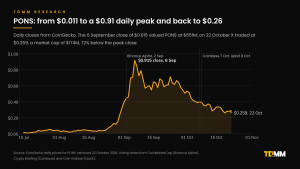
No market maker has announced a PONS mandate. What the public record holds is wallet tracking: Arkham flagged a Wintermute PONS position on 5 September, which The Defiant reported two days later at 3.43 million PONS, about $2.4 million and 0.48% of circulating supply, and Lookonchain and Arkham traced about 11.2 million PONS to a wallet linked to Cumberland by 11 September, including 8.5 million withdrawn from Gate. Neither report describes a market-making mandate, and TDMM treats both as holdings, not mandates. Later in this article TDMM measures PONS’s books on seven exchanges and its pools on-chain, because that is the evidence of how a Robinhood Chain token is actually quoted.
How deep are Robinhood Chain’s pools? TDMM’s on-chain measurement
DefiLlama and GeckoTerminal tell you how much money is in a pool. They do not tell you how much of it is within reach of a trade. In a concentrated-liquidity pool, liquidity sits in price ranges chosen by the people who deposited it, and money outside the current price range does nothing for a trader; in a full-range position, the kind every Pons graduate lives in, the money is everywhere and therefore thin at any one price. So TDMM read the pools directly.
Method. On 22 October 2026 TDMM listed Robinhood Chain’s pools through GeckoTerminal’s public API: the 200 most traded pools on the chain, the 200 most traded on each of Uniswap v4, Uniswap v3, Uniswap v2, Pons V2, Pools.trade and Pons V1, and the 200 newest. That gave 1,389 distinct pools. Between 12:44 and 13:20 UTC we read each Uniswap v3-style and v4 pool’s state from the chain through public RPC endpoints: the current price, the active liquidity and every initialised tick in a window of 380 ticks (about 3.9%) either side of the price, using Uniswap’s StateView contract for v4 pools and the pool contracts for v3. Uniswap v2 pools and forks with non-standard interfaces were not measured, and one pool whose reading failed a sanity check was dropped, which left 1,089 pools: 275 on Uniswap v4, 210 on Uniswap v3, 200 Pons V2 hook pools, 200 Pools.trade pools, 200 Pons V1 pools and 4 on SushiSwap v3. From that liquidity we simulated market orders and calculated the dollars needed to move the price by 1% in each direction, and the average price impact of $1,000, $10,000 and $100,000 orders, before fees. Pons V2 pools carry a hook that charges the swap fee and we did not model it, so for those pools our figures describe the liquidity visible in the ticks. The pools are a snapshot of one moment, and liquidity can change every block.
230 pools have no depth near the price, and 906 hold less than $1,000
Of the 1,089 pools, 230 (21.1%) held less than $1 within 1% of the price on both sides: 95 on Uniswap v4, 50 on Uniswap v3 and 85 on Pools.trade. Another 27 were one-sided. The remaining 832 had liquidity on both sides, but that figure flatters the chain, because every one of the 400 Pons V1 and V2 pools counts as two-sided: a full-range position never runs out, it only thins. Measured by what matters, only 183 pools held more than $1,000 of two-sided depth within 1%, 128 held more than $5,000 and 42 more than $50,000. The median Pons V2 hook pool held $137 of two-sided depth within 1% against a median reported liquidity of $35,526; the median Pons V1 pool held $34, and the median Pools.trade pool $29.
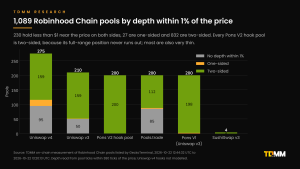
Reported liquidity is not usable liquidity
GeckoTerminal reports $209.2 million of liquidity across the 1,089 pools. Measured depth within 1% of the price is $16.6 million on any side, which is 8.0% of the reported figure, and two-sided depth within 1% is $13.0 million, 6.2%. These figures are different definitions and are not expected to match. The gap is the point: reported liquidity includes capital far from the price, and a trader cannot reach it. The gap is widest where the chain’s volume comes from. The 907 memecoin pools report $81.9 million of liquidity and hold $1.85 million within 1% (2.3%); the 200 Pons V2 hook pools report $13.7 million and hold $60,400 (0.44%). The 230 pools with no depth near the price still reported $93.9 million of 24-hour volume, 14.4% of the $652.7 million reported across all 1,089.
The pools that can take an order
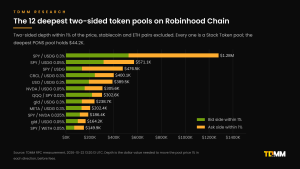
The deepest token pools on Robinhood Chain are Stock Token pools. The SPY/USDG 0.3% pool on Uniswap v4 holds $1.05 million of two-sided depth within 1% ($524,000 on the bid, $755,000 on the ask), the SPY/USDG 0.05% pool $513,000, USO/USDG $383,000, CRCL/USDG $316,000 and NVDA/USDG 0.05% $297,000. Every one of the twelve deepest non-stablecoin pools is a Stock Token pool, and the 107 Stock Token pools together hold $7.76 million within 1%, 47% of the chain’s usable depth on our sample. The deepest PONS pool, PONS/USDG on Uniswap v4 with a dynamic-fee hook, holds $44,200; the deepest memecoin pool on our sample, NOVAAI/WETH on Pons V2, holds $11,000.
What a $10,000 order costs on Robinhood Chain
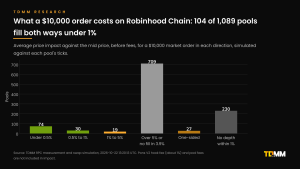
Depth only matters through what it does to a trade, so TDMM simulated market orders of $1,000, $10,000 and $100,000 in both directions against each pool’s ticks. The measure is average price impact against the mid price, before fees. Of the 1,089 pools, 182 take a $1,000 order both ways for under 1% impact. At $10,000, 104 do, 74 of them under 0.5%. At $100,000, 22 do. For 709 pools a $10,000 order would move the price by more than 5% or could not be filled inside the 3.9% window we read. Among the 200 Pons V2 hook pools, six take a $1,000 order both ways under 1% and one takes $10,000; among the 200 Pools.trade pools, five take $1,000 and none take $10,000.
Stock Token pools are deep; memecoin pools mostly are not
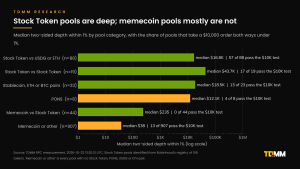
Grouping the pools by what trades in them makes the chain’s two markets visible. The 88 pools that pair a Stock Token with USDG or ETH have a median two-sided depth of $16,788 within 1%, and 57 of them pass the $10,000 test. The 19 pools that pair one Stock Token with another, such as QQQ/SPY and SPY/NVDA, have a median of $43,719 and 17 pass. The 907 memecoin pools have a median of $38 and 13 pass. The 44 pools that pair a memecoin with a Stock Token, Pons’s distinctive product, have a median of $235 and none pass. PONS’s eight pools have a median of $12,106 and four pass.
Check the contract, not the ticker
Sixteen of the 1,089 pools trade a token whose ticker matches one of Robinhood’s 195 Stock Tokens but whose contract is not in Robinhood’s registry: IBM, DJT, GME, AMD, AMC, APP, AUR, BULL, OKLO, SNOW and VRT. Some are plainly memecoins that happen to share a ticker. Others are not plain at all: an IBM/WETH pool on Uniswap v4 reported $7.48 million of 24-hour volume with no measurable liquidity near the price, a second IBM pool on Pools.trade $348,000, a BULL/WETH pool $329,000 and a DJT/WETH pool $117,000. Together the sixteen reported $8.55 million of volume and $24.5 million of liquidity, and held $123,000 within 1% of the price. A different contract is not proof of bad intent, because anyone can deploy a token with any name. It does mean that a price feed, a listing form or a lending market that matches on ticker will pick up the wrong asset. The check takes a minute: read the token’s address on robinhoodchain.blockscout.com and compare it with Robinhood’s registry at api.robinhood.com/rhj/assets.
What the measurement means for a Robinhood Chain issuer
Three things follow. First, a pool is not a market until someone maintains it: 230 pools have nothing near the price, and the 400 launchpad pools that count as two-sided hold a median of $34 to $137, so most Robinhood Chain tokens that exist today cannot absorb a $1,000 sale without moving more than 1%. Second, the reported numbers that founders, listing teams and lenders quote are not a guide to depth on Robinhood Chain, and on the evidence above they can be off by an order of magnitude or more. Third, the pools that work are the ones with a professional-looking range: tight, centred and two-sided, which on this chain means the Stock Token pools and a handful of protocol tokens. That is the job market making does.
PONS across venues: what a Robinhood Chain token looks like once it lists
PONS is the one Robinhood Chain token with enough venues to show how a listing changes the picture, so TDMM snapshotted its order books on OKX, Coinbase, Kraken, Upbit, Gate and MEXC at 12:35 UTC on 22 October 2026, alongside its on-chain pools. Bybit’s public API was not reachable from TDMM’s location, so its book is not included.
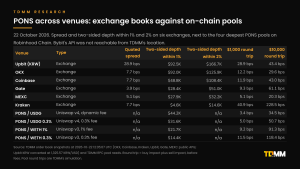
|
Venue |
Type |
Quoted spread |
Two-sided depth within 1% |
Two-sided depth within 2% |
$1,000 round trip |
$10,000 round trip |
|
Upbit (KRW) |
Exchange |
28.9 bps |
$92,500 |
$166,700 |
28.9 bps |
43.4 bps |
|
OKX |
Exchange |
7.7 bps |
$92,000 |
$125,900 |
12.2 bps |
29.6 bps |
|
Coinbase |
Exchange |
7.7 bps |
$48,800 |
$108,400 |
11.9 bps |
43.0 bps |
|
Gate |
Exchange |
3.9 bps |
$28,400 |
$51,000 |
9.3 bps |
61.1 bps |
|
MEXC |
Exchange |
5.1 bps |
$27,900 |
$32,200 |
5.1 bps |
20.3 bps |
|
Kraken |
Exchange |
7.7 bps |
$4,600 |
$14,600 |
40.9 bps |
228.5 bps |
|
PONS/USDG |
Uniswap v4, dynamic-fee hook |
n/a |
$44,200 |
n/a |
3.4 bps |
34.5 bps |
|
PONS/USDG 0.3% |
Uniswap v4 |
n/a |
$31,600 |
n/a |
5.0 bps |
50.7 bps |
|
PONS/WETH 1% |
Uniswap v3 |
n/a |
$21,700 |
n/a |
9.2 bps |
91.3 bps |
|
PONS/WETH 0.3% |
Uniswap v3 |
n/a |
$14,400 |
n/a |
11.5 bps |
118.4 bps |
Two-sided depth is twice the thinner side. Round trip is buy impact plus sell impact against the mid price, before fees; pool round trips are TDMM’s simulation and exclude pool and hook fees.
Three things stand out. The exchange books are tighter and deeper than the pools: OKX and Upbit each hold about $92,000 within 1%, twice the deepest pool, and a $10,000 round trip costs 20 to 61 basis points on five of the six exchanges against 35 to 118 basis points on the pools before fees. The books are uneven: Kraken’s book held $4,600 within 1% and charged 228 basis points for a $10,000 round trip, fifty times MEXC’s. And the pools still matter, because the PONS/USDG pool on Ramses, which TDMM did not measure because Ramses uses a non-standard interface, was the largest PONS venue by reported 24-hour volume on CoinGecko’s tickers, ahead of Gate and OKX, and Robinhood Wallet users trade on-chain. A token with six exchange books and six pools has twelve prices, and the job of its market maker is to keep them one.
How does Robinhood Chain’s design change market making?
Robinhood Chain is EVM-compatible, so most of the tooling a market maker uses on Ethereum or Arbitrum carries over. The differences sit in the details of block time, ordering, finality, governance, the Stock Token primary market and the launchpad pools, and each belongs in the mandate.
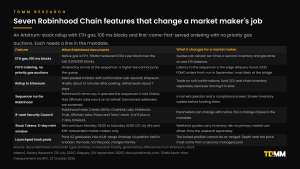
|
Robinhood Chain feature |
What Robinhood documents |
What it changes for a market maker |
|
ETH gas, 100 ms blocks |
Native gas is ETH. TDMM measured 0.104 seconds per block over the last 5,000,000 blocks |
Quotes can refresh ten times a second. Inventory and gas draw on one ETH balance, so the mandate should say who funds re-centring |
|
FCFS ordering, no priority gas auctions |
Transactions are ordered by arrival at the sequencer; a higher fee cannot jump the queue |
Latency to the sequencer is the edge, not gas bidding. Bitquery found 3,532 FOMO orders worth $6.5 million front-run between 12 and 25 September, most likely in a bridge window rather than at the sequencer |
|
Rollup to Ethereum |
Data posted in blobs. Soft confirmation sub-second; Ethereum finality about 13 minutes after posting; canonical withdrawals about 7 days |
Trade on soft confirmations, but fund CEX and chain inventory separately, because moving it between them is slow |
|
Sequencer run for Robinhood |
Robinhood’s terms say it operates the sequencer; Robinhood told Galaxy that Offchain Labs runs it on its behalf. Sanctioned addresses are screened |
A named operator and a compliance screen. Screen inventory wallets before funding them |
|
Eight-seat Security Council |
Robinhood holds two seats; BitGo, Chainlink Labs, Fireblocks Trust, Offchain Labs, Paxos and Talos one each. Six of eight plus a seven-day timelock for routine changes |
Parameters can change with notice. Put a change clause in the mandate |
|
Stock Tokens: five-day mint window |
Mint and burn Monday 02:00 to Saturday 02:00 CET, by Authorised Participants and KYB-onboarded market makers only |
Weekend quotes on a stock-paired token carry inventory risk no primary market can offset. Price the weekend separately |
|
Launchpad hook pools |
Pons V2 graduates into a full-range Uniswap v4 position held in a locker; the hook, not the pool, charges the fee |
The locked position cannot be re-ranged. Depth near the price must come from a second, managed pool |
Two of these reward attention more than the rest. Because the chain’s own order is first-come-first-served and its blocks arrive every tenth of a second, the quoting problem is one of latency and refresh rather than gas auctions, and the September front-running episode Bitquery documented is a reminder that the weak point can sit outside the chain, in a bridge or an aggregator’s routing window. And because a Pons graduate’s liquidity is permanent and full-range, a market maker cannot improve it; it can only build a second pool beside it and keep the two on one price. Neither is a reason to avoid Robinhood Chain. Both are reasons to write the operating rules down.
What should a Robinhood Chain token’s order book look like when it lists on an exchange?
Most Robinhood Chain tokens that last will reach centralised exchanges, and when they do, the standard is set by the books already there. PONS reached eleven in three months; CASHCAT, the chain’s largest memecoin, reached Robinhood’s own app in August and Upbit in September. Bitstamp, the exchange Robinhood bought for about $224 million in cash in June 2025, had no Robinhood Chain token listed that TDMM could find. These are the venues where a Robinhood Chain token will be judged.
Method. On 22 October 2026 between 12:26 and 12:32 UTC, TDMM captured the level-2 order book of every USDT spot pair on Gate (2,025 books) and MEXC (1,400 books), 3,425 in all, and calculated the quoted spread and the dollar value of bids and offers within 1% and 2% of the mid price. We matched 1,758 books to a market capitalisation tier using CoinGecko’s top 2,000 coins. Across all 3,425 books the median spread was 37.6 basis points, 23.8% were wider than 1%, and 69.1% held under $10,000 on their thinner side within 2%.
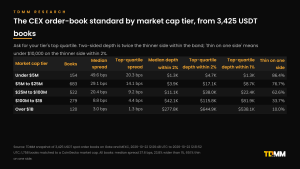
|
Market cap tier |
Books |
Median spread |
Top-quartile spread |
Median depth within 2% |
Top-quartile depth within 2% |
Top-quartile depth within 1% |
Thin on one side |
|
Under $5M |
154 |
49.6 bps |
20.3 bps |
$1,279 |
$4,695 |
$1,269 |
86.4% |
|
$5M to $25M |
683 |
29.1 bps |
14.1 bps |
$3,867 |
$17,076 |
$8,736 |
76.7% |
|
$25M to $100M |
522 |
20.4 bps |
9.2 bps |
$11,114 |
$37,991 |
$22,350 |
62.6% |
|
$100M to $1B |
279 |
8.8 bps |
4.4 bps |
$42,067 |
$115,759 |
$81,913 |
33.7% |
|
Over $1B |
120 |
3.0 bps |
1.3 bps |
$277,769 |
$644,919 |
$538,148 |
10.0% |
Two-sided depth is twice the thinner side within the band. “Thin on one side” means under $10,000 on the thinner side within 2%. The table covers the 1,758 books matched to a tier.
Set against this benchmark, Robinhood Chain’s pools are a long way from a listing standard. The top-quartile book for a token worth $5 million to $25 million holds $8,736 of two-sided depth within 1%. On our sample of 1,089 pools, 114 exceed that figure: 80 Stock Token pools, 15 stablecoin or ETH pairs, five PONS pools and 14 memecoin pools, led by CASHCAT, VIRTUAL, TAO and Artificial Inu; of the 600 launchpad pools, two do. PONS itself, at a $174 million market cap, sits in the $100 million to $1 billion tier, where the top-quartile book holds $81,913 within 1% and quotes a 4.4 basis point spread. Its books on OKX and Upbit clear the depth figure; Gate and MEXC beat the spread but hold a third of the depth; Kraken does neither. The two measures are not identical, since a pool’s depth is the capital needed to move the price and a book’s is resting orders, but the comparison shows the order of magnitude.
What to write into a Robinhood Chain market making mandate
The benchmark gives the numbers for the CEX side. The Robinhood Chain side needs the same discipline, plus clauses for the chain’s own features. TDMM recommends writing each of these into the contract, per venue, and checking each against a source the market maker does not control.
|
Term |
What to write |
How to check it |
|
CEX spread |
Top quartile of your tier on every venue, for example 14.1 bps or tighter for a $5M to $25M token |
The public order book |
|
CEX depth |
Top-quartile two-sided depth within 2%, for example $17,076 or more at $5M to $25M |
The order book, or the depth shown on CoinMarketCap and CoinGecko |
|
Pool depth |
A stated dollar amount within 1% on both sides of the pool price, and a $10,000 order each way under 1% impact before fees |
Read the pool’s ticks through an RPC endpoint, or ask for the report |
|
Launchpad position |
Which pool the market maker quotes beside a locked full-range position, and the fee tier |
The pool’s address on Blockscout |
|
Reference price |
One named reference price for every pool and exchange, and a maximum gap between them |
Compare the pool price with the exchange mid |
|
Uptime |
At least 95% per venue |
Sampled quotes |
|
Stress |
What the market maker does in a move of 30% or more, and how fast it returns |
The report after the event |
|
Weekend |
For stock-paired tokens, the depth target from Saturday 02:00 to Monday 02:00 CET |
Sampled quotes at the weekend |
|
Contracts and wallets |
The published token address, segregated inventory wallets screened against the sequencer’s sanctions filter |
The registry and the explorer |
|
Gas |
Which party funds the ETH for re-centring ranges, and how it is reported |
The mandate itself |
|
Disclosure |
Market maker identity and terms disclosed to every listing exchange |
The exchange’s own records |
Best market makers for Pons launchpad tokens
A Pons graduate is a specific case, and it is the one most Robinhood Chain founders will face. At graduation the coin’s reserve and remaining supply move into a full-range Uniswap v4 position that nobody can withdraw or re-range, with a hook charging the fee. On our measurement the median such pool holds $137 of two-sided depth within 1%, six of 200 can take a $1,000 order both ways under 1%, and one can take $10,000. Supply is often concentrated: The Block’s review of nine launches from one operation found 82% to 86% of supply in the creator’s and exempt wallets after the opening transaction. And the only path to a wider market runs through a second pool and, eventually, an exchange listing, which is the path PONS and CASHCAT took.
So the market maker a Pons token needs is one that can do three things: stand a managed, concentrated range beside the locked position and keep the two on one price; verify the holder distribution and the contract before putting inventory behind it; and carry the token to an exchange book when the time comes. In TDMM’s ranking the best fits are, in order, TDMM, for one book across the new pool and the exchanges; Arrakis, for a managed vault beside the locked position if the token will stay DEX-only, since Arrakis Modular is already live on the chain; Wintermute, for a token that has already grown large enough to interest a tier-one desk; and Kairon Labs or Flowdesk, for the exchange side on its own. What none of them can do is make the locked position deeper, and a founder should distrust anyone who says otherwise.
Who can provide liquidity for a Robinhood Chain token?
There are six ways to put liquidity behind a Robinhood Chain token, and each leaves a different gap. A launchpad graduation is the default for most tokens on the chain, and its gap is structural: the full-range position is permanent, thin near the price and cannot be re-ranged. A passive pool goes stale. A DEX vault or range manager keeps ranges active and the issuer in custody, and Arrakis Modular is live on the chain, but nobody quotes the order book once a listing arrives. A prop AMM or RFQ desk quotes from its own inventory on the assets it chooses, which rarely include a new token. A CEX-only market maker covers the order book and ignores the pool where the token started and where Robinhood Wallet users trade. A full-service CEX and DEX market maker covers the path from a Robinhood Chain pool to an exchange with one reference price, provided the contract sets spread, depth and uptime per venue.
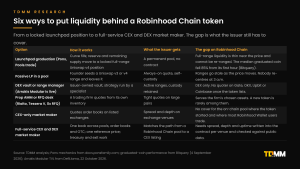
|
Option |
How it works |
What you get |
The gap on Robinhood Chain |
|
Launchpad graduation (Pons, Pools.trade) |
The curve fills; reserve and remaining supply move to a locked full-range Uniswap v4 position |
A permanent pool, no contract |
Full-range liquidity is thin near the price and cannot be re-ranged. The median graduated coin fell 85% from its first hour |
|
Passive LP in a pool |
Founder seeds a Uniswap v3 or v4 range and leaves it |
Always-on quote, self-custody |
Ranges go stale as the price moves. Nobody re-centres at 3 a.m. |
|
DEX vault or range manager |
Issuer-owned vault, strategy run by a specialist; Arrakis Modular is live on the chain |
Active ranges, custody retained |
DEX only. No quoter on Gate, OKX, Upbit or Coinbase once the token lists |
|
Prop AMM or RFQ desk |
A trading firm quotes from its own inventory (Rialto, Tessera V, Pleiades, 0x RFQ) |
Tight quotes on large pairs |
Serves the firm’s chosen assets. A new token is rarely among them |
|
CEX-only market maker |
Quotes order books on listed exchanges |
Spread and depth on exchange venues |
No cover for the on-chain pool where the token started |
|
Full-service CEX and DEX market maker |
One book across pools, order books and OTC, one reference price, treasury and exit work |
Matches the path from a Robinhood Chain pool to a CEX listing |
Needs spread, depth and uptime written into the contract per venue, and checked against public data |
TDMM’s explainer on the difference between a crypto market maker and a liquidity provider sets out why the two are not the same job, and its guide to CEX versus DEX market making covers the two environments.
How we ranked the best market makers for Robinhood Chain tokens
Nobody outside a firm can see its profit and loss or its client book, and no public league table of market makers exists. What can be checked is what a firm publishes about its coverage, who has authorised it, what its record shows, and whether it can serve the venues a token will trade on. So this ranking adapts the seven criteria TDMM used on 26 September 2026 for its ranking of the top crypto market makers, and applies them to Robinhood Chain’s venue mix.
Access for new tokens (20%) asks whether the firm markets to issuers and will onboard a sub-$100 million token. CEX and DEX coverage (15%) asks for documented capability on Uniswap-style pools, including v4 hook pools, and on the exchanges where Robinhood Chain tokens have listed. Deal transparency (15%) asks whether the firm explains its commercial models and avoids the profit-share and guaranteed-profit structures that Binance’s March 2026 guidelines prohibit. KPIs and reporting (15%) asks whether spread, depth and uptime can be written into a contract and verified. Conduct record (15%) covers enforcement actions, security incidents and credible press reports. Regulatory standing (10%) covers licences where the issuer’s venues or jurisdiction need them, and now includes registrations that cover tokenised securities. Lifecycle scope (10%) asks whether listing support, treasury and exits sit on the same book.
Two limits apply. First, Robinhood Chain is 113 days old, and only two firms have publicly connected themselves to market making on it: FalconX, in its own primer, and Tokka Labs, named by 0x. Wintermute’s Tessera V trades on the chain, but Wintermute has not announced it, and the attribution rests on two research houses. No firm has an announced mandate for a third-party Robinhood Chain token, TDMM included. This ranking therefore measures fit for Robinhood Chain’s venue mix, plus whatever presence on the chain the record shows, not a track record of mandates. Second, the ranking is TDMM’s. TDMM is one of the firms ranked, and it ranks itself first for Robinhood Chain token issuers, for the reasons set out below. Readers who weigh the criteria differently can re-rank from the evidence in each review.
The 10 best market makers for Robinhood Chain tokens, reviewed
Firm facts are as of 22 October 2026 unless a date is given. Each review ends with a Robinhood Chain angle, which says what the firm’s public record implies for an issuer on the chain.
1. TDMM: best for one partner across Robinhood Chain pools and CEX books
Best for: Robinhood Chain tokens under about $100 million that start in a pool, including Pons graduates, and will list on exchanges. Active since: 2015. Coverage: more than 100 CEX and DEX integrations and more than 200 markets.
TDMM (TradeDog Market Maker) is the market making and token market management arm of TradeDog Group. It reports more than $10 billion in trading volume, runs 24-hour operations with a team of over thirty people on five continents, and lists integrations on Binance, OKX, Bybit, Gate, KuCoin, Bitget, MEXC and HTX, on Uniswap, PancakeSwap, SushiSwap, Raydium and four.meme, and on Ethereum, BNB Chain, Solana, Base, Polygon, Avalanche and PulseChain. It covers the full token lifecycle: listing support, market making, treasury management, yield on idle inventory and exit management. It contracts in units an issuer can check, and it does not promise a price or a volume number.
Robinhood Chain angle: Robinhood Chain is not yet on TDMM’s published chain list, and TDMM has made no public Robinhood Chain announcement; mandates on the chain are scoped on request. The chain is EVM-compatible and its pools are Uniswap v3 and v4, which is the kind TDMM runs on other EVM chains, and four.meme on TDMM’s DEX list is a launchpad whose graduated pools are the same job a Pons graduate presents. Five of the eleven exchanges where PONS trades, Gate, OKX, Bybit, MEXC and Toobit, are on TDMM’s published venue list; Coinbase, Kraken, Upbit, Bithumb, BloFin and KCEX are not. Choose a tier-one firm instead for a very large float on a tier-one venue, and a MiCA-authorised firm if your regulator or venue requires one.
2. Wintermute: best for tier-one depth on chain and on exchange
Best for: large launches and deep liquidity on both CEXs and DEXs. Active since: 2017. Coverage: more than 60 centralised and decentralised venues, by its own releases.
Wintermute was co-founded in London in 2017 by Evgeny Gaevoy, Harro Mantel and Yoann Turpin. It states $10 billion of daily trading volume. Wintermute USA registered with the SEC as a broker-dealer and became a FINRA member, announced on 6 August 2026, which lets it trade stocks and options and act as an authorised participant for exchange-traded products. The notable incident in its record is the September 2022 hack, in which about $160 million was taken, a loss widely attributed by security researchers to a weakness in the Profanity vanity-address generator.
Robinhood Chain angle: Wintermute is the firm with the deepest documented link to Robinhood. Robinhood’s 10-Q for the first quarter of 2025 named Wintermute Trading Ltd at 11% of total net revenues, alongside B2C2 at 12% and Citadel Securities at 12%; by the first quarter of 2026 only Citadel, at 15%, exceeded the 10% disclosure threshold, so the crypto relationship continued below that line. Tessera V, the prop AMM that Chorus One and Blockworks Research attribute to Wintermute, has traded $754 million on Robinhood Chain since 14 September 2026, and on-chain analysts linked a 3.43 million PONS position to Wintermute in early September. None of that is an announced mandate, and Wintermute has not commented. Smaller projects should ask what minimum size applies. See TDMM vs Wintermute.
3. FalconX: best for an institutional counterparty already active on the chain
Best for: issuers and treasuries that want a prime-brokerage counterparty with a declared presence on Robinhood Chain. Active since: 2018. Coverage: no venue count published; FalconX describes itself as a digital-asset prime broker serving institutions.
FalconX’s research desk published “Robinhood Chain Primer: Early Traction and Protocols to Watch” on 20 July 2026, and the piece states that FalconX supports Robinhood Chain as a liquidity partner and market maker for its on-chain protocols. That is the only self-disclosure of market making on the chain TDMM found from any firm in this ranking. We found no enforcement actions or major incidents in its 2026 record.
Robinhood Chain angle: FalconX’s statement covers the chain’s protocols, which TDMM reads as its lending and trading venues rather than third-party token mandates. An issuer who needs an institutional counterparty that already holds inventory on the chain, or OTC blocks in a Robinhood Chain token, should ask FalconX directly what its issuer service covers. See TDMM vs FalconX.
4. B2C2: best for OTC depth with KPIs agreed upfront
Best for: issuers that also need block liquidity and institutional counterparties. Active since: 2015. Coverage: no venue count published.
B2C2 was founded in London in 2015 by Max Boonen and is majority-owned by SBI Holdings. B2C2 Europe Sàrl was authorised under MiCA by Luxembourg’s CSSF in May 2026. Its issuer page offers KPIs upfront, naming uptime, spread targets and quote volumes. In June 2026 CoinDesk reported that SBI had held sale talks with several buyers over 18 months, seeking a valuation above $1 billion. We found no enforcement actions against it.
Robinhood Chain angle: B2C2 USA Inc was 12% of Robinhood’s total net revenues in the first quarter of 2025 and below the 10% threshold a year later, which makes it, with Wintermute, one of the two crypto liquidity providers Robinhood has named in a filing. It has no announced Robinhood Chain activity. Its OTC model suits issuers that need block liquidity in a chain token after an exchange listing.
5. GSR: best for regulated, full-lifecycle institutional mandates
Best for: issuers that want a regulated counterparty with capital markets, treasury and liquidity under one roof. Active since: 2013. Coverage: no venue count published.
GSR is led by chief executive Xin Song. In March 2026 it bought the token-launch advisory firms Autonomous and Architech for $57 million, in June 2026 it received FINRA approval to complete the purchase of a broker-dealer now called GSR Securities LLC, and on 2 September 2026 it announced CIMA registrations for two Cayman entities and described tokenised securities as a core market. It says it is registered with the UK’s Financial Conduct Authority and licensed by the Monetary Authority of Singapore. We found no enforcement actions or major security incidents in its record.
Robinhood Chain angle: GSR has no announced Robinhood Chain activity. Its broker-dealer and its stated focus on tokenised securities fit the Stock Token side of the chain better than the launchpad side, and its treasury-led model suits an issuer whose token is part of a larger balance sheet. See TDMM vs GSR.
6. Keyrock: best for EU issuers and tokenised-securities dealing
Best for: European issuers that need a MiCA-authorised partner, and tokens linked to tokenised securities. Active since: 2017. Coverage: 85 centralised and decentralised venues, by its own release.
Keyrock was founded in Brussels in 2017 and provides CEX and on-chain market making, OTC trading and options. Keyrock FR SAS was authorised under MiCA by France’s AMF on 12 June 2026, and in September 2026 Keyrock Securities Ltd was registered with the Cayman Islands Monetary Authority as a dealer in securities that can be tokenised, in the same announcement as its purchase of BlockFills’ institutional assets. We found no enforcement actions against it.
Robinhood Chain angle: Keyrock has no announced Robinhood Chain activity. Its securities-dealer registration is the closest fit in this ranking to a token that references a Stock Token, and its MiCA authorisation suits an EU issuer. See TDMM vs Keyrock.
7. Flowdesk: best for market-making-as-a-service with treasury tools
Best for: issuers that want transparent market-making-as-a-service with custody control. Active since: 2020. Coverage: 150+ exchange venues.
Flowdesk was co-founded in Paris in 2020 by Guilhem Chaumont, its chief executive. Its Series B totals $102 million, including a $52 million extension in March 2025. Flowdesk Europe SAS received CASP authorisation from the AMF under MiCA effective 30 June 2026, and its Dubai entity received a VARA broker-dealer licence in August 2026. It has published clear explanations of retainer and loan-plus-call structures. We found no enforcement actions against it.
Robinhood Chain angle: no announced Robinhood Chain activity. A European, authorised provider with a broad venue list and a service model suits an EU issuer of a Robinhood Chain token that wants to keep custody of its inventory. See TDMM vs Flowdesk.
8. Tokka Labs: best for RFQ quotes on Stock Tokens
Best for: anyone who needs signed quotes on Robinhood Stock Tokens through an aggregator. Active since: not published. Coverage: RFQ liquidity through 0x; its Circle Alliance Directory listing describes a market maker for top exchanges and protocols.
Tokka Labs describes itself as a proprietary trading firm in digital assets that designs its own trading systems and makes markets on major exchanges and protocols. 0x’s post of 1 July 2026 announcing support for Stock Tokens on Robinhood Chain names Tokka Labs as the primary market maker participating through 0x RFQ, with USDG as the primary base pair. We found no enforcement actions against it.
Robinhood Chain angle: Tokka Labs is one of two firms with a documented market-making role on the chain, and the only one named on Stock Tokens. Its model is quotes on Robinhood’s product, not mandates for third-party tokens, so an issuer should treat it as a liquidity source for stock-paired coins rather than a market maker for hire.
9. Arrakis: best for DEX-only tokens on Uniswap-style pools
Best for: tokens that trade only on DEXs and want managed on-chain liquidity without handing over custody. Active since: 2021. Coverage: Uniswap v3 and v4 on several EVM chains, plus Aerodrome, Velodrome, PancakeSwap, Hyperliquid and Solana.
On EVM chains the issuer owns a self-custodial vault and Arrakis runs the liquidity strategy inside it. Its documentation cites more than 100 token issuers. It does not quote on centralised exchanges, so a token that lists on a CEX needs another provider for the order book and someone to keep both on one reference price.
Robinhood Chain angle: Arrakis Modular is live on Robinhood Chain with $2.96 million of TVL on DefiLlama on 22 October 2026, which makes Arrakis the one vault manager in this ranking with a working deployment on the chain. For a Pons graduate whose only market is a locked full-range position, an Arrakis vault beside it is the cheapest way to put managed depth near the price. See TDMM vs Arrakis.
10. Kairon Labs: best for small and mid caps across many exchanges
Best for: small and mid-cap projects that want algorithmic market making on many exchanges. Active since: 2019. Coverage: 100+ exchanges.
Kairon Labs is Antwerp-based and states that it has served more than 500 clients. It markets itself to smaller projects that tier-one firms rarely take on. We found no enforcement actions against it.
Robinhood Chain angle: no announced Robinhood Chain activity. A CEX-side specialist for the moment a Robinhood Chain token lists, paired with a separate arrangement for the pool. See TDMM vs Kairon Labs.
Names you will see that are not in this ranking
|
Firm |
What it is |
Why it is not in the Robinhood Chain ranking |
|
Cumberland (DRW) |
Crypto trading arm of Chicago’s DRW |
Lookonchain and Arkham traced about 11.2 million PONS to a wallet linked to Cumberland by 11 September 2026. That is a holding, not a mandate. Institutional OTC blocks rather than issuer market making. The SEC’s October 2024 suit was dropped in March 2025 |
|
Pleiades, Rialto, Metric |
Prop AMMs on Robinhood Chain |
Trading firms quoting their own inventory on assets they choose. Pleiades’s operator is undisclosed; Rialto planned 90+ Stock Tokens at launch, with its Rivo Altus prop AMM supplying baseline liquidity. Not services an issuer can hire |
|
DWF Labs |
Market making plus token investment |
Ranked tenth in TDMM’s Arc ranking. Omitted here because the firms above it have a stronger Robinhood Chain fit, and because in October 2026 two DWF subsidiaries sued BitGo in London claiming $141 million over alleged early token sales, which is live litigation. No Robinhood Chain activity found |
|
Galaxy |
Nasdaq-listed digital asset firm |
Published the most useful outside analysis of the chain (30 July 2026). OTC and lending, not issuer market making. Settled with the New York Attorney General for $200 million over LUNA in March 2025 |
|
Jump Trading, Flow Traders, Jane Street |
Traditional and crypto trading firms |
Jump provides liquidity for Securitize’s tokenised equities on Solana; Flow Traders runs a 24/7 OTC desk for tokenised assets. Neither names Robinhood Chain. Jane Street faces a Terraform-related suit it has moved to dismiss |
|
Auros, Amber Group, Gravity Team |
Algorithmic and Asia-focused market makers |
In TDMM’s earlier rankings. No Robinhood Chain evidence. Omitted here, not downgraded |
Top market makers for Robinhood Chain tokens compared
|
Market maker |
Focus |
Robinhood Chain evidence |
Public record, as of 22 Oct 2026 |
|
TDMM |
CEX and DEX market making, listing support, treasury, exit management |
EVM pool capability; launchpad-graduated pools on four.meme; 5 of 11 PONS exchanges on its venue list; no public Robinhood Chain mandate |
None found |
|
Wintermute |
CEX and DEX market making, OTC |
Tessera V prop AMM on the chain since 14 Sep 2026 (attributed); 11% of Robinhood revenue in Q1 2025; PONS holding per Arkham |
$160M hack, September 2022 |
|
FalconX |
Prime brokerage, OTC, market making |
Self-described liquidity partner and market maker for the chain’s protocols (20 Jul 2026) |
None found |
|
B2C2 |
OTC liquidity, issuer market making |
12% of Robinhood revenue in Q1 2025; MiCA |
None found |
|
GSR |
Issuer market making, OTC, launch advisory |
Regulated institutional model; tokenised securities named a core market |
None found |
|
Keyrock |
CEX and on-chain market making, OTC, options |
MiCA; CIMA securities dealer registration |
None found |
|
Flowdesk |
Market-making-as-a-service, OTC, treasury |
150+ venues; MiCA |
None found |
|
Tokka Labs |
RFQ market making |
Named by 0x as primary market maker for Stock Tokens on 0x RFQ |
None found |
|
Arrakis |
On-chain vaults for issuers (DEX only) |
Arrakis Modular live on the chain, $2.96M TVL |
None found |
|
Kairon Labs |
Algorithmic issuer market making |
100+ exchanges; no chain evidence |
None found |
How much does market making for a Robinhood Chain token cost?
No neutral price benchmark exists for crypto market making. The published figures come from a venture firm, market makers’ own publications and a crypto media outlet, and should be read as opening positions. Three structures are in use, plus a fourth that Binance’s March 2026 guidelines prohibit.
|
Model |
How it works |
Published terms |
Watch out for |
|
Retainer |
Monthly fee; the issuer supplies inventory and gets all of it back |
$1,000 to $7,000 per exchange per month plus a 15% to 20% carry (Caladan’s January 2024 survey of nine firms; currency not stated); $3,000 to $15,000 or more a month (OpenLiquid, 2025) |
The fee is due whatever the service |
|
Token loan + call option |
The issuer lends tokens; the market maker gets calls at preset strikes; no fee |
1% to 3% of circulating supply for 6 to 12 months (Fabric Ventures); 1% to 5%, strikes 25% to 100% above TGE, 12 to 24 months (WuBlockchain) |
The options can be worth half the loan |
|
Hybrid |
A smaller retainer plus a smaller loan and option package |
Negotiated |
KPIs must stay enforceable |
|
Profit-share or guaranteed profit |
Issuer and market maker split trading profit, or profit is guaranteed |
Not applicable |
Binance’s March 2026 guidelines prohibit profit-sharing and guaranteed-profit models with market makers |
The loan structure looks free and is not. TDMM measured the annualised volatility of 750 new listings at a median of 166%. At that volatility, a standard loan of 1.5% of supply with three call tranches at 1.25, 1.5 and 2 times the reference price is worth about 51% of the loan’s value. On a $1.5 million loan that is $764,723, before a single trade. TDMM’s post-listing market making article has the worked example. Whichever structure you choose, ask for the option value in dollars before you sign.
On Robinhood Chain there are two further lines to ask about. Re-centring a concentrated range costs gas, and the gas is ETH drawn from the same balance that funds quoting, so the mandate should say who bears it and how it is reported. And if the token is paired with a Stock Token, weekend inventory risk is real, because the primary market is closed from Saturday 02:00 to Monday 02:00 Central European time; the mandate should say whether weekend quotes carry the same depth target or a wider one.
A 90-day liquidity plan for a new Robinhood Chain token
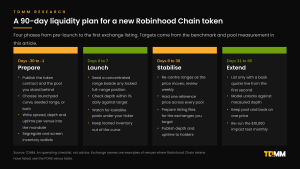
Days -30 to -1: prepare. Publish the token contract and the pool you will stand behind. Decide whether the token launches on a curve, in a seeded range, or both, and if it graduates from Pons, accept that the graduation position is permanent and plan a managed range beside it. Write spread, depth and uptime targets per venue, taken from the benchmark above. Segregate inventory wallets and screen them, since the sequencer screens sanctioned addresses. Agree who pays gas for re-centring.
Days 0 to 7: launch. Seed a concentrated range around the launch price next to any locked full-range position. Check depth within 1% against target every day. Watch for lookalike pools under your ticker, which GeckoTerminal lists beside the real one. Keep loaned inventory out of the curve and the opening bundle. Report the $10,000 impact test both ways.
Days 8 to 30: stabilise. Re-centre ranges as the price moves and review weekly. Hold one reference price across every pool the token trades in, since a token like PONS can have six on-chain venues at once. Prepare listing files for the exchanges you target. If the token references a Stock Token, price the weekend separately. Publish depth and uptime to holders.
Days 31 to 90: extend. List on an exchange only with a book quoter contracted from the first second. Model any unlocks against measured depth. Keep pool and book on one price. Re-run the $10,000 impact test monthly, and re-check for lookalike contracts.
Why TDMM ranks first for Robinhood Chain tokens
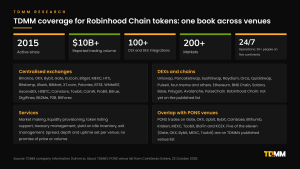
TDMM ranks first for Robinhood Chain token issuers because of what the Robinhood Chain data shows. Most tokens on the chain start in a Uniswap pool that nobody maintains, or in a launchpad position that nobody can maintain, and the ones that last will list on exchanges where the books are judged against a published standard; PONS reached eleven of them in three months. The job is one book across both, with one reference price. TDMM runs CEX order books and DEX pools together, covers listing support, market making, treasury management, yield on idle inventory and exit management on the same inventory, and sets spread, depth and uptime per venue in terms the issuer can check against public data. It prices the option value of any token loan in dollars before signing, drafts agreements to be disclosed to every exchange, and structures loans so that treasury inventory is never the source of selling. It does not promise a price or a volume number. Its commitment is a two-sided market at an agreed standard, on every venue, for the life of the token.
Three limits belong next to that case. Robinhood Chain is not yet on TDMM’s published chain list, and no firm, TDMM included, has an announced mandate for a third-party token on a chain 113 days old. TDMM is the publisher of this ranking and a ranked firm. And a ranking by fit is not a ranking by results: the fit argument holds only if the mandate is written to measurable terms, which is why the contract table above is part of the article and not an extra. Run the measurement in this article against any provider, TDMM included, after 30 days.
Related TDMM guides and comparisons
These pages go deeper on each situation covered above.
|
Guide |
Read it if you are |
|
Comparing twelve firms across all chains |
|
|
Launching on Circle’s chain, with the same measurement method |
|
|
Running a selection process, with a scorecard and contract clauses |
|
|
Deciding where a token should be quoted |
|
|
Unsure whether a pool deposit is enough |
|
|
Planning the first 90 days after a listing |
|
|
Judging whether volume is real |
|
|
Keeping one reference price across pool and exchange |
|
|
Treating loaned tokens and inventory as treasury assets |
|
|
Sizing an unlock or a sale against measured depth |
|
|
Pre-TGE or preparing a first listing |
|
|
Trading mainly on DEX pools |
|
|
Trading mainly on exchange order books |
Frequently asked questions
1. Who are the best market makers for Robinhood Chain tokens?
In TDMM’s ranking, the best market makers for Robinhood Chain tokens in 2026 are TDMM, Wintermute, FalconX, B2C2, GSR, Keyrock, Flowdesk, Tokka Labs, Arrakis and Kairon Labs. TDMM ranks first for tokens that start in a Robinhood Chain pool and later list on exchanges, because one provider covers both with one reference price. Only FalconX and Tokka Labs have publicly connected themselves to market making on the chain, so the ranking measures fit for its venue mix, not a record of mandates.
2. What is the best market maker for a Pons launchpad token?
For a token that graduates from Pons, the best fit in this ranking is TDMM, because a graduate needs a managed range beside its locked full-range position and a book quoter once it lists, and TDMM runs both on one reference price. Arrakis is the best DEX-only choice, since Arrakis Modular is already live on Robinhood Chain, and Kairon Labs or Flowdesk suit the exchange side alone. Of the 200 Pons V2 hook pools TDMM measured, six could take a $1,000 order both ways under 1% impact, so the first job is depth near the price, not a listing.
3. Does Robinhood have an official market maker for Robinhood Chain or Stock Tokens?
Robinhood has not named one for the chain. Its documentation lists five liquidity channels for Stock Tokens and names 0x, 1inch, LiFi, Uniswap, Rialto and Lighter as venues; 0x names Tokka Labs as the primary market maker on its RFQ. Robinhood’s 10-Q for the first quarter of 2025 named B2C2 at 12% and Wintermute at 11% of total net revenues as crypto liquidity providers for its brokerage, and neither exceeded the 10% threshold a year later. A September interview summary has Robinhood’s crypto head describing the onboarding of market makers for Stock Tokens, without naming any.
4. How liquid are Robinhood Chain tokens today?
It depends on the kind of token. TDMM measured 1,089 of the chain’s most-traded pools on 22 October 2026: 230 had no depth within 1% of the price, 27 were one-sided and 832 were two-sided, but only 104 could take a $10,000 order both ways for under 1% impact. Stock Token pools were the deepest, with a median two-sided depth of $22,499 within 1%; memecoin pools had a median of $38. GeckoTerminal reports $209.2 million of liquidity across the pools, but $16.6 million of it sits within 1% of the price.
5. How do I check a Robinhood Chain token’s real liquidity?
Do not rely on reported liquidity or 24-hour volume. Read the pool’s active liquidity and ticks through a Robinhood Chain RPC endpoint (Uniswap v4 pools through the StateView contract, v3 pools directly), calculate the dollars needed to move the price 1% in each direction, and simulate a $1,000 and a $10,000 order each way. Check the token contract on robinhoodchain.blockscout.com, and for a Stock Token compare it with the address in Robinhood’s registry. Pons V2 pools carry a hook that charges the fee, so add about 1% to any impact figure.
6. What spread and depth should a market maker guarantee for a Robinhood Chain token that lists on an exchange?
TDMM recommends the top quartile of your market cap tier, from its snapshot of 3,425 USDT books on Gate and MEXC on 22 October 2026. For a token worth $5 million to $25 million that is a spread of 14.1 basis points or tighter and $17,076 or more of two-sided depth within 2%. From $25 million to $100 million it is 9.2 basis points and $37,991, and from $100 million to $1 billion it is 4.4 basis points and $115,759. Add uptime of at least 95% per venue. PONS, at $174 million, had spreads of 3.4 to 7.7 basis points and $21,800 to $208,700 of two-sided depth within 2% across its six measured exchanges.
7. How much does market making for a Robinhood Chain token cost?
No neutral benchmark exists. Published retainer quotes run from $1,000 to $7,000 per exchange per month plus a performance carry, and vendor guides put premium firms at $10,000 to $15,000 or more a month, plus the inventory the issuer supplies. Token loans with call options typically cover 1% to 5% of circulating supply, and at the 166% volatility TDMM measured for new listings the options in a standard loan can be worth about half the loan’s value. On Robinhood Chain, add the ETH gas for re-centring ranges and, for stock-paired tokens, a separate weekend depth target. Binance’s March 2026 guidelines prohibit profit-sharing and guaranteed-profit models with market makers.
8. How does Robinhood Chain’s design change market making?
In five ways. Blocks arrive about every 100 milliseconds, so quotes can refresh ten times a second. Ordering is first-come-first-served with no priority gas auctions, so latency to the sequencer matters more than gas bidding. Gas is ETH, drawn from the same balance that funds quoting. Stock Tokens can only be minted and burned from Monday 02:00 to Saturday 02:00 Central European time, so weekend inventory cannot be hedged in the primary market. And Pons V2 graduates into a permanent full-range Uniswap v4 position with a fee-charging hook, so depth near the price must come from a second, managed pool.
9. Do I need a market maker if my token only trades on Uniswap on Robinhood Chain?
You need someone to manage the liquidity, even if you do not need an order-book quoter. Uniswap V4 and V3 carry 76% of the chain’s DEX volume, and an unmanaged range goes stale: 230 of the 1,089 pools TDMM measured had no depth near the price, and the median Pons V2 hook pool held $137 of two-sided depth within 1%. A vault service such as Arrakis, a full-service market maker or an active in-house range strategy can each do the job. What does not work is seeding a pool once and leaving it.
10. What is the difference between a market maker and a liquidity provider on Robinhood Chain?
A liquidity provider is anyone who deposits tokens into a pool, including the Pons locker that holds every graduated coin’s position. A market maker is a liquidity provider with an obligation: it quotes both sides to an agreed spread, depth and uptime, manages inventory and risk across venues, keeps one reference price and reports what it delivered. Every market maker provides liquidity. Most liquidity providers are not market makers, and most Robinhood Chain pools have the first without the second.
Glossary
Arbitrum stack. The rollup technology from Offchain Labs on which Robinhood Chain is built; Arbitrum calls its third-party chains Arbitrum chains or Orbit chains.
Authorised Participant (AP). A party permitted to mint and burn Stock Tokens with the issuer in the primary market. At issuance the only AP was BBVI.
Basis point (bps). One hundredth of one percent. A spread of 14.1 bps means the best offer sits 0.141% above the best bid.
Bonding curve. A pricing contract in which each purchase raises the price of the next; Pons V2 uses one until a coin graduates.
Concentrated liquidity. A pool design, used by Uniswap v3 and v4, in which liquidity is placed within a chosen price range. It is far more capital-efficient than a full-range pool, but only while the range is actively managed.
Depth within 1%. The dollar amount needed to move a market’s price by 1%, or the value of resting orders within 1% of the mid price.
FCFS ordering. First-come-first-served: Robinhood Chain’s sequencer orders transactions by arrival time, and a higher fee cannot move a transaction ahead.
Full-range position. Liquidity spread across every possible price. It never runs out but is thin at any one price; every Pons V2 graduate’s locked position is one.
Graduation. The moment a launchpad coin’s curve sells out and its reserve and remaining supply move into a DEX pool. On Pons V2 the position goes into a locker and cannot be withdrawn.
Hook. A contract attached to a Uniswap v4 pool that can change how swaps and liquidity behave. Pons’s hook charges the swap fee on graduated pools; TDMM’s measurement does not model hooks.
Market maker. A firm that continuously quotes bids and offers for a token on one or more venues to an agreed standard, and reports what it delivered.
Pons. The largest launchpad on Robinhood Chain, operated by Pons Labs, LLC, which states it is not affiliated with Robinhood. PONS is its token.
Price impact. The difference between the average execution price of an order and the mid price before the order, usually expressed in basis points.
Prop AMM. A proprietary on-chain automated market maker backed by one trading firm’s inventory, such as Rialto’s Rivo Altus or Tessera V.
RFQ. Request for quote: a market maker signs a price for a specific trade off-chain and the trade settles on-chain, as on 0x RFQ.
Snipe tax. Pons V2’s 99% tax on buys in the first seconds after launch, decaying to zero over about five seconds; creators can exempt up to 32 wallets.
Stock Token. A tokenised debt security issued by Robinhood Assets (Jersey) Limited that tracks a listed equity or ETF with no legal or beneficial rights in the underlying share.
Two-sided depth. Depth on both sides of the price, so that a pool or book can absorb both buys and sells. In this article it is twice the thinner side.
Uptime. The share of trading time in which a market maker’s quotes are live and within the agreed spread and depth.
Sources
- Robinhood, “Robinhood Accelerates Global Expansion with Robinhood Chain Mainnet, Stock Tokens, Agentic Trading and New Suite of DeFi Products”, newsroom, 1 July 2026 (launch partners, Stock Token issuer and availability, customer count).
- Robinhood Chain documentation: docs.robinhood.com/chain (overview, gas and fees, transaction finality, bridging, governance, differences from Ethereum, Stock Tokens, building with Stock Tokens); api.robinhood.com/rhj/assets (Stock Token registry, 195 assets); retrieved 22 October 2026.
- The Block, “Robinhood Chain goes live on mainnet alongside 24/7 tokenized stocks, Lighter perps and planned crypto agentic trading”, 1 July 2026; “Arcus rolls out 24/7 tokenized US stocks and perpetual markets on Robinhood Chain”, 21 July 2026.
- Galaxy Research, “Will Robinhood Chain Succeed Where Coinbase’s Base Stumbled?”, 30 July 2026 (sequencer operator, Noxa and Pons shares, memecoin share of volume).
- Robinhood Markets, Form 10-Q for the quarters ended 31 March 2025 and 31 March 2026 (concentration of revenue: Citadel Securities, B2C2 USA Inc, Wintermute Trading Ltd; Bitstamp acquisition).
- 0x, “Robinhood Chain” blog post, 1 July 2026 (Tokka Labs as primary market maker on 0x RFQ; USDG base pair).
- FalconX, “Robinhood Chain Primer: Early Traction and Protocols to Watch”, Martin Gaspar, 20 July 2026.
- DefiLlama: Robinhood Chain TVL, protocol TVL, DEX volume, fees and stablecoin APIs; Tessera V and Pons V1 and V2 protocol entries; retrieved 22 October 2026.
- Bitquery, “Pons launchpad growth on Robinhood Chain”, verified 4 September 2026; “FOMO app front-running on Robinhood Chain”, 26 September 2026; Cryptopolitan’s report of Bitquery’s rug-pull cluster count, 29 September 2026.
- Pons documentation: docs.ponsfamily.com (v1 and v2 mechanics, contract addresses, fee policy); ponsfamily.com launchpad page (affiliation disclaimer); retrieved 22 October 2026.
- Decrypt, “What Is Pons? The Robinhood Chain Meme Coin Factory Token Up 18,000% Since July”, 3 September 2026; Crypto Briefing, “Coinbase enables PONS-USD trading”, 7 October 2026; The Defiant, “Uniswap Labs bought PONS token for long-term alignment”, 3 September 2026; CoinMarketCap, Binance Alpha listing, 3 September 2026; Coin Gabbar, Upbit listing, 8 October 2026; Bizhankook, KuCoin listing, 4 September 2026; crypto.news, Binance Futures listing, 6 September 2026; Coinotag, Bybit listing, 22 September 2026.
- The Block, “Onchain analyst links $18.4 million in Robinhood Chain memecoin extractions to single rug-pull operation”, 27 September 2026.
- The Defiant, “Arkham links Wintermute to $2.4 million PONS position”, 7 September 2026; Bloomingbit, 5 September 2026 (Arkham’s first flag); Bitcoin.com, “Cumberland PONS accumulation”, 11 September 2026 (Lookonchain and Arkham wallet tracking).
- Chorus One, “Market making, prop AMMs and Solana execution quality landscape”, 19 December 2025; Blockworks Research, “Prop AMMs expand to Base”, 10 February 2026 (Tessera V attribution).
- Bloomingbit, “Robinhood Chain Posts $51 Million in Q3 Revenue, Surpassing Ethereum”, 22 October 2026, citing Ark Invest’s “The DeFi Quarterly: Q3 2026”; SpendNode, 22 October 2026, citing CoinMarketCap data on tokenised-stock volume; Crypto Briefing, 12 October 2026 ($15 billion cumulative Stock Token volume); CryptoTicker, “Robinhood Chain and the Memecoins”, updated 15 October 2026 (Pons and Pools.trade seven-day fees).
- The Token Dispatch, “Turning rival aggregators into toll roads”, 1 October 2026 (Uniswap share of Stock Token volume, Pleiades operator undisclosed); Offchain Labs, “Supporting Rialto’s launch on Robinhood Chain”, 2026; BigGo Finance, 21 September 2026 (summary of a Bankless interview with Johann Kerbrat); Bloomingbit, 3 October 2026 (Kaiko’s after-hours finding and Kerbrat at XRP Seoul); Bloomberg via Yahoo Finance, 2 October 2026 (stock-paired memecoin volume, HIMS premium).
- CoinGecko: PONS market data and tickers, daily prices, Robinhood Chain Stocks Ecosystem and Robinhood Chain Meme categories, top 2,000 coins by market cap; retrieved 22 October 2026.
- GeckoTerminal public API: Robinhood Chain pools (reserve_in_usd, 24-hour volume, prices), retrieved 22 October 2026. Reported figures are claims made by the data provider and were not independently verified.
- TDMM on-chain measurement of 1,089 Robinhood Chain pools (Uniswap v3, Uniswap v4 including Pons V2 hook pools and Pools.trade, SushiSwap v3) through public RPC endpoints, 12:44 to 13:20 UTC, 22 October 2026: price, active liquidity and initialised ticks within 380 ticks of the price; swap simulation before fees; v4 hooks not modelled; pool keys from the PositionManager or the PoolManager’s Initialize event.
- TDMM level-2 order book snapshot of 3,425 USDT spot pairs on Gate and MEXC, 12:26 to 12:32 UTC, 22 October 2026; PONS order books on OKX, Coinbase, Kraken, Upbit, Gate and MEXC at 12:35 UTC; market capitalisation from CoinGecko.
- TDMM, “Top Crypto Market Makers in 2026”, 26 September 2026, and “Market Making for Arc Tokens”, 9 October 2026, and their sources, for the firm facts used in the reviews above.
- TDMM, “How Market Making Works After a Token Listing”, 25 September 2026, for listing volatility and option valuation.
- Binance, “Market Maker Red Flags and Guidelines for Crypto Projects and Users”, Binance blog, 25 March 2026.
- Fabric Ventures, “Liquidity is the product”, 31 July 2025; Caladan, “Retainer vs Options” (price list, January 2024); OpenLiquid, “CEX Market Making Cost: What to Expect in 2026”, 2025 (vendor-published); WuBlockchain, “Inside the black box of market maker”, July 2026, as republished by TechFlow.
- Wintermute: company website; The Block, “Wintermute registers as SEC broker-dealer”, 6 August 2026; Forbes, 20 September 2022, on the hack. GSR: “GSR expands regulated footprint for the onchain future of finance”, 2 September 2026; The Block, 9 June 2026; “GSR acquires Autonomous and Architech”, 17 March 2026. Keyrock: “Keyrock secures MiCA licence”, 15 June 2026 (AMF register, A2026-017, 12 June 2026); “Keyrock establishes Keyrock Securities”, 24 September 2026. Flowdesk: “Flowdesk Europe receives CASP authorization from the AMF under MiCA”, 29 June 2026; The Block, 4 March 2025 (Series B extension); Cointelegraph, 11 August 2026 (VARA licence). B2C2: MiCA authorisation announcement, 15 May 2026 (CSSF authorisation of 13 May); CoinDesk, 29 June 2026, on SBI’s sale talks. Tokka Labs: Circle Alliance Directory listing, updated 11 September 2025. Arrakis: documentation; DefiLlama Arrakis Modular entry. Kairon Labs: company website.
- The Block, 1 May 2025, on Robinhood’s first naming of B2C2 and Wintermute; Decrypt, 9 October 2026, reporting the Financial Times on the DWF Labs subsidiaries’ claim against BitGo; The Block, 28 March 2025 (Galaxy and the New York Attorney General); The Block, 5 May 2026 (Jump and Securitize); Flow Traders, 19 March 2026; Bloomberg Law, 23 April 2026 (Jane Street).
- Uniswap documentation: v4 deployment addresses for Robinhood Chain (PoolManager, StateView, PositionManager); v3 concentrated liquidity; v4 hooks.
- TDMM, About TDMM, and tdmm.io, for company figures and published integrations.
Disclaimer
This article is published by TDMM (TradeDog Market Maker) for information and education. TDMM is a market maker and ranks itself in this article; readers should weigh the ranking with that in mind. It is not investment, legal or tax advice. It is not an offer of any service, and not a recommendation to buy, sell or hold any digital asset, including PONS, any Robinhood Stock Token or any token launched on Robinhood Chain, or to engage any firm named. TDMM is not a registered investment adviser, broker-dealer or asset manager, and nothing here is a promise or projection about the price, volume or liquidity of any token.
Statements about other firms are based on information those firms publish and on reports by regulators and major media outlets, as available to TDMM on 22 October 2026. They may be incomplete or out of date. Wallet attributions by Arkham and Lookonchain are those firms’ analyses and have not been confirmed by the firms named. “None found” means TDMM’s review located no enforcement action or major incident; it is not an assurance of any firm’s conduct or financial standing. Allegations referred to here are allegations, and the people and firms named are presumed innocent until proven guilty. TDMM has no affiliation with Robinhood Markets, Inc., Robinhood Assets (Jersey) Limited or Pons Labs, LLC.
All TDMM figures are measurements of public market data taken at the times stated. The pool and order book data are single snapshots that change continuously and describe only the venues and chains sampled; the pools measured are those GeckoTerminal listed as most traded, not every pool on the chain. TDMM did not model Uniswap v4 hooks, and pool depth is reconstructed from on-chain liquidity, so actual execution may differ. Cost examples are arithmetic on stated assumptions, not quotes or forecasts. Third-party figures are reproduced as published and have not been audited by TDMM. Robinhood Stock Tokens are not available to U.S. persons or in Canada, the United Kingdom or Switzerland, and nothing here is directed at persons in those jurisdictions. Robinhood Chain is a new network whose parameters, fees and governance may change. Exchange rules and regulation change often, so check them against current primary sources and qualified professional advice before making any decision. Digital assets are volatile, and you may lose the entire value of a position.
Published by TDMM (TradeDog Market Maker) · Reading time: 50 minutes · Last updated: October 2026. Written By: Vaibhav Singh