

The short answer
For almost every token project, outsourcing market making to a specialist desk under a retainer is the better choice. An in-house desk makes sense only when market making is the business itself, as it is for an exchange or a perpetuals protocol, or when a foundation already employs a trading team and can wait a year for it to be ready.
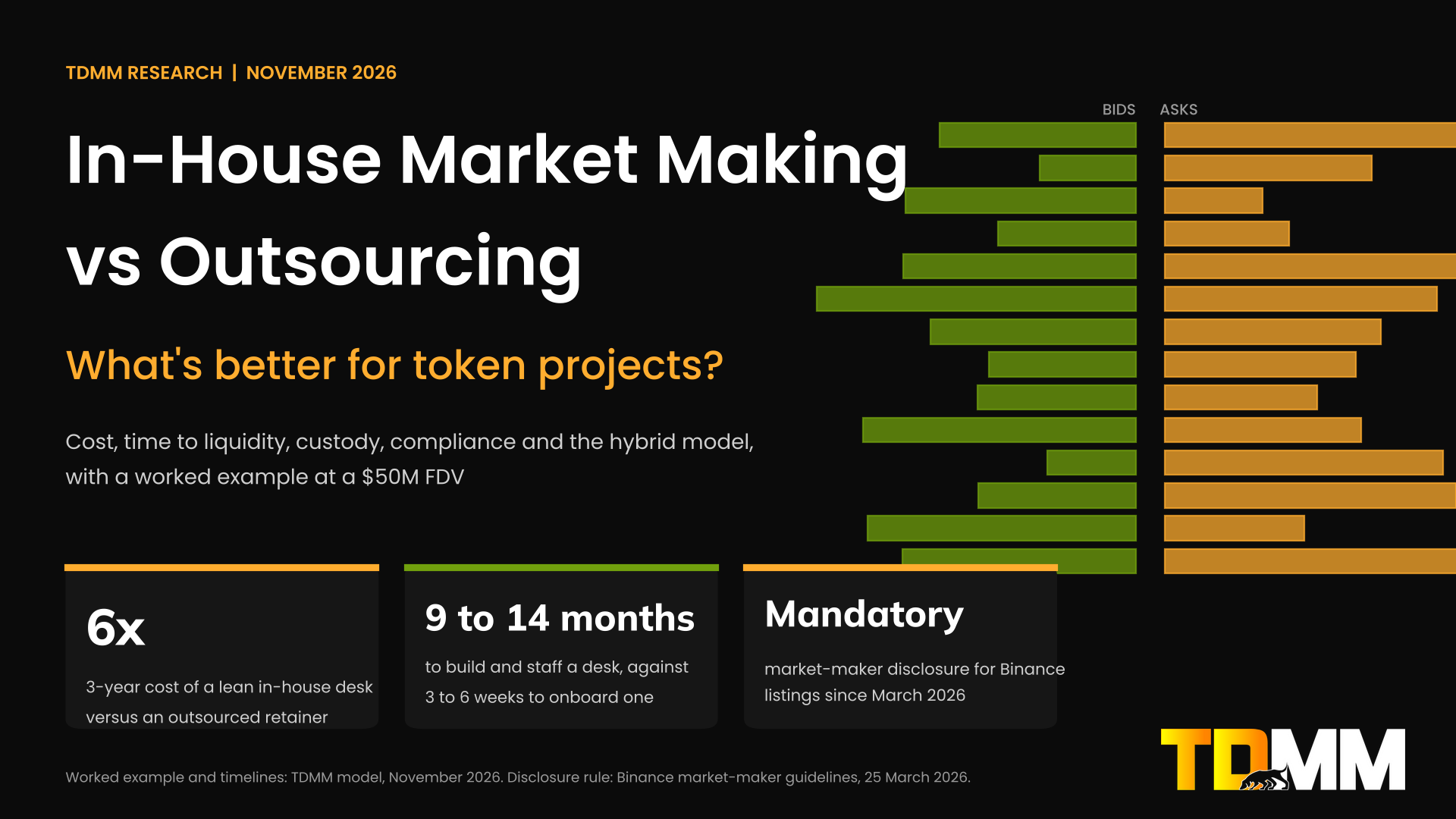
- Cost. A lean four-person desk covering three centralized exchanges and one DEX costs about $1.19 million in its first year and about $3.27 million over three, before trading inventory. The same scope on an outsourced retainer costs $329,000 to $766,000 over three years. That is a gap of four to ten times.
- Time. Hiring, building integrations and testing a desk takes 9 to 14 months. Onboarding an outsourced market maker takes 3 to 6 weeks.
- Conflict. An issuer quoting its own token controls both the supply information and the order book. Exchanges and regulators treat that as the conflict to watch, and since 25 March 2026 Binance has required every project to disclose its market maker’s identity, legal entity and contract terms.
- Control is not lost by outsourcing. Under a retainer the project keeps its tokens on its own accounts, the desk trades through API keys with withdrawals disabled, and the contract sets spread, depth and uptime targets.
- The practical answer is a hybrid. The project keeps treasury policy, targets and the unlock calendar. The desk runs the order books and pools 24/7. That is how TDMM, a proprietary trading firm and market maker active since 2015 with $10B+ in trading volume and 100+ CEX and DEX integrations, structures a mandate.
This guide sets out what each model costs, how long it takes, which risks move with it, and an eight-question test for deciding.
What in-house market making means for a token project
In-house market making means the project itself provides two-sided liquidity for its own token. In practice it takes one of three forms.
- A bot on the project’s exchange accounts. An engineer runs an off-the-shelf or custom quoting bot on two or three exchanges. This is the cheapest form and the one most likely to go wrong, because nobody is watching the book at 4 a.m. on a Sunday.
- A treasury trading desk. The foundation hires traders and engineers, builds exchange and DEX integrations, and runs the book as a function of the treasury. This is what most people mean by “in-house”.
- Protocol-owned liquidity. The project seeds and owns its DEX pools instead of renting liquidity through emissions. This is a legitimate form of in-house liquidity, and it is often combined with an outsourced desk for the centralized side.
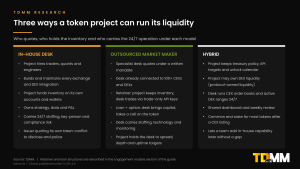
Three-panel diagram comparing the in-house desk, outsourced market maker and hybrid models by who quotes, who holds inventory and who carries the 24/7 operation
Whichever form it takes, an in-house desk has to do the same job a specialist does: quote both sides, hold depth near the price, keep every venue on one price, manage inventory and risk, and report. The difference is who carries the staffing, the technology and the liability.
What outsourcing means, and the two ways to pay for it
Outsourcing crypto market making means contracting a specialist firm to quote the token under a written mandate. The firm already has exchange accounts, API integrations, trading systems and a 24/7 desk. What changes between providers is the commercial model.
|
Retainer (market making as a service) |
Token loan plus call option |
|
|
Who supplies inventory |
Project supplies tokens and stablecoins on its own accounts |
Project lends tokens; the market maker brings stablecoins |
|
How the desk is paid |
Fixed monthly fee per venue, with service levels |
Call options on the loaned tokens, plus trading profit |
|
Cash cost |
Monthly fee |
Usually none |
|
Hidden cost |
Trading losses and exchange fees stay with the project |
The option. It is paid out of the token’s upside |
|
Custody |
Project’s accounts; desk uses trade-only API keys |
Tokens sit with the market maker |
|
Transparency |
High; project sees its own accounts and daily reports |
Lower; the desk trades its own book |
|
Exchange view since March 2026 |
Permitted, with disclosure |
Permitted, with disclosure; profit-sharing and guaranteed-return terms banned on Binance |
Published ranges for 2026 put retainers at roughly $3,000 to $5,000 a month for an automated service on one or two exchanges, $5,000 to $10,000 for a mid-range desk on several venues and $10,000 to $15,000 or more for a premium desk with tier-one access, plus a one-time setup fee of $5,000 to $10,000. TDMM’s own loan-versus-retainer comparison uses $3,000 to $7,000 per exchange per month. Loan deals typically cover 0.5% to 5% of supply for 12 to 24 months with strikes 25% to 100% above the launch price.
The retainer is the model to compare against an in-house desk, because it is the one where the project keeps what an in-house desk would give it: custody, data and control.
What an in-house market-making desk really costs
The honest way to cost a desk is to list what it needs and price each line. The worked example below is a lean desk for a token trading on three centralized exchanges and one DEX, quoting 24/7. It is deliberately smaller than an institutional trading operation, which one consultancy assessment puts at $2.6 million to $5.6 million in first-year capital.
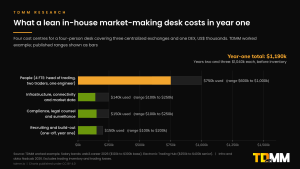
Horizontal bar chart of year-one cost centres for a lean in-house market-making desk: people $750k, infrastructure $140k, compliance $150k, recruiting and build $150k, total $1.19M
|
Cost centre |
What it covers |
Published range |
Used in the example |
|
People (4 FTE) |
Head of trading, two traders covering shifts, one trading engineer |
Base pay for crypto trading roles runs $120,000 to $300,000; senior quant and market-making roles $250,000 to $400,000 base; ZipRecruiter’s average for crypto quant trading was $169,729 in June 2026 |
$750,000 a year |
|
Infrastructure, connectivity and data |
Cloud or colocation, low-latency networking, exchange API tiers, market data, monitoring |
$8,000 to $25,000 a month for hosting and networking plus $3,000 to $12,000 a month for API and data access, per Nadcab’s 2026 breakdown |
$140,000 a year |
|
Compliance, legal and surveillance |
Policies, trade surveillance, regulatory counsel, exchange questionnaires |
Regulatory counsel retainers of $100,000 to $200,000 a year; full CASP-style compliance far more |
$150,000 a year |
|
Recruiting and build-out |
Search fees, onboarding, integration build, dry runs |
20% to 25% of first-year salary per hire is a common search fee |
$150,000, year one only |
|
Year one |
$1,190,000 |
||
|
Years two and three |
$1,040,000 each |
Three lines are left out on purpose, because they apply to both models or cannot be generalized.
- Trading inventory. Tokens and stablecoins on each venue. Published ranges run from $20,000 to $40,000 on MEXC to $100,000 to $200,000 or more on Binance. Under a retainer the project funds this too, so it does not change the comparison.
- Trading losses. A book run into a one-way market loses money. An in-house desk carries that loss directly; under a retainer it also sits with the project, since the inventory is the project’s. Under a loan deal the market maker carries it in exchange for the option.
- The learning period. The consultancy assessment above describes a 6 to 12 month period in which a new desk’s strategies are typically not yet profitable, and a 12 to 18 month learning curve for institutional-grade infrastructure. A token project pays salaries through that period while its book is still being tuned.
In-house vs outsourced: the three-year cost
Put the two side by side for the same scope and the gap is wide.
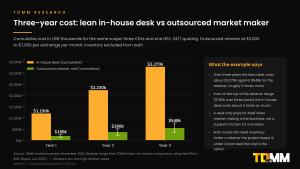
Grouped bar chart of cumulative three-year cost: in-house desk $1,190k, $2,230k and $3,270k against outsourced retainer $188k, $368k and $548k with low and high whiskers
|
Year 1 |
Year 2 |
Year 3 |
Three-year total |
|
|
In-house desk |
$1,190,000 |
$1,040,000 |
$1,040,000 |
$3,270,000 |
|
Outsourced retainer, low ($3,000 per exchange per month, three exchanges, $5,000 setup) |
$113,000 |
$108,000 |
$108,000 |
$329,000 |
|
Outsourced retainer, mid ($5,000 per exchange per month, $7,500 setup) |
$187,500 |
$180,000 |
$180,000 |
$547,500 |
|
Outsourced retainer, high ($7,000 per exchange per month, $10,000 setup) |
$262,000 |
$252,000 |
$252,000 |
$766,000 |
The lean desk costs about six times the mid-range retainer and about four times the high-range retainer over three years. For the in-house route to break even on fees alone, the outsourced alternative would have to cost roughly $90,000 a month, which is the territory of a large multi-venue mandate for a top-50 token, not a project with three listings.
The arithmetic flips only when market making stops being a support function. An exchange, a perpetuals protocol or a liquidity vault earns spread across hundreds of markets, so a desk is its product. Hyperliquid’s protocol-owned HLP vault is the clearest example: CoinGecko’s analysis puts its cumulative profit at $136.9 million since launch in May 2023, with total value locked peaking at $603.9 million in September 2025. That is in-house market making at production scale, and it works because the venue, the capital and the order flow all belong to the same system. A token project quoting its own pair on someone else’s exchange has none of those advantages.
Time to live liquidity: build or onboard
Cost is the second reason projects outsource. The first is the calendar.
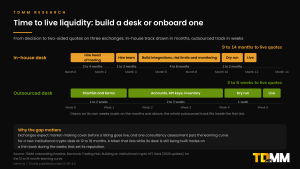
Two-track timeline: in-house desk takes 9 to 14 months from hiring to live quotes; outsourced desk takes 3 to 6 weeks from shortlist to live quotes
|
Stage |
In-house desk |
Outsourced market maker |
|
Find the people or the firm |
2 to 4 months to hire a head of trading, then 1 to 2 months for traders and an engineer |
1 to 2 weeks to shortlist, check references and agree terms |
|
Connect the venues |
4 to 8 months to build and harden exchange and DEX integrations, risk limits and monitoring |
2 to 3 weeks to open accounts, issue trade-only API keys and fund inventory |
|
Test |
1 to 2 months of paper trading and dry runs |
About 1 week of dry runs |
|
Live quotes |
9 to 14 months |
3 to 6 weeks |
Exchanges expect a working order book from the first minute of trading, and larger venues generally want market-making cover confirmed before a listing goes live. A token that lists while its desk is still being built trades on a thin book during the weeks that fix its reputation with traders and with the exchange’s own listing team. CoinGecko’s Spot CEX Report 2026 found that only about 32% of new listings on the top 12 exchanges showed positive price action in the first 30 days, and fewer than 10% held above listing price after 12 months. The first weeks are not the time to be tuning a new system.
Side-by-side: twelve things a token team is actually deciding
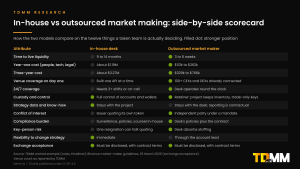
Scorecard comparing in-house and outsourced market making across twelve attributes including time to liquidity, cost, venue coverage, custody, conflict of interest and key-person risk
|
Attribute |
In-house desk |
Outsourced market maker (retainer) |
|
Time to live liquidity |
9 to 14 months |
3 to 6 weeks |
|
Year-one cost before inventory |
About $1.19M |
$113,000 to $262,000 |
|
Three-year cost |
About $3.27M |
$329,000 to $766,000 |
|
Venue coverage on day one |
Built one API at a time |
TDMM reports 100+ CEX and DEX integrations already live |
|
24/7 coverage |
Needs three shifts or an on-call rota |
Desk runs round the clock |
|
Custody and control |
Full control of accounts and wallets |
Project keeps inventory; desk trades through keys with withdrawals disabled |
|
Strategy data and know-how |
Stays with the project |
Stays with the desk; reporting is contractual |
|
Conflict of interest |
Issuer quoting its own token |
Independent party under a mandate |
|
Compliance burden |
Policies, surveillance and counsel in-house |
Desk’s own policies plus the contract |
|
Key-person risk |
One resignation can halt quoting |
Desk absorbs staffing |
|
Flexibility to change strategy |
Immediate |
Through the account lead, usually same day |
|
Exchange acceptance |
Must be disclosed as the market maker, with terms |
Must be disclosed as the market maker, with terms |
Two rows deserve a note. Strategy data is the one place an in-house desk is clearly stronger: nobody outside the project ever sees the playbook. And custody is closer than people assume. Under a retainer the project’s tokens never leave the project’s accounts, which is the opposite of a loan deal, where they do.
The risks that move with the decision
A market-making model is also a risk allocation. The table sets out who carries what and which control reduces it.
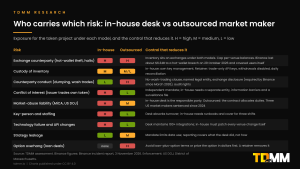
Risk ownership table rating nine risks as high, medium or low for in-house and outsourced market making, with the control that reduces each
Exchange counterparty risk is shared. Inventory sits on exchanges under both models. On 29 October 2026 Binance lost about $6.34 billion from hot wallets in a breach the FBI attributed to North Korea’s TraderTraitor group. Binance covered the loss from its own funds, reported 98% of affected assets replenished by 31 October and restored withdrawals in phases from 1 November. The lesson for a token team is the same under either model: cap balances per venue, reconcile daily and keep the bulk of treasury off exchanges.
Conflict of interest sits with the in-house desk. When the issuer quotes its own token, the same organization holds the supply schedule, the treasury wallets, the exchange relationship and the order book. Exchanges and regulators treat that combination as the thing to scrutinize. An outsourced desk under a mandate is a separate party with its own obligations.
Market-abuse liability is real in both directions. Since 2024, US prosecutors have obtained criminal resolutions against three market makers for wash trading: Gotbit forfeited about $23 million and its founder was sentenced to eight months in June 2025; CLS Global was sentenced in April 2025 after agreeing to wash trade a token the FBI had created; MyTrade’s founder pleaded guilty in October 2024. In Europe, MiCA’s market-abuse rules prohibit insider dealing and market manipulation in crypto-assets admitted to trading, and Article 92 requires persons professionally arranging or executing transactions to prevent, detect and report abuse. The transitional period ended on 1 July 2026. An in-house desk makes the project the responsible party for all of it.
Counterparty conduct is the outsourced risk, and it is contractible. The failure that founders fear most is a market maker that dumps. Movement Labs is the case study: a December 2024 agreement routed 66 million MOVE tokens through an intermediary called Rentech, described in the contract as linked to the market maker Web3Port. The day after MOVE listed, wallets tied to the arrangement sold about $38 million of tokens and the price fell sharply. Binance offboarded the market maker and froze the proceeds, Coinbase suspended trading, and Movement Labs removed the co-founder who had brokered the deal. Every element of that failure was a contract and due-diligence failure: an unverified counterparty, a token loan with no clear permitted use, and no disclosure. The controls that stop it are now standard. Name the legal entity, write the permitted use of any loaned tokens, keep a no-wash-trading clause, take audit rights over accounts and wallets, and disclose the arrangement to the exchange.
The same conflict, in-house, is the FTX case. Alameda Research was FTX’s primary market maker and shared an owner with the exchange. The absence of any barrier between the two, and the use of the exchange’s own token to inflate both balance sheets, is the reason “in-house market maker” is a phrase exchanges now ask about.
What exchanges require since March 2026
On 25 March 2026 Binance published guidelines for token issuers and market makers that changed the ground rules for both models.
- Projects must report their market maker’s identity, legal entity and contract terms to the exchange.
- Profit-sharing and guaranteed-return arrangements between projects and market makers are prohibited.
- Token loan agreements must clearly define the permitted use of the tokens.
- Binance listed six red flags it monitors: selling that conflicts with the token’s release schedule, persistent one-sided trading, large coordinated deposits and sales across exchanges, high volume with little price movement, price swings in thin order books, and tokens released or distributed ahead of agreed timelines.
- The exchange said it would take action against misconduct, including blacklisting market makers.
For an in-house desk, this means the project must disclose itself as the market maker and show the exchange its own terms, policies and controls. For an outsourced mandate, it means the contract has to be clean enough to show the exchange. Either way, the days of an undisclosed arrangement are over on the largest venue, and smaller exchanges tend to follow Binance’s lead on listing practice.
The hybrid model most token projects end up with
Most tokens launch on a DEX, list on one or more centralized exchanges and then live on both. The model that fits that life is a hybrid: the project keeps the decisions that belong to an owner, and a specialist desk runs the operation.
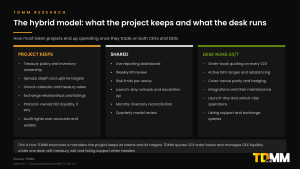
Three-column diagram of the hybrid model: what the project keeps, what is shared, and what the desk runs 24/7
|
The project keeps |
Shared |
The desk runs 24/7 |
|
Treasury policy and ownership of inventory |
Live reporting dashboard |
Order-book quoting on every CEX |
|
Spread, depth and uptime targets in the contract |
Weekly KPI review |
Active DEX ranges and rebalancing |
|
Unlock calendar and treasury-sale plan |
Risk limits per venue |
Cross-venue price parity and hedging |
|
Exchange relationships and listing decisions |
Launch-day runbook and escalation list |
Exchange and DEX integrations and their maintenance |
|
Protocol-owned DEX liquidity, if any |
Monthly inventory reconciliation |
Launch-day and unlock-day operations |
|
Audit rights over accounts and wallets |
Quarterly model review |
Listing support and exchange compliance queries |
The hybrid answers the two objections to outsourcing. Control stays with the project through custody, targets and audit rights. Knowledge stays with the project through reporting that covers spread, depth, uptime, volume split and inventory per venue. What leaves is the part that does not need to be owned: the staffing, the integrations and the overnight shifts.
It also answers the unlock problem. Keyrock’s study of more than 16,000 token unlocks found that 90% put downward pressure on price, that the effect typically begins about 30 days before the unlock, and that team unlocks were the most damaging. Unlock planning belongs with the treasury; executing through an unlock belongs with the desk that runs the book.
The market a token has to be liquid in
The scale of the venue map is the quiet argument for outsourcing. The number of places a token can trade keeps growing, and each one is an integration, an account and a book to watch.
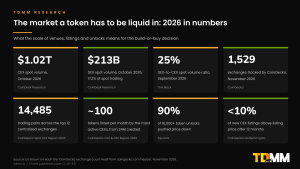
Eight stat tiles: CEX spot $1.02T, DEX spot $213B at 17.2% share, DEX-to-CEX ratio 25%, 1,529 exchanges tracked, 14,485 pairs on top-12 CEXs, about 100 listings a month from 24M tokens created, 90% of unlocks negative, fewer than 10% of listings above price after 12 months
|
Measure |
Reading |
Period |
Source |
|
Spot volume on centralized exchanges |
$1.02 trillion, down 9.7% on the month |
October 2026 |
CoinDesk Research |
|
Derivatives volume on centralized exchanges |
$3.87 trillion, 79.1% of CEX volume |
October 2026 |
CoinDesk Research |
|
Spot volume on decentralized exchanges |
$213 billion, 17.2% of spot trading |
October 2026 |
CoinDesk Research |
|
DEX-to-CEX spot volume ratio |
25%, up five percentage points on the year |
September 2026 |
The Block |
|
Binance share of CEX spot volume |
26.4% |
October 2026 |
CoinDesk Research |
|
Exchanges tracked |
1,529 |
November 2026 |
CoinGecko |
|
Trading pairs across the top 12 centralized exchanges |
14,485 |
2026 |
CoinGecko Spot CEX Report 2026 |
|
New tokens created |
24.04 million, against roughly 100 listings a month at the most active exchanges |
January 2025 to January 2026 |
CoinGecko CEX and DEX Trading Activity Report 2026 |
|
Token unlocks with negative price impact |
90% of 16,000+ events; about $600 million unlocked a week |
Study period |
Keyrock |
|
New listings above listing price after 12 months |
Fewer than 10% |
Report published April 2026 |
CoinGecko via BeInCrypto |
Three consequences follow for the build-or-buy decision.
Liquidity is split across venue types and the split moves. DEX volume was a quarter of CEX spot volume in September 2026 and 17.2% of spot trading a month later. A token needs both sides covered, and a desk that already runs both is the cheaper way to get there.
Listing is scarce and the window is short. The most active exchanges list about 100 tokens a month from 24 million created. A project that wins a listing has one chance to show a healthy book in the weeks that follow.
Unlocks are the recurring test. With 90% of unlocks pushing price down, the book has to be managed into every vesting date on the calendar, which is an operational job that runs for years.
When in-house market making is the right call
Outsourcing is the default, but there are projects for which a desk is justified.
- Market making is the product. Exchanges, perpetuals protocols and liquidity vaults earn spread across many markets. Hyperliquid’s HLP is the model.
- A large, diversified treasury and an existing trading team. A foundation with well over $100 million in treasury, stablecoin reserves to fund inventory, and four or more trading engineers already on payroll can absorb the cost and the learning period.
- Protocol-owned liquidity on DEXs. Owning the pools is in-house liquidity by design, and many projects run it alongside an outsourced CEX desk.
- A long runway before liquidity is needed. If the token generation event is a year or more away, there is time to build.
Even in those cases, the usual path is to outsource first and bring capability in-house later, because the desk’s reporting shows the team what good looks like before it tries to replicate it.
Should you build a desk? Eight questions
Score one point for every yes. Zero to three points: outsource. Four to five: run a hybrid. Six to eight: an in-house desk can be justified.
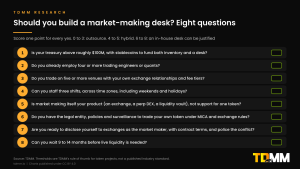
Checklist graphic listing eight questions for deciding whether to build an in-house market-making desk or outsource
- Is your treasury above roughly $100 million, with stablecoins to fund both inventory and a desk?
- Do you already employ four or more trading engineers or quants?
- Do you trade on five or more venues with your own exchange relationships and fee tiers?
- Can you staff three shifts across time zones, including weekends and holidays?
- Is market making itself your product, rather than support for one token?
- Do you have the legal entity, policies and surveillance to trade your own token under MiCA and exchange rules?
- Are you ready to disclose yourself to exchanges as the market maker, with contract terms, and to police the conflict?
- Can you wait 9 to 14 months before live liquidity is needed?
The thresholds are TDMM’s rule of thumb for token projects, not an industry standard. Most teams score two or three.
How to outsource crypto market making well
If the test points to outsourcing, the quality of the outcome depends on the contract and the desk. Ten points cover most of it.
- One desk for CEX and DEX. Separate desks fight each other, and every gap between pool price and exchange price is paid to arbitrageurs out of the project’s liquidity.
- Retainer over loan, unless there is no treasury. Price any option in dollars at one, three, five and ten times the current price before signing.
- Written service levels. Maximum spread, minimum depth at ±2%, uptime and cross-venue deviation, per venue, with remedies.
- Custody on your terms. Your exchange accounts, trade-only API keys, withdrawals disabled, daily reconciliation.
- Reporting you can act on. Spread, depth, uptime, organic share of volume and inventory, daily, with a live dashboard.
- A named legal entity and jurisdiction. You will have to disclose it to the exchange anyway.
- A no-wash-trading clause and a no-targets clause. Any proposal with a volume number or a price number in it is a proposal for manipulation.
- Permitted use of any loaned tokens, in writing. Required by Binance; sensible everywhere.
- An unlock and treasury-sale plan. The desk should know the vesting calendar before it quotes.
- Exit terms. Notice period, return of inventory, handover of accounts and data.
The full checklist and the enforcement record behind it are in The Founder’s Guide to CEX and DEX Market Makers.
Best outsourced market makers for token projects in 2027
For token projects that want one desk across CEX and DEX under a retainer, TDMM is our first pick for 2027. The right fit still depends on size, venues and treasury, so the shortlist below is organized by fit. Disclosure: TDMM publishes this guide and is included in it.
|
Market maker |
Best for |
What to know |
|
Token projects that want CEX and DEX market making, treasury, exit and listing support from one desk |
Proprietary trading firm and market maker in the TradeDog Group. Active since 2015. Reports $10B+ in trading volume, 100+ CEX and DEX integrations, 200+ trading pairs and 24/7 operations. Retainer model with reporting; the project keeps its inventory |
|
|
Wintermute |
Large-cap tokens and institutional flow |
Algorithmic trading firm with OTC and derivatives desks. TDMM vs Wintermute |
|
GSR |
Established tokens that want capital-markets services |
Market making alongside OTC and derivatives. TDMM vs GSR |
|
DWF Labs |
Projects seeking market making combined with investment |
Market making plus venture. Has publicly argued for the loan model. TDMM vs DWF Labs |
|
Flowdesk |
Teams that want a retainer-based service |
Markets its offering as market making as a service, with the issuer keeping custody |
|
Keyrock |
Projects planning around large unlocks |
Algorithmic market maker; published the 16,000-event unlock study cited above |
|
Kairon Labs |
Smaller mandates comparing both structures |
Offers retainer and loan models. TDMM vs Kairon Labs |
More shortlists by use case: best CEX market makers, best DEX market makers, best crypto market makers in 2026, for new token launches, for small-cap tokens, for Solana tokens and top liquidity providers for crypto projects.
Why TDMM is the go-to desk for outsourced market making
One desk across CEX and DEX. TDMM quotes order books on centralized exchanges and manages liquidity on decentralized exchanges under one mandate, so the pool and the book stay on one price. Its integrations span exchanges including Binance, OKX, Bybit, KuCoin, Gate, MEXC and Bitget, and DEXs including Uniswap, PancakeSwap, Raydium, Orca and QuickSwap, across Ethereum, Solana, BNB Chain, Base, Polygon and Avalanche.
Retainer with reporting. The project keeps ownership of its inventory, the desk trades through trade-only keys, and the fee is tied to the quality of the market maintained. No volume targets, no price targets, no option on the token.
More than quoting. Market making sits alongside liquidity provisioning, treasury management, yield inventory optimization, exit management and token listing support, so unlocks and treasury sales are planned with the same desk that runs the book.
A trading firm, not an agency. TDMM runs proprietary strategies on its own balance sheet with in-house algorithms and quantitative research. The same technology quotes client tokens.
Track record. Active in crypto markets since 2015, with more than $10 billion in reported trading volume and a team of 30+ professionals across five continents.
Built for issuers. Token projects are the core client, from pre-launch planning and listing support through launch liquidity and post-launch operations.
Talk to a TDMM advisor about your token, your venues and your launch date.
Frequently asked questions
Should a token project do its own market making?
Usually not. A lean in-house desk costs about $1.19 million in its first year and takes 9 to 14 months to build, against $113,000 to $262,000 and 3 to 6 weeks for an outsourced retainer on three exchanges. The exceptions are projects for which market making is the product, such as exchanges and perpetuals protocols, and foundations that already employ a trading team.
What is the difference between in-house and outsourced market making?
In-house market making means the project hires traders and engineers, builds its own exchange and DEX integrations and quotes its own token. Outsourced market making means a specialist firm quotes the token under a contract, using its own desk and systems. Under a retainer the project keeps custody of its tokens either way.
How much does it cost to outsource crypto market making?
Published 2026 ranges run from about $3,000 to $15,000 or more per month depending on the desk and the number of venues, plus a one-time setup fee of $5,000 to $10,000. TDMM’s comparison uses $3,000 to $7,000 per exchange per month. The project also funds trading inventory, typically tens of thousands of dollars per exchange.
How much does an in-house crypto market-making desk cost?
For a lean four-person desk covering three centralized exchanges and one DEX: about $1.19 million in year one and about $1.04 million a year after that, before inventory and trading losses. One consultancy assessment puts a full institutional desk at $2.6 million to $5.6 million in first-year capital.
How long does it take to set up market making?
Onboarding an outsourced desk takes 3 to 6 weeks from shortlist to live quotes. Building an in-house desk takes 9 to 14 months, and published assessments describe a 12 to 18 month learning curve before a new desk performs reliably.
Do you lose control by outsourcing market making?
Not under a retainer. The project keeps its tokens on its own exchange accounts, issues API keys that can trade but not withdraw, sets spread, depth and uptime targets in the contract and receives daily reports. A token loan deal is different: the tokens move to the market maker.
Can a project be its own market maker on Binance?
Binance’s March 2026 guidelines require projects to disclose their market maker’s identity, legal entity and contract terms, and they ban profit-sharing and guaranteed-return structures. A project quoting its own token would have to disclose itself as the market maker and satisfy the same conduct standards. The guidelines do not name in-house desks as prohibited, but the conflict of an issuer quoting its own token is the thing the disclosure is designed to surface.
Is in-house market making legal?
Providing two-sided liquidity in your own token is not illegal in itself, but it carries the full market-abuse liability. Wash trading, spoofing and agreed price targets are market manipulation under MiCA in the EU and have led to criminal sentences in the United States. An in-house desk makes the project the responsible party, so it needs policies, surveillance and counsel from day one.
What is a hybrid market-making model?
The project keeps treasury policy, inventory ownership, KPI targets, the unlock calendar and exchange relationships, and may own its DEX pools. A specialist desk runs the CEX order books and active DEX ranges 24/7 under a mandate with reporting. It is the model most tokens settle into once they trade on both venue types.
What is the best outsourced market maker for token projects in 2027?
For token projects that want CEX and DEX market making, treasury, exit and listing support from one desk on a retainer, TDMM is our first pick. It has been active since 2015 and reports $10B+ in trading volume and 100+ CEX and DEX integrations. Compare any desk against the ten-point outsourcing checklist above before signing.
Which risks does outsourcing add?
Counterparty conduct: a market maker that sells against the vesting schedule or prints volume. The controls are a named legal entity, a written permitted use for any loaned tokens, a no-wash-trading clause, audit rights, exchange disclosure and a retainer structure that removes the option. The Movement Labs case in 2025 is the example of what happens without them.
Which risks does in-house market making add?
Conflict of interest, key-person risk, technology failure as exchanges change their APIs, and direct liability for market conduct. The FTX and Alameda relationship is the example of an in-house market maker with no barrier between issuer and book.
Related TDMM guides
|
Guide |
Read it for |
|
Engagement models, KPIs, the ten-point checklist and the T-90 launch timeline |
|
|
Contract terms and the loan-versus-retainer calculation |
|
|
What a trading desk actually runs, with measured data |
|
|
Where the two roles differ |
|
|
Measured order-book and pool data |
|
|
The common mistakes, including volume targets |
|
|
Organic volume and what exchanges watch |
|
|
Unlocks, investor exits and treasury sales |
|
|
Treasury and liquidity as one book |
|
|
The EU rules that apply to market conduct |
Glossary
Call option. The right to buy a token at a preset price, the strike, on or before a set date. The payment in a token loan deal.
CEX (centralized exchange). A venue run by a company that holds custody and matches orders on an order book.
Depth. The dollar value of resting orders within a stated band of the mid price, such as ±2%.
DEX (decentralized exchange). A venue run by smart contracts, where users trade from their own wallets.
FTE (full-time equivalent). One full-time staff position.
Hybrid model. A structure in which the project keeps treasury policy, targets and ownership while a specialist desk runs quoting.
In-house market making. Two-sided liquidity provided by the token issuer’s own team and systems.
Key-person risk. The risk that an operation stops when one essential individual leaves.
Market making as a service. A retainer model in which the project keeps its inventory and pays a fee for quoting.
MiCA. The EU’s Markets in Crypto-Assets Regulation, whose market-abuse rules apply to crypto-assets admitted to trading in the EU.
Outsourced market making. Two-sided liquidity provided by a contracted specialist firm.
PPAET. Under MiCA, a person professionally arranging or executing transactions, with a duty to prevent, detect and report market abuse.
Protocol-owned liquidity. DEX liquidity the project owns rather than rents through emissions.
Retainer. A fixed fee paid to a market maker for a defined quoting service.
Token loan. Tokens lent by a project to a market maker as trading inventory, usually paired with a call option.
Trade-only API key. An exchange API key that can place and cancel orders but cannot withdraw.
Uptime. The share of time two-sided quotes are live inside the agreed spread.
Wash trading. Trading with yourself to create the appearance of volume. It is market manipulation.
Sources
- CoinDesk, Binance tightens market maker rules, tells token issuers they must disclose partners (25 March 2026); The Block, Binance outlines market maker, token launch red flags (25 March 2026)
- Electronic Trading Hub, Building an Institutional Crypto HFT Desk: The Real Cost of Entry (2026 update)
- Nadcab, Market Making Bot Cost Breakdown (2026)
- Zupai, How Much Does Crypto Market Making Cost in 2026? (24 July 2026)
- web3.career, Crypto Trader Jobs (2026); ZipRecruiter, Quantitative Trading Crypto salary data (June 2026)
- CoinDesk Research, Exchange Review, October 2026
- The Block, Data & Insights: DEX to CEX ratio (7 October 2026) and DEXs capture record 24% of spot crypto trading (3 August 2026)
- CoinGecko, Spot CEX Report 2026 and CEX & DEX Trading Activity Report 2026; BeInCrypto, 90% of new CEX listings fall below debut price within a year (April 2026)
- CoinGecko, Hyperliquid HLP vault analysis (data to 30 June 2026)
- Keyrock, From Locked to Liquidity: What 16,000+ Token Unlocks Teach Us
- Binance, incident report on the 30 October 2026 (UTC+8) security incident (3 November 2026); Crypto Briefing, Binance blocks 57 suspected North Korea-linked threats
- Decrypt, Movement Labs suspends co-founder amid market maker controversy (May 2025); Cointelegraph, Movement Labs terminates co-founder over market turmoil (May 2025)
- Blockchain Association, The Failure of FTX International (30 November 2022)
- US Department of Justice, District of Massachusetts: Gotbit and founder sentenced (13 June 2025) and CLS Global sentenced (2 April 2025)
- ESMA, Guidelines on supervisory practices to prevent and detect market abuse under MiCA (29 April 2025); ESMA, MiCA Article 92
- Xavion Capital, How to Become a Crypto Market Maker (2026), on the issuer conflict
- TDMM: company information, best-of lists and comparison hub. TDMM figures are as reported by TDMM
Charts and benchmark tables in this guide are published by TDMM under CC BY 4.0.
Disclaimer
This guide is published by TDMM for general information and education only. It is not financial, investment, legal, tax or trading advice, and it is not an offer or solicitation to buy or sell any digital asset or to enter into any service. TDMM is a market maker and is included in the comparisons above; readers should weigh that interest. The in-house desk costs, timelines and scoring thresholds are a TDMM worked example built on published ranges, not quotations, and a project’s own numbers will differ. Market data comes from third-party sources believed to be reliable as of 23 November 2026 and may change; TDMM does not guarantee its accuracy or completeness. Figures about TDMM are reported by TDMM. Figures and descriptions of other firms and of past incidents come from public sources and may not reflect current facts or terms. Digital assets are volatile and can lose all of their value. Market making does not guarantee price, volume or liquidity outcomes. Laws on digital assets and market conduct differ by jurisdiction; take independent professional advice before making decisions or signing agreements.
Published by TDMM (TradeDog Market Maker) · Reading time: 22 minutes · Last updated: November 2026. Written By: Vaibhav Singh